Learn More
Description
Fas (APO-1, CD95) is a 45 kD cell surface protein that mediates apoptosis when crosslinked with agonistic anti-Fas antibodies or Fas ligand (FasL). Fas belongs to the TNF (tumor necrosis factor)/NGF (nerve growth factor) receptor family, and is expressed in various tissue and cells including the thymus, liver, ovary and lung. FasL is a member of the TNF cytokine family that induces apoptosis by binding to Fas, its cell-surface receptor. FasL may exist in both membrane and soluble forms and expressed on activated T cells, NK cells, and other “immunologically privileged” sites. Both Fas and FasL are thought to play an important role in the apoptotic processes that take place during T cell development.
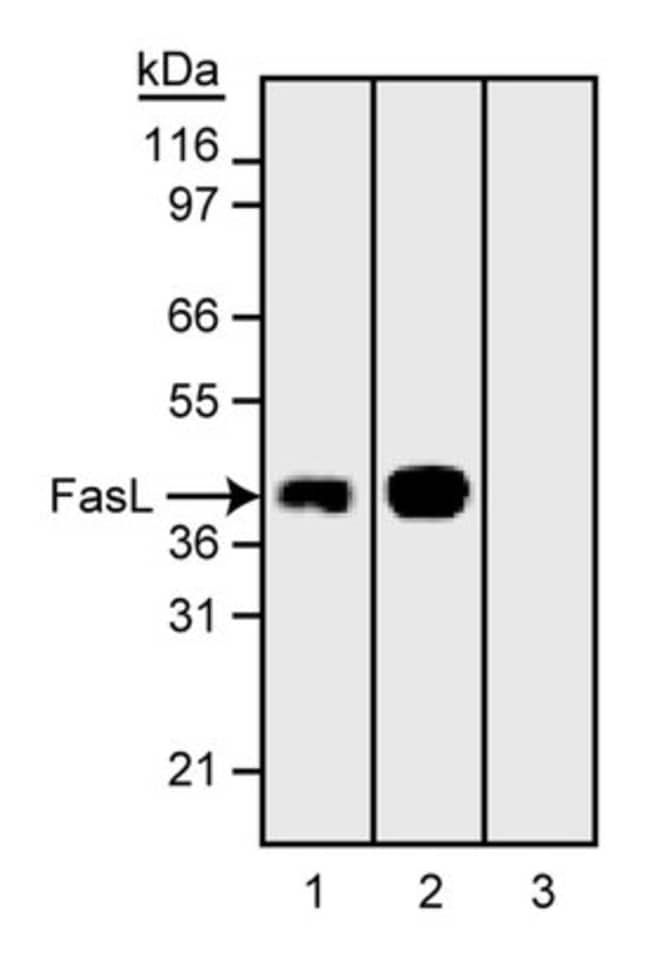
G247-4 recognizes human FasL. It recognizes both the membrane bound (FasL) and soluble (sFasL) forms. A recombinant protein containing the external domain of human FasL was used as immunogen. FasL and sFasL migrate at reduced molecular weights of 40 and 26 kD, respectively. However, the molecular weights observed in a particular sample may vary according to FasL and sFasL glycosylation and breakdown patterns as described in Tanaka et al. For example, FasL may migrate as a doublet of 40 and 42 kD.

Specifications
Specifications
| Antigen | CD178 |
| Applications | Western Blot |
| Classification | Monoclonal |
| Clone | G247-4 |
| Concentration | 0.5mg/mL |
| Conjugate | Unconjugated |
| Description | Fas Ligand, CD95 Ligand |
| Formulation | Aqueous buffered solution containing ≤0.09% sodium azide. |
| Host Species | Mouse |
| Immunogen | Recombinant Human FasL |
| Show More |
Safety and Handling
For Research Use Only.
By clicking Submit, you acknowledge that you may be contacted by Fisher Scientific in regards to the feedback you have provided in this form. We will not share your information for any other purposes. All contact information provided shall also be maintained in accordance with our Privacy Policy.