Learn More
Description
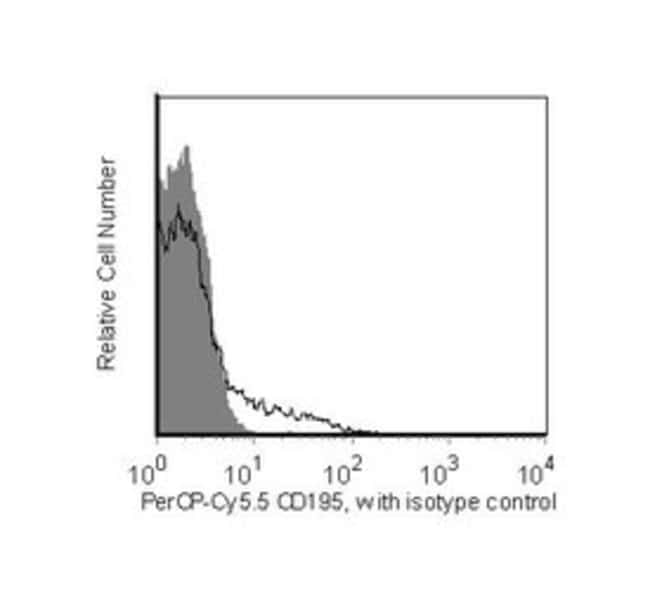
Reacts with the chemokine receptor, CCR5, a seven transmembrane-spanning G protein-associated molecule. 3A9 antibody has also been reported to cross-react with human CCR8. Results of epitope mapping and sequence comparison between CCR5 and CCR8 reveals that the first three amino acid residues for these two receptors are identical: MDY (Met-Asp-Tyr). CCR5 belongs to the β-chemokine receptor family. It is expressed on a subset of T lymphocytes (CD3+, CD45RO+, CD95+). CCR5 regulates lymphocyte chemotaxis activation and transendothelial migration during inflammation. It signals a response to at least three chemokines: RANTES and macrophage inflammatory protein-1 (MIP-1) α and β. Additionally, CCR5 has been found to be a co-receptor for macrophage-tropic HIV-1 on CD4+ cells, a characteristic that is important in viral transmission. Reports indicate that individuals who have partial (heterozygous) or complete (homozygous) deletion of the CCR5 allele, demonstrate resistance to HIV infection. CCR5 has been clustered as CD195 in the VIIth HLDA workshop.
PerCP-Cy™5.5 Mouse Anti-Human CD195 (clone 3A9) antibody is not routinely tested on non-human primate samples.

Specifications
Specifications
| Antigen | CD195 |
| Applications | Flow Cytometry |
| Classification | Monoclonal |
| Clone | 3A9 |
| Conjugate | PerCP-Cyanine5.5 |
| Description | CCR5 |
| Formulation | Aqueous buffered solution containing BSA and ≤0.09% sodium azide. |
| Host Species | Mouse |
| Immunogen | Human CCR5 Transfected Cell Line |
| Purification Method | Affinity Purified |
| Show More |
By clicking Submit, you acknowledge that you may be contacted by Fisher Scientific in regards to the feedback you have provided in this form. We will not share your information for any other purposes. All contact information provided shall also be maintained in accordance with our Privacy Policy.