Learn More

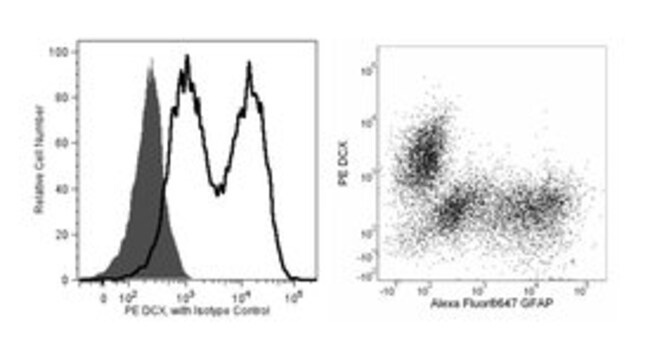
Description
The cerebral cortex is composed of multiple layers of neurons of distinct types and functions, which perform in unison to orchestrate cognitive function. The formation of the cortex relies on complex signaling mechanisms, which mediate the migration of newly formed neurons from deep within the brain to the superficial regions. Defects in neuronal migration and disruption of the multi-layered cortex are apparent in conditions such as X-linked lissencephaly (XLIS) and subcortical laminar heterotopia (SCLH) or “double cortex” (DC) syndrome. Mutations in the doublecortin gene have been linked to these brain disorders. Doublecortin is highly expressed in developing brain, primarily in migrating neurons. It is significantly homologous with the N-terminal region of the product of the KIAA0369 gene, a protein that is also similar to the CaM kinase family in its C-terminal region. Doublecortin has four potential MAP kinase family phosphorylation sites and a putative site for Abl tyrosine phosphorylation. Thus, doublecortin is thought to be an integral component of tyrosine kinase signal transduction pathways that regulate neuronal migration and development of the cerebral cortex.

Specifications
Specifications
| Antigen | Doublecortin |
| Applications | Flow Cytometry |
| Classification | Monoclonal |
| Clone | 30/Doublecortin |
| Conjugate | PE |
| Description | DCX, Lissencephalin-X, Lis-X, Doublin, Doublecortex, DBCN, LISX |
| Formulation | Aqueous buffered solution containing BSA and ≤0.09% sodium azide. |
| Host Species | Mouse |
| Immunogen | Mouse Doublecortin aa. 211-317 Recombinant Protein |
| Purification Method | Affinity Purified |
| Show More |
Safety and Handling
By clicking Submit, you acknowledge that you may be contacted by Fisher Scientific in regards to the feedback you have provided in this form. We will not share your information for any other purposes. All contact information provided shall also be maintained in accordance with our Privacy Policy.