Learn More
Description
The B56 monoclonal antibody specifically binds to the Ki-67 antigen that is expressed in the nucleus of cycling cells (G1, S, G2, M cell cycle phases). During the G0 phase, the antigen cannot be detected. During interphase of the cell cycle, it is associated with nucleolar components, and it is on the surface of the chromosomes during M phase. Ki-67 is a large protein having 2 alternatively spliced isoforms, an N-terminal forkhead-associated domain, a C-terminal domain that binds to heterochromatin proteins, and multiple phosphorylation sites, the functions of which are still unclear. Because of the strict association of Ki-67 expression with cell proliferation, anti-Ki-67 antibodies are useful for the identification, quantification, and monitoring of growing cell populations.
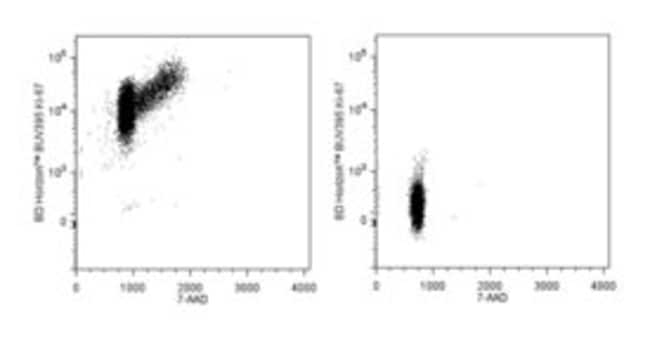
The antibody was conjugated to BD Horizon BUV395 which has been exclusively developed by BD Biosciences as an optimal dye for use on a 355nm laser equipped instrument. With an Ex Max at 348nm and an Em Max at 395nm, this dye has virtually no spillover into any other detector. BD Horizon BUV395 can be excited with a 355nm laser and detected with a 379/28 filter.

Specifications
Specifications
| Antigen | Ki-67 |
| Applications | Flow Cytometry |
| Classification | Monoclonal |
| Clone | B56 |
| Conjugate | Brilliant Ultraviolet 395 |
| Description | MKI67; Antigen identified by monoclonal antibody Ki-67; KIA |
| Formulation | Aqueous buffered solution containing BSA and ≤0.09% sodium azide. |
| Host Species | Mouse |
| Immunogen | Human Ki-67 |
| Purification Method | Affinity Purified |
| Show More |
Safety and Handling
By clicking Submit, you acknowledge that you may be contacted by Fisher Scientific in regards to the feedback you have provided in this form. We will not share your information for any other purposes. All contact information provided shall also be maintained in accordance with our Privacy Policy.