Learn More
Description
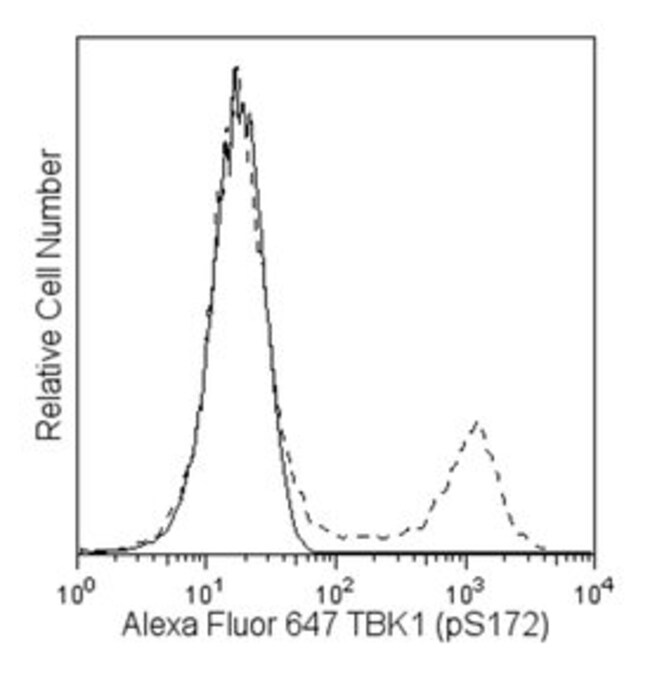
NF-κB is a ubiquitously expressed transcription factor that regulates many cytokine and Ig genes. It is involved in immune, inflammatory, viral, and acute phase responses. In most cells, NF-κB is sequestered in an inactive cytoplasmic form via interactions with the inhibitory proteins IκBα, IκBβ, and IκBε. Stimulation induces the release, activation, and nuclear translocation of NF-κB. Release of NF-κB results from the phosphorylation and proteolytic degradation of the IκB proteins. Two cytokine-inducible IκB kinases (IKKα and IKKβ) phosphorylate and target the IκB proteins for degradation via the ubiquitin pathway. IKKγ/NEMO, a third member of the IKK complex, functions as a regulatory subunit and interacts directly with IKKβ. TBK1 (TANK-binding kinase 1, also known as T2K or NAK), a protein of 729 amino acids, is another member of the IKK family of kinases regulating NF-κB downstream of the tumor necrosis factor and Toll-like receptor pathways. TBK1 forms a complex with the adaptor proteins TANK (TRAF-associated NF-κB activator) and TRAF2 (TNF-receptor-associated factor 2), and this oligomer is required for activation and phosphorylation of TBK1 at serine 172 (S172). The J133-587 monoclonal antibody recognizes the phosphorylated S172 of human TBK1. Our in-house testing is performed on a cell line that has been co-transfected with TBK1 and IRF-7 because we have been unable to detect endogenous TBK1 (pS172) by western blotting of lysates from activated cell lines (HeLa activated with PMA and A431 activated with PDGF). In the transfectants, the over-expression of TBK1 is necessary for phosphorylation of IRF-7, but the presence of IRF-7 does not affect TBK1 expression or phosphorylation. We confirmed that mAb J133-587 does not cross-react with IRF-7 by ELISA.
Intracellular Staining

Specifications
Specifications
| Antigen | TBK1 (pS172) |
| Applications | Flow Cytometry |
| Classification | Monoclonal |
| Clone | J133-587 |
| Conjugate | Alexa Fluor 647 |
| Description | T2K, NAK |
| Formulation | Aqueous buffered solution containing BSA and ≤0.09% sodium azide. |
| Host Species | Mouse |
| Immunogen | Phosphorylated Human TBK1 |
| Purification Method | Affinity Purified |
| Show More |
By clicking Submit, you acknowledge that you may be contacted by Fisher Scientific in regards to the feedback you have provided in this form. We will not share your information for any other purposes. All contact information provided shall also be maintained in accordance with our Privacy Policy.