Learn More
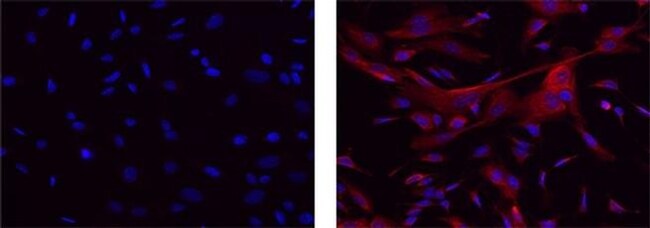
Invitrogen™ APP (Amyloid Precursor Protein) Monoclonal Antibody (22C11), eFluor™ 570, eBioscience™


Description
The monoclonal antibody 22C11 recognizes human, mouse, and rat APP (Amyloid Precursor Protein). APP is expressed in high abundance in the central nervous system and has three major isoforms resulting from alternative splicing. APP plays a role in synaptic formation and repair, anterograde neuronal transport, iron export, and hormonal regulation. Secreted APP (sAPP) may have neuroprotective effects against neurotoxic insult, oxidative stress, and excitotoxicity. APP belongs to a family that contains at least two homologs, amyloid precursor-like proteins 1 and 2 (APLP1 and APLP2). Similarities between APP and APLP, especially APLP2, suggest that APLP could share and compensate for the function of APP. Proteolytic cleavage of APP results in the generation of beta amyloid, which is the primary component of senile plaques. Senile plaques are one of the major histopathologic features of Alzheimer's disease. Abnormal regulation and processing of APP also plays a role in Down's syndrome, early onset familial Alzheimer's disease, cerebral hemorrhage, and arthritis. This 22C11 antibody reacts with pre-A4 and recognizes all three isoforms of APP (immature, sAPP, and mature). This 22C11 antibody is known to cross react with APLP2. Applications Reported: This 22C11 antibody has been reported for use in microscopy, and immunocytochemistry. Applications Tested: This 22C11 antibody has been tested by immunocytochemistry of methanol-fixed cells and can be used at less than or...

Specifications
Specifications
| Antigen | APP (Amyloid Precursor Protein) |
| Applications | Immunohistochemistry, Immunocytochemistry |
| Classification | Monoclonal |
| Clone | 22C11 |
| Concentration | 0.2 mg/mL |
| Conjugate | eFluor 570 |
| Formulation | PBS with 0.09% sodium azide; pH 7.2 |
| Gene | APP |
| Gene Accession No. | P05067, P08592, P12023 |
| Gene Alias | A4; AAA; ABETA; Abeta40; Abeta42; ABPP; AD1; Adap; AG; AICD-50; AICD-57; AICD-59; AID(50); AID(57); AID(59); Alpha-CTF; Alpha-secretase C-terminal fragment; Alzheimer disease amyloid A4 protein homolog; alzheimer disease amyloid protein; amyloid A4; Amyloid b precursor protein; amyloid beta (A4) precursor protein; amyloid beta A4 protein; amyloid beta precursor protein; Amyloid intracellular domain 50; Amyloid intracellular domain 57; Amyloid intracellular domain 59; Amyloid precursor protein; Amyloid β precursor protein; Amyloid-beta A4 protein; Amyloid-beta precursor protein; Amyloid-beta protein 40; Amyloid-beta protein 42; Amyloidogenic glycoprotein; APP; APP-C57; APP-C59; APP-C99; APPI; appican; beta-amyloid peptide; beta-amyloid peptide(1-40); beta-amyloid peptide(1-42); beta-amyloid precursor protein; betaApp; Beta-APP40; Beta-APP42; Beta-CTF; Beta-secretase C-terminal fragment; C31; C80; C83; C99; Cerebral vascular amyloid peptide; CTFgamma; CVAP; E030013M08Rik; Gamma-CTF(50); Gamma-CTF(57); Gamma-CTF(59); Gamma-secretase C-terminal fragment 50; Gamma-secretase C-terminal fragment 57; Gamma-secretase C-terminal fragment 59; N-APP; P3(40); P3(42); Pan-Abeta; peptidase nexin-II; PN2; PN-II; PreA4; protease nexin II; protease nexin-II; S-APP-alpha; S-APP-beta; Soluble APP-alpha; Soluble APP-beta; testicular tissue protein Li 2 |
| Show More |
Frequently Asked Questions (FAQs)
Our options will depend on the samples you are analyzing.
If cell viability is not critical, you can store your stained samples at 4 degrees C or on ice overnight in the dark and analyze the following day.
For samples stained with eFluor organic fluorochromes, we recommend that cells be suspended in 100 uL of Flow Cytometry Staining Buffer (Cat. No. 00-4222) and 100 uL of eBioscience IC Fixation Buffer (Cat. No. 00-8222); samples can be incubated for up to 3 days at 4 degrees C in the dark. Alternatively, the 1-step Fix/Lyse Solution (Cat. No. 00-5333) can be used. This is a great option when working with whole blood but also works for other cell types.
Yes, the eFluor Organic fluorochromes can be used for intracellular staining. The eFluor organic fluorochromes maintain bright signal and require minimal changes in compensation when fixed with eBioscience IC Fixation Buffer (Cat. No. 00-8222-49) and Permeabilization Buffer (Cat. No. 00-8333-56) or 1-step Fix/Lyse Solution (Cat. No. 00-5333-54, 00-5333-57) (as compared to live cells).
The eFluor Organic Dyes (eFluor 450, APC-eFluor 780, PerCP-eFluor 710, eFluor 710) are conventional fluorochromes. In contrast, the eVolve line of products are Quantum dots.
As with other fluorochromes, we recommend minimal exposure to light to maintain optimal signal.
By clicking Submit, you acknowledge that you may be contacted by Fisher Scientific in regards to the feedback you have provided in this form. We will not share your information for any other purposes. All contact information provided shall also be maintained in accordance with our Privacy Policy.