Learn More
Invitrogen™ BASP1 Recombinant Rabbit Monoclonal Antibody (5H3L1)


Description
This antibody is predicted to react with Mouse, Rat, Bovine.

Specifications
Specifications
| Antigen | BASP1 |
| Applications | Western Blot, Immunocytochemistry |
| Classification | Recombinant Monoclonal |
| Clone | 5H3L1 |
| Concentration | 0.5 mg/mL |
| Conjugate | Unconjugated |
| Formulation | PBS with 0.09% sodium azide; pH 7.2-7.4 |
| Gene | BASP1 |
| Gene Accession No. | P80723 |
| Gene Alias | 22 kDa neuronal tissue-enriched acidic protein; 2610024P12Rik; BASP1; brain abundant membrane attached signal protein 1; brain abundant, membrane attached signal protein 1; brain acid soluble protein 1; brain acidic membrane protein; brain acid-soluble protein 1; CAP23; CAP-23; Ckap3; cytoskeleton associated protein 3; MGC8555; NAP22; NAP-22; neuronal axonal membrane protein NAP-22; neuronal tissue-enriched acidic protein |
| Show More |
Frequently Asked Questions (FAQs)
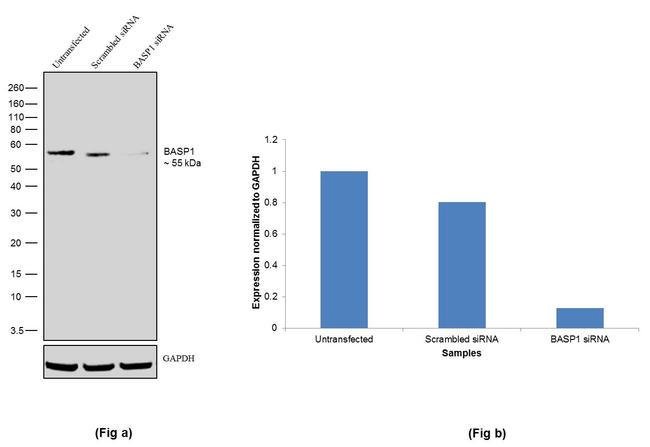
While the predicted MW for BASP1 is 23 kDa, it can show multiple bands in the presence of SDS. BASP1 can form oligomers in SDS, ranging in size from 30-150 kDa. This apparent molecular weight can change with varying SDS concentrations. In addition, the UniProt database entry for human BASP1 shows that BASP1 can form interchain protein cross-links with the SUMO2 protein. This modification can add 20 kDa in apparent MW.
Safety and Handling
By clicking Submit, you acknowledge that you may be contacted by Fisher Scientific in regards to the feedback you have provided in this form. We will not share your information for any other purposes. All contact information provided shall also be maintained in accordance with our Privacy Policy.