Learn More
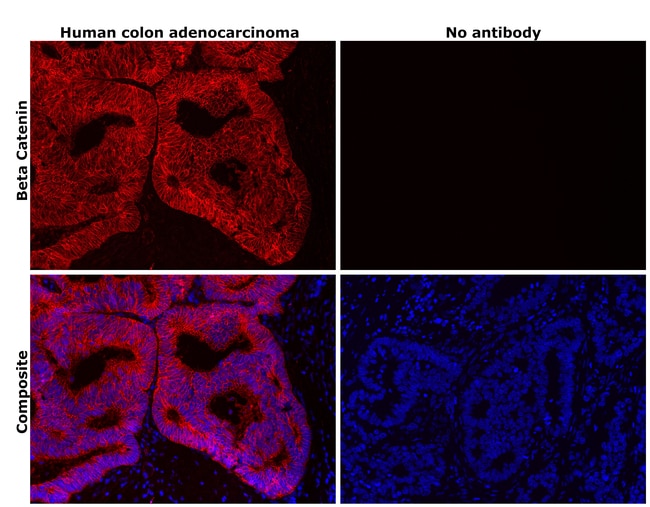
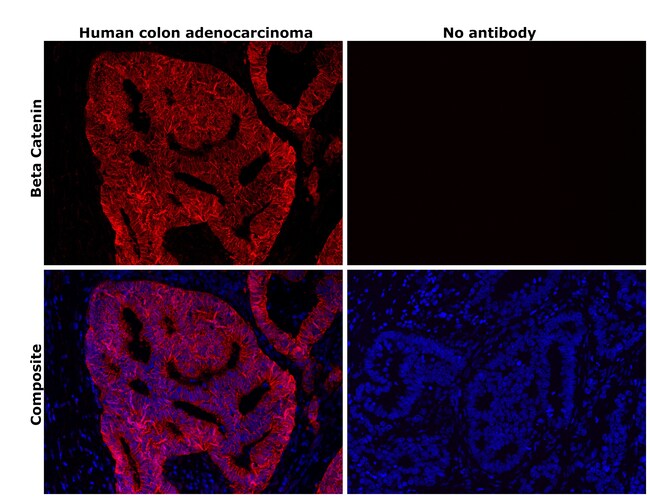
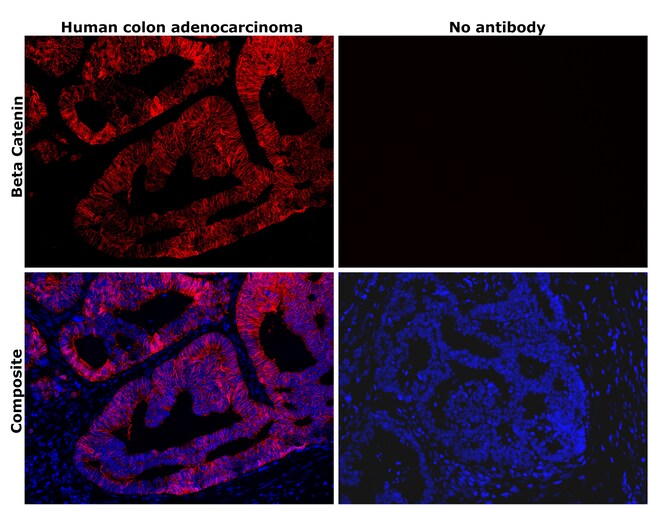
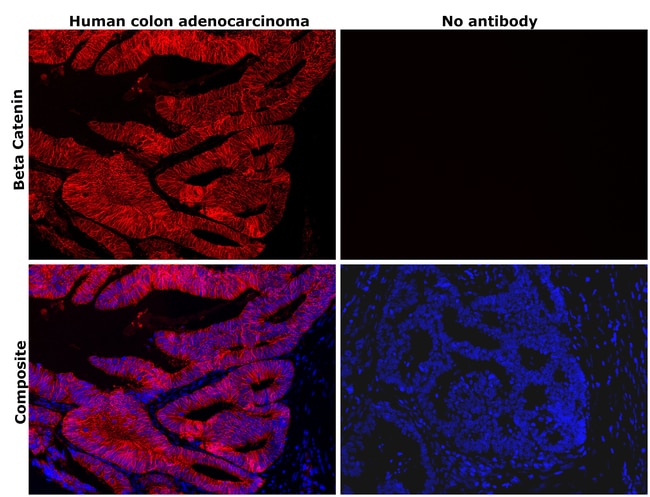

Invitrogen™ beta Catenin Monoclonal Antibody (15B8), eFluor™ 660, eBioscience™, Invitrogen™


Description
Description: The 15B8 monoclonal antibody reacts with human and mouse beta-catenin, one member of a family of catenins, which are intracellular proteins that interact with cadherins to mediate cellular adhesion. More specifically, beta-catenin binds to the cytoplasmic tail of E-cadherin. In addition, this molecule is a component of the canonical Wnt signaling pathway. In the absence of Wnt binding its receptor, beta-catenin is phosphorylated and resides in the cytoplasm where it is eventually targeted for degradation by ubiquitination. Upon Wnt binding, beta-catenin becomes dephosphorylated, translocates to the nucleus, and modulates gene expression in partnership with the transcription factors T cell factor (TCF) and lymphocyte enhancer binding factor (LEF). Expression of beta-catenin is found in a wide variety of non-immune and immune tissues, including thymocytes and T and B lymphocytes. The Wnt and beta-catenin signaling pathway has been demonstrated to play a crucial role in the development of T, B, and hematopoietic stem cells. Applications Reported: This 15B8 antibody has been reported for use in intracellular staining followed by flow cytometric analysis. Applications Tested: This 15B8 antibody has been tested by intracellular staining and flow cytometric analysis of the Jurkat cell line using the Foxp3/Transcription Factor Staining Buffer Set (cat. 00-5523). This can be used at less than or equal to 0.25 μg per test.

Specifications
Specifications
| Antigen | beta Catenin |
| Applications | Flow Cytometry, Immunohistochemistry (Paraffin) |
| Classification | Monoclonal |
| Clone | 15B8 |
| Concentration | 5 μL/Test |
| Conjugate | eFluor 660 |
| Formulation | PBS with BSA and 0.09% sodium azide; pH 7.2 |
| Gene | CTNNB1 |
| Gene Accession No. | P35222, Q02248 |
| Gene Alias | armadillo; armadillo homolog; Bcatenin; b-catenin; beta 1 88kDa; beta catenin; Betacatenin; beta-catenin; beta-catenin 1; Bfc; C20orf33; Cadherin associated protein; catenin; catenin (cadherin associated protein), beta 1; catenin (cadherin associated protein), beta 1, 88kDa; catenin (cadherin-associated protein) beta 1; catenin (cadherin-associated protein), beta 1; catenin (cadherin-associated protein), beta 1, 88kDa; Catenin b 1; Catenin b1; catenin beta; catenin beta 1; catenin beta 1 L homeolog; Catenin beta1; Catenin beta-1; Catenin β 1; Catenin β1; Catnb; CHBCAT; CTNB1; CTNNB; ctnnb1; ctnnb1.L; ctnnb1-a; ctnnb1-b; dJ633O20.1; DKFZp686D02253; FLJ25606; FLJ37923; id:ibd2058; Mesc; MRD19; NAP; NYD-SP19; OK/SW-cl.35; OTTHUMP00000209289; P14L; PP8304; PRO2286; RP5-1118M15.1; wu:fb73e10; wu:fi81c06; wu:fk25h01; XELAEV_18031149mg; β catenin; βcatenin |
| Show More |
Frequently Asked Questions (FAQs)
Yes, the eFluor Organic fluorochromes can be used for intracellular staining. The eFluor organic fluorochromes maintain bright signal and require minimal changes in compensation when fixed with eBioscience IC Fixation Buffer (Cat. No. 00-8222-49) and Permeabilization Buffer (Cat. No. 00-8333-56) or 1-step Fix/Lyse Solution (Cat. No. 00-5333-54, 00-5333-57) (as compared to live cells).
Yes, in-house studies have demonstrated that the eFluor 660 fluorochrome is recognized by Anti-Cy5/Alexa Fluor 647 beads. Side by side studies with Alexa Fluor 647 versus eFluor 660 conjugated antibodies have demonstrated comparable results.
The eFluor Organic fluorochromes and eVolve QDots can be used with flow staining buffers containing PBS and protein.
The eFluor Organic Dyes (eFluor 450, APC-eFluor 780, PerCP-eFluor 710, eFluor 710) are conventional fluorochromes. In contrast, the eVolve line of products are Quantum dots.
As with other fluorochromes, we recommend minimal exposure to light to maintain optimal signal.
For Research Use Only.
By clicking Submit, you acknowledge that you may be contacted by Fisher Scientific in regards to the feedback you have provided in this form. We will not share your information for any other purposes. All contact information provided shall also be maintained in accordance with our Privacy Policy.