Learn More
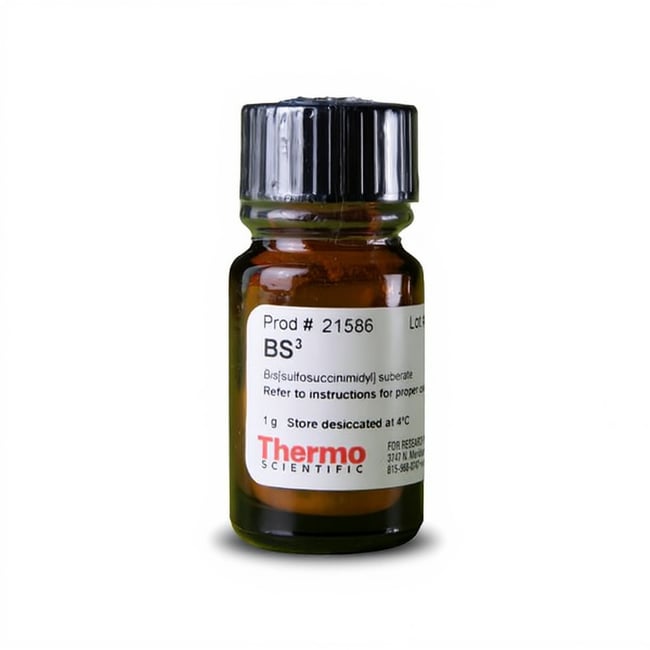


Thermo Scientific™ BS3 (bis(sulfosuccinimidyl)suberate)

Description
Thermo Scientific™ Pierce BS3 (Sulfo-DSS) is bis(sulfosuccinimidyl)suberate, an amine-to-amine crosslinker that is homobifunctional, water-soluble, non-cleavable and membrane impermeable.
Highlights:
- Crosslink cell-surface proteins before cell lysis and immunoprecipitation
- Identify receptor-ligand interactions by chemical crosslinking
- “Fix” protein interactions to allow identification of weak or transient protein interactions
- Identify near-neighbor protein interactions
- Protein crosslinking to create bioconjugates via single-step reactions
- Immobilize proteins onto amine-coated surfaces

Specifications
Specifications
| Chemical Reactivity | Amine-Amine |
| Cleavable | No |
| Molecular Weight (g/mol) | 572.43 |
| PEGylated | No |
| Spacer Arm Length | 11.4 Å |
| Content And Storage | Upon receipt store desiccated at 4°C. |
| Cell Permeability | No |
| Shipping Condition | Ambient |
| Product Line | Pierce |
| Labeling Method | Chemical Labeling |
| Show More |
Frequently Asked Questions (FAQs)
BS3 is the water-soluble analogue of DSS (i.e., DSS is the membrane-permeable analog of BS3). DSS is water-insoluble and membrane-permeable, so it can be used for both intracellular and cell surface crosslinking. BS3 is water-soluble and membrane-impermeable, so it can be used for cell-surface crosslinking.
For crosslinking the antibody to Protein G Dynabeads, please refer to the crosslinking protocol with BS3 (bis(sulfosuccinimidyl)suberate) or Sulpha-DSS, which is an analogue of DSS. The only difference between these two molecules is that DSS is water insoluble and needs to be solubilized in DMSO before use. You can find the protocol at the following link.
BS3 (bis(sulfosuccinimidyl)suberate) is covered under our general 1-year warranty and is guaranteed to be fully functional for 12 months from the date of shipment, if stored as recommended. Please see section 8.1 of our Terms & Conditions of Sale (https://www.thermofisher.com/content/dam/LifeTech/Documents/PDFs/Terms-and-Conditions-of-Sale.pdf) for more details.
A homobifunctional cross-linker has the same reactive group on both ends, for example two amine-reactive groups. It is used in a one-step conjugation where the two molecules are mixed prior to the addition of the cross-linker. This leads to less efficient cross-linking because polymers can easily be created. A heterobifunctional cross-linker has two different reactive groups, for example an amine-reactive group on one end and a sulhydryl reactive group on the other. These can be used in two-step conjugations by reacting the fIrst end with the molecule containing its reactive group, and then adding the molecule that is reactive towards the other end. This leads to much more efficient cross-linking because polymerization does not occur.
Safety and Handling
For Research Use Only. Not for use in diagnostic procedures.
By clicking Submit, you acknowledge that you may be contacted by Fisher Scientific in regards to the feedback you have provided in this form. We will not share your information for any other purposes. All contact information provided shall also be maintained in accordance with our Privacy Policy.