Learn More
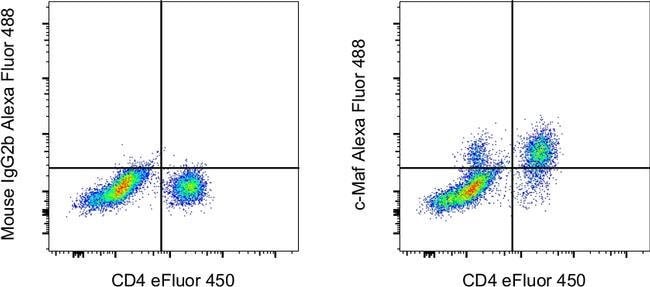
Invitrogen™ c-MAF Monoclonal Antibody (sym0F1), Alexa Fluor™ 488, eBioscience™


Description
The sym0F1 monoclonal antibody reacts with human and mouse c-Maf, a 42 kDa basic leucine zipper transcription factor shown to be involved in the neural, ocular and hematopoietic systems. In hematopoietic cells, it was first shown to be crucial for IL-4 expression in Th2 and was the first transcription factor believed to be Th subset-specific. More recent evidence shows that specific phospho-tyrosine residues lead to upregulation of IL-4. c-Maf has also been shown to be important to differentiation and function in both Th17 and Tfh cells. It drives expression of IL-21 in both cell types, while promoting expression of IL-23R in Th17 and CXCR5 in Tfh as well. Applications Reported: This sym0F1 antibody has been reported for use in flow cytometric analysis. Applications Tested: This sym0F1 antibody has been tested by flow cytometric analysis of stimulated mouse splenocytes using the Foxp3/Transcription Factor Staining Buffer Set (Product # 00-5523-00) and protocol. Please refer to 'Staining Intracellular Antigens for Flow Cytometry, Protocol B: One step protocol for intracellular (nuclear) proteins' located at www.thermofisher.com/flowprotocols . This may be used at less than or equal to 0.5 μg per test. A test is defined as the amount (μg) of antibody that will stain a cell sample in a final volume of 100 μL. Cell number should be determined empirically but can range from 10^5 to 10^8 cells/test. It is recommended that the antibody be carefully titrated...

Specifications
Specifications
| Antigen | c-MAF |
| Applications | Flow Cytometry |
| Classification | Monoclonal |
| Clone | sym0F1 |
| Concentration | 0.5 mg/mL |
| Conjugate | Alexa Fluor 488 |
| Formulation | PBS with 0.09% sodium azide; pH 7.2 |
| Gene | MAF |
| Gene Accession No. | O75444, P54843 |
| Gene Alias | 2810401A20Rik; A230108G15Rik; Avian musculoaponeurotic fibrosarcoma (MAF) protooncogene; avian musculoaponeurotic fibrosarcoma (v-maf) AS42 oncogene homolog; AW047063; AYGRP; basic domain leucine zipper transcription factor; CCA4; cMaf; C-Maf; c-Maf long form; c-maf proto-oncogene; CTRCT21; fl13d12; hMafA; LOW QUALITY PROTEIN: transcription factor Maf; LOW QUALITY PROTEIN: transcription factor MafA; maf; MAF bZIP transcription factor; MAF bZIP transcription factor A; maf protein; Maf2; MAFA; Mafa homolog; MGC71685; pancreatic beta-cell-specific transcriptional activator; Proto-oncogene c-Maf; RGD1562627; RIPE3b1; RIPE3b1 factor; T lymphocyte c-maf long form; transcription factor Maf; Transcription factor Maf-2; transcription factor MafA; transcription factor RIPE3b1; v-maf avian musculoaponeurotic fibrosarcoma oncogene A; v-maf avian musculoaponeurotic fibrosarcoma oncogene homolog; v-maf avian musculoaponeurotic fibrosarcoma oncogene homolog A; v-maf avian musculoaponeurotic fibrosarcoma oncogene homolog a (paralog a); v-maf musculoaponeurotic fibrosarcoma oncogene family, protein A; v-maf musculoaponeurotic fibrosarcoma oncogene family, protein A (avian); v-maf musculoaponeurotic fibrosarcoma oncogene homolog; V-maf musculoaponeurotic fibrosarcoma oncogene homolog A; wu:fl13d12; Z-cmaf |
| Show More |
Safety and Handling
By clicking Submit, you acknowledge that you may be contacted by Fisher Scientific in regards to the feedback you have provided in this form. We will not share your information for any other purposes. All contact information provided shall also be maintained in accordance with our Privacy Policy.