Promotional price valid on web orders only. Your contract pricing may differ. Interested in signing up for a dedicated account number?
Learn More
Learn More
Invitrogen™ CADM1 Polyclonal Antibody

Description
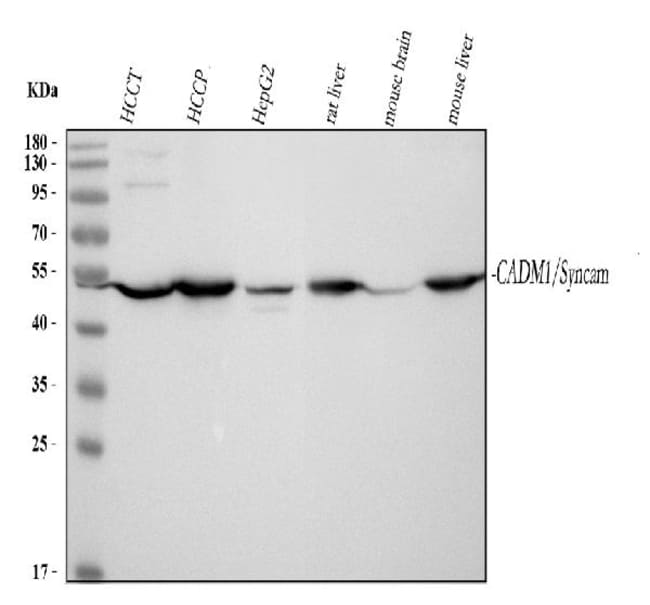
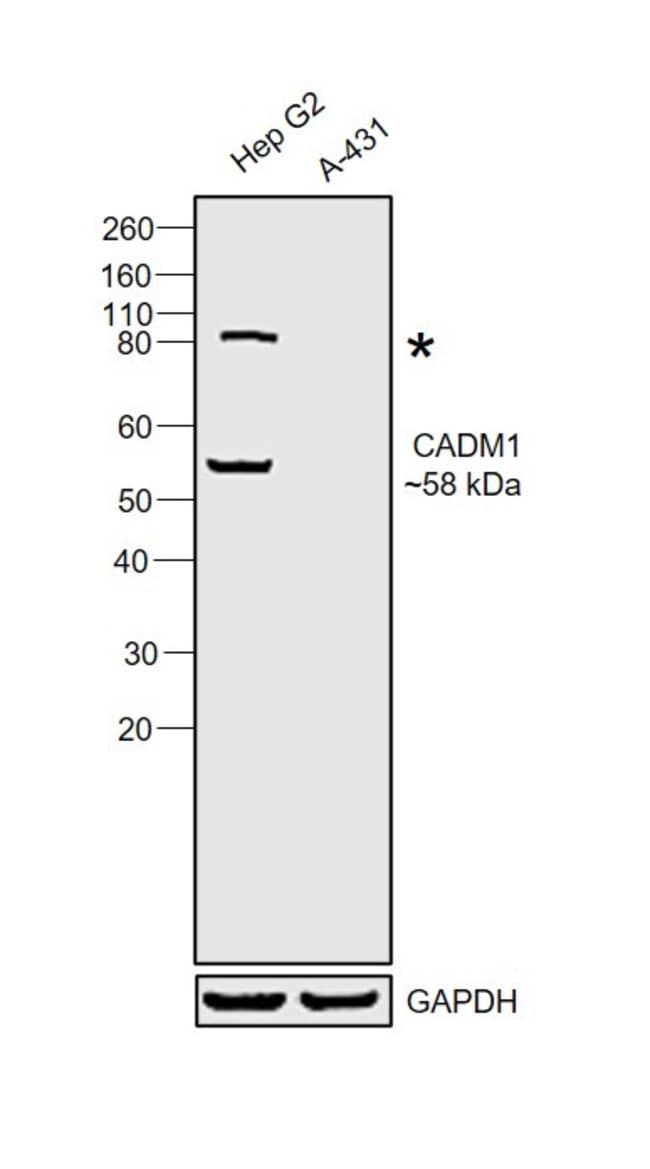
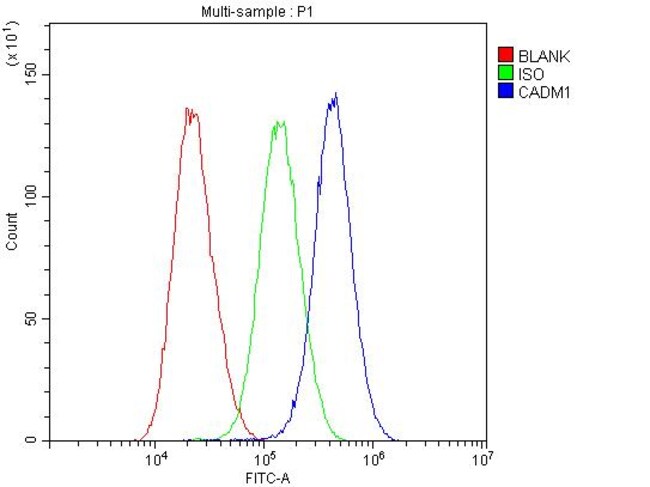
Reconstitute with 0.2 mL of distilled water to yield a concentration of 500 μg/mL. Positive Control - WB: human hepatocellular carcinoma tumor tissue (HCCT), human hepatocellular carcinoma paracancerous tissue (HCCP), human HepG2 whole cell, rat liver tissue, mouse brain tissue, mouse liver tissue. Flow: A549 cell.
Mediates homophilic cell-cell adhesion in a Ca (2+)-independent manner. Also mediates heterophilic cell-cell adhesion with CADM3 and PVRL3 in a Ca (2+)-independent manner. Acts as a tumor suppressor in non-small-cell lung cancer (NSCLC) cells. Interaction with CRTAM promotes natural killer (NK) cell cytotoxicity and interferon-gamma (IFN-gamma) secretion by CD8+ cells in vitro as well as NK cell-mediated rejection of tumors expressing CADM3 in vivo. May contribute to the less invasive phenotypes of lepidic growth tumor cells. In mast cells, may mediate attachment to and promote communication with nerves. CADM1, together with MITF, is essential for development and survival of mast cells in vivo. May act as a synaptic cell adhesion molecule that drives synapse assembly. May be involved in neuronal migration, axon growth, pathfinding, and fasciculation on the axons of differentiating neurons. May play diverse roles in the spermatogenesis including in the adhesion of spermatocytes and spermatids to Sertoli cells and for their normal differentiation into mature spermatozoa.

Specifications
Specifications
| Antigen | CADM1 |
| Applications | Flow Cytometry, Western Blot |
| Classification | Polyclonal |
| Concentration | 500 μg/mL |
| Conjugate | Unconjugated |
| Formulation | PBS with 4mg trehalose and 0.05mg sodium azide |
| Gene | CADM1 |
| Gene Accession No. | Q6AYP5, Q8R5M8, Q9BY67 |
| Gene Alias | 2900073G06Rik; 3100001I08Rik; AI987920; Bl2; cadm1; Cell adhesion molecule 1; cell adhesion molecule 1 transcript variant 8abc; Igsf4; Igsf4a; Immunoglobulin superfamily member 4; immunoglobulin superfamily member 4A; immunoglobulin superfamily, member 4; immunoglobulin superfamily, member 4A; immunoglobulin superfamily, member 4D variant 1; immunoglobulin superfamily, member 4D variant 2; immunosuperfamily protein Bl2; Necl2; NECL-2; nectin-like 2; nectin-like protein 2; RA175; RA175A; RA175B; RA175C; RA175N; secretory isoform of TSLC1; sgigsf; Spermatogenic immunoglobulin superfamily; ST17; sTSLC-1; Synaptic cell adhesion molecule; SynCAM; SynCam1; truncated CADM1 protein; TSLC1; TSLC-1; TSLC1/Nectin-like 2/IGSF4; tumor suppressor in lung cancer 1; Tumor suppressor in lung cancer 1 homolog |
| Gene Symbols | CADM1 |
| Show More |
Product Title
By clicking Submit, you acknowledge that you may be contacted by Fisher Scientific in regards to the feedback you have provided in this form. We will not share your information for any other purposes. All contact information provided shall also be maintained in accordance with our Privacy Policy.
Spot an opportunity for improvement?