Promotional price valid on web orders only. Your contract pricing may differ. Interested in signing up for a dedicated account number?
Learn More

Invitrogen™ CCR5 Recombinant Rabbit Monoclonal Antibody (2H14L10)

Catalog No. PI702233 Shop All Thermo Scientific Products
Change view
Click to view available options
Quantity:
100 μg
1 product options available for selection
Product selection table with 1 available options. Use arrow keys to navigate and Enter or Space to select.
Catalog No. Quantity
PI702233 100 μg
Use arrow keys to navigate between rows. Press Enter or Space to select a product option. 1 options available.
1 options
Catalog No. PI702233 Supplier Invitrogen™ Supplier No. 702233
Add to Cart
Edge
Add to Cart

missing translation for 'validMainframeMsg'

Rabbit Recombinant Monoclonal Antibody

This antibody is predicted to react with Monkey Recombinant rabbit monoclonal antibodies are produced using in vitro expression systems. The expression systems are developed by cloning in the specific antibody DNA sequences from immunoreactive rabbits. Then, individual clones are screened to select the best candidates for production. The advantages of using recombinant rabbit monoclonal antibodies include: better specificity and sensitivity, lot-to-lot consistency, animal origin-free formulations, and broader immunoreactivity to diverse targets due to larger rabbit immune repertoire.

Human immunodeficiency virus (HIV) and related virus require coreceptors, in addition to CD4, to infect target cells. Some G protein-coupled receptors including CCR5, CXCR4, CCR3, CCR2b and CCR8 in the chemokine receptor family, and four new human molecules GPR15, STRL33, GPR1 and V28 were recently identified as HIV coreceptors. Among them, CCR5 (CC-CKR-5) is a principal coreceptor for macrophage- and dual-tropic HIV-1 strains fusion and entry of human white blood cells. CCR5 is required for the infection by HIV-1, HIV-2, and SIV. The beta-chemokines RANTES, MIP-alpha and MIP-beta are the ligands for CCR5 and prevent infection by M-tropic HIV-1. CCR5 associates with the surface CD4-gp120 of HIV complex and leads to membrane fusion and virus entry of target cells. The amino-terminal domain and the extracellular loops of CCR5 serve as HIV biding sites. CCR5 messenger RNA is expressed in lymphoid organs and monocytes.
TRUSTED_SUSTAINABILITY

Specifications

Antigen CCR5
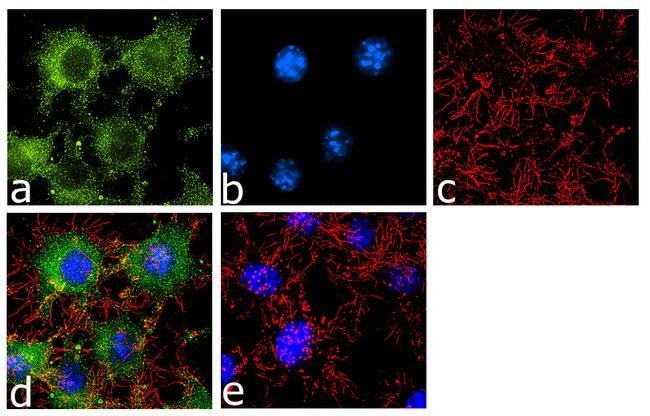
Applications Immunocytochemistry
Classification Recombinant Monoclonal
Clone 2H14L10
Concentration 0.5 mg/mL
Conjugate Unconjugated
Formulation PBS with 0.09% sodium azide; pH 7.2-7.4
Gene CCR5
Gene Accession No. P51681, P51682
Gene Alias AM4-7; C-C chemokine receptor type 5; C-C CKR-5; C-C motif chemokine receptor 5 (gene/pseudogene); C-C motif chemokine receptor 5 A159A; CCCKR5; CC-CKR-5; Ccr5; CCR-5; CD195; CD195 antigen; chemokine (C-C motif) receptor 5; chemokine (C-C) receptor 5; chemokine receptor CCR5; chemr13; CKR5; CKR-5; Cmkbr5; HIV-1 fusion coreceptor; IDDM22; MIP-1 alpha receptor
Gene Symbols CCR5
Host Species Rabbit
Immunogen Peptides corresponding to Human CCR5 (aa 171-185, 333-347).
Purification Method Protein A
Quantity 100 μg
Regulatory Status RUO
Primary or Secondary Primary
Gene ID (Entrez) 1234, 12774
Target Species Human, Mouse
Content And Storage Store at 4°C short term. For long term storage, store at -20°C, avoiding freeze/thaw cycles.
Product Type Antibody
Form Liquid
Isotype IgG
Show More Show Less
Product Title
Select an issue

By clicking Submit, you acknowledge that you may be contacted by Fisher Scientific in regards to the feedback you have provided in this form. We will not share your information for any other purposes. All contact information provided shall also be maintained in accordance with our Privacy Policy.