Learn More
Invitrogen™ CD107a (LAMP-1) Monoclonal Antibody (eBioH4A3), PE-eFluor™ 610, eBioscience™


Description
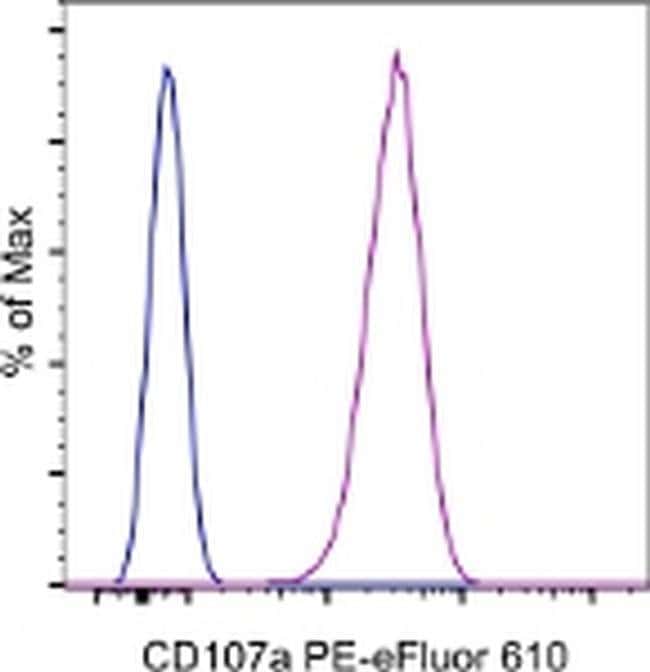
The eBioH4A3 monoclonal antibody reacts with human CD107a, also known as lysosomal-associated membrane protein-1 (LAMP-1). CD107a is a highly glycosylated protein of approximately 110kDa. It is predominantly expressed intracellularly in the lysosomal/endosomal membrane in nearly all cells. CD107a is transiently expressed on the cell surface of degranulating cytolytic T cells, and is also upregulated on the surface of activated platelets and some cancer cells. Applications Reported: This eBioH4A3 antibody has been reported for use in intracellular staining followed by flow cytometric analysis. Applications Tested: This eBioH4A3 antibody has been pre-titrated and tested by intracellular staining and flow cytometric analysis of Jurkat cells using the Intracellular Fixation & Permeabilization Buffer Set (Product # 88-8824-00) and protocol. Please refer to BestProtocols: Protocol A: Two step protocol for (cytoplasmic) intracellular proteins located under the Resources Tab online. This can be used at 5 μL (0.25 μg) per test. A test is defined as the amount (μg) of antibody that will stain a cell sample in a final volume of 100 μL. Cell number should be determined empirically but can range from 10^5 to 10^8 cells/test. PE-eFluor 610 can be excited with laser lines from 488-561 nm and emits at 607 nm. We recommend using a 610/20 band pass filter (equivalent to PE-Texas Red). Please make sure that your instrument is capable of detecting t...

Specifications
Specifications
| Antigen | CD107a (LAMP-1) |
| Applications | Flow Cytometry |
| Classification | Monoclonal |
| Clone | eBioH4A3 |
| Concentration | 5 μL/Test |
| Conjugate | PE-eFluor 610 |
| Formulation | PBS with BSA and 0.09% sodium azide; pH 7.2 |
| Gene | LAMP1 |
| Gene Accession No. | P11279 |
| Gene Alias | 120 kDa lysosomal membrane glycoprotein; AI196048; CD107 antigen-like family member A; CD107a; I79_011073; Lamp I; LAMP1; LAMP-1; LAMPA; LGP120; LGP-120; LGPA; LGP-A; lysosomal associated membrane protein 1; Lysosomal associated membrane protein 1 (120 kDa); lysosomal membrane glycoprotein 1; lysosomal membrane glycoprotein A; lysosomal-associated membrane protein 1; lysosome-associated membrane glycoprotein 1; LYSOSOME-ASSOCIATED MEMBRANE GLYCOPROTEIN 1 PRECURSOR (LAMP-1) (LGP-A) (LGP-120) (CD107A) (P2B); lysosome-associated membrane protein 1; P2B |
| Show More |
Frequently Asked Questions (FAQs)
Our options will depend on the samples you are analyzing.
If cell viability is not critical, you can store your stained samples at 4 degrees C or on ice overnight in the dark and analyze the following day.
For samples stained with eFluor organic fluorochromes, we recommend that cells be suspended in 100 uL of Flow Cytometry Staining Buffer (Cat. No. 00-4222) and 100 uL of eBioscience IC Fixation Buffer (Cat. No. 00-8222); samples can be incubated for up to 3 days at 4 degrees C in the dark. Alternatively, the 1-step Fix/Lyse Solution (Cat. No. 00-5333) can be used. This is a great option when working with whole blood but also works for other cell types.
The eFluor Organic Dyes (eFluor 450, APC-eFluor 780, PerCP-eFluor 710, eFluor 710) are conventional fluorochromes. In contrast, the eVolve line of products are Quantum dots.
As with other fluorochromes, we recommend minimal exposure to light to maintain optimal signal.
By clicking Submit, you acknowledge that you may be contacted by Fisher Scientific in regards to the feedback you have provided in this form. We will not share your information for any other purposes. All contact information provided shall also be maintained in accordance with our Privacy Policy.