Learn More
Invitrogen™ CD182 (CXCR2) Monoclonal Antibody (eBio5E8-C7-F10 (5E8-C7-F10)), eBioscience™, Invitrogen™

Description
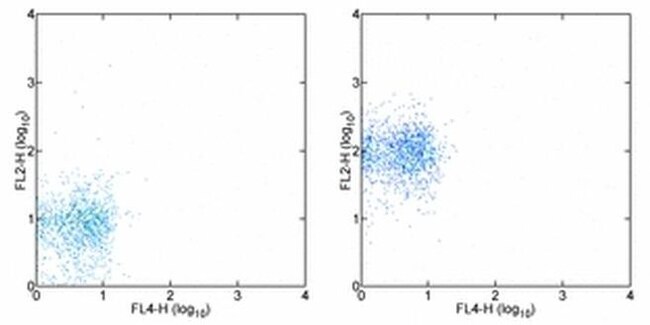
Description: The eBio5E8-C7-F10 monoclonal antibody reacts with human CD182 (CXCR2, IL-8Rbeta). CD182 is a 67-70 kDa member of the seven-transmembrane spanning G-protein coupled receptor (GPCR) family. CD182 is expressed as a homodimer, or a heterodimer with CD181 (CXCR1, IL-8Ralpha) and is expressed on granulocytes, NK cells, a subset of T cells, mast cells, monocytes, endothelial cells, megakaryocytes and oligodendrocytes. Binding of it's ligands, which include IL-8, NAP-2, GCP-2 and GRO-alpha, -beta and -gamma, induces several biological outcomes such as cell activation, chemotaxis, proliferation and angiogenesis. There are several functional differences between CD181 and CD182. Both receptors are able to mediate chemotaxis and intracellular calcium changes, but only CD181 mediates phospolipase D activation and respiratory burst. Furthermore, studies have shown that IL-8 predomitly mediates its effects on neutrophil function through CD181. Applications Reported: This eBio5E8-C7-F10 (5E8-C7-F10) antibody has been reported for use in flow cytometric analysis. Applications Tested: This eBio5E8-C7-F10 (5E8-C7-F10) antibody has been tested by flow cytometric analysis of normal human peripheral blood. This can be used at less than or equal to 0.5 μg per test. A test is defined as the amount (μg) of antibody that will stain a cell sample in a final volume of 100 μL.

Specifications
Specifications
| Antigen | CD182 (CXCR2) |
| Applications | Flow Cytometry |
| Classification | Monoclonal |
| Clone | eBio5E8-C7-F10 (5E8-C7-F10) |
| Concentration | 0.5 mg/mL |
| Conjugate | Unconjugated |
| Formulation | PBS with 0.09% sodium azide; pH 7.2 |
| Gene | CXCR2 |
| Gene Accession No. | P25025 |
| Gene Alias | C Cmotif chemokine; C X C motif chemokine; CC motif chemokine; CCmotif chemokine; CD128; CD182; CD182 antigen; CDw128; CDw128b; chemokine (C-X-C motif) receptor 2; chemokine (CXC) receptor 2; chemokine (C-X-C) receptor 2; Cmkar2; CXC; C-X-C chemokine receptor type 2; CXC motif chemokine; C-X-C motif chemokine receptor 2; Cxcr2; CXC-R2; CXCR-2; CXCR2 gene for IL8 receptor type B; Gpcr16; GRO/MGSA receptor; high affinity interleukin-8 receptor B; IL-8 receptor alpha chain; Il-8 receptor b; IL-8 receptor beta; IL-8 receptor type 2; IL-8R B; IL8R2; IL8RA; Il8rb; IL-8rb; IL-8Rh; interleukin 8 receptor B; interleukin 8 receptor type 2; interleukin 8 receptor, beta; interleukin-8 receptor type B; mIL-8RH |
| Show More |
For Research Use Only.
By clicking Submit, you acknowledge that you may be contacted by Fisher Scientific in regards to the feedback you have provided in this form. We will not share your information for any other purposes. All contact information provided shall also be maintained in accordance with our Privacy Policy.