Learn More
Invitrogen™ CD1a Monoclonal Antibody (HI149), PE-eFluor™ 610, eBioscience™, Invitrogen™


Description
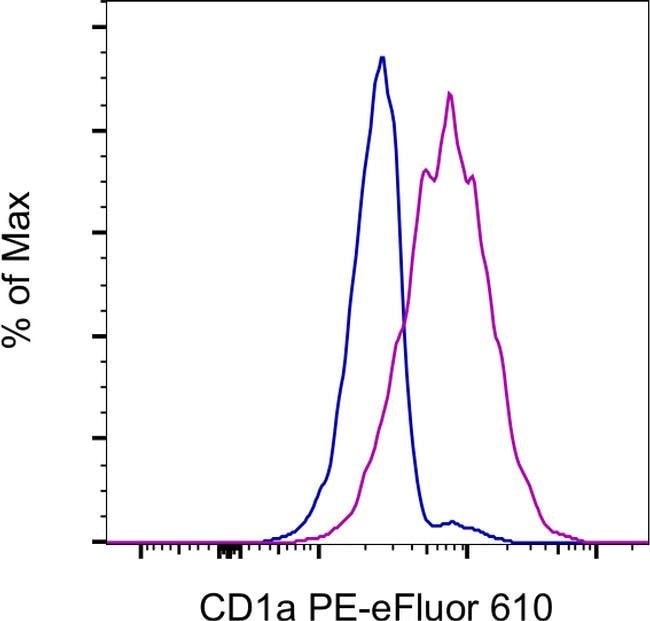
Description: The HI149 monoclonal antibody reacts with human CD1a, a 49 kDa protein expressed by cortical thymocytes and dendritic cells including Langerhans cells. The CD1 family of proteins share some structural and functional characteristics with the MHC class I molecules; however, members of the CD1 family are not polymorphic. Similar to MHC class I, CD1a associates with the beta2-microglobulin and is thought to play a role in antigen presentation. Applications Reported: This HI149 antibody has been reported for use in flow cytometric analysis. Applications Tested: This HI149 antibody has been pre-diluted and tested by flow cytometric analysis of MOLT-4 cells. This may be used at 5 μL (0.125 μg) per test. A test is defined as the amount (μg) of antibody that will stain a cell sample in a final volume of 100 μL. Cell number should be determined empirically but can range from 10^5 to 10^8 cells/test. PE-eFluor 610 can be excited with laser lines from 488-561 nm and emits at 607 nm. We recommend using a 610/20 band pass filter (equivalent to PE-Texas Red). Please make sure that your instrument is capable of detecting this fluorochrome. Light sensitivity: This tandem dye is sensitive to photo-induced oxidation. Please protect this vial and stained samples from light. Fixation: Samples can be stored in IC Fixation Buffer (Product No. 00-8222-49) (100 μL of cell sample + 100 μL of IC Fixation Buffer) or 1-step Fix/Lyse Solution (Product No.

Specifications
Specifications
| Antigen | CD1a |
| Applications | Flow Cytometry |
| Classification | Monoclonal |
| Clone | HI149 |
| Concentration | 5 μL/Test |
| Conjugate | PE-eFluor 610 |
| Formulation | PBS with BSA and 0.09% sodium azide; pH 7.2 |
| Gene | CD1A |
| Gene Accession No. | P06126 |
| Gene Alias | CD1; CD1 antigen; CD1.1; CD1A; CD1A antigen, a polypeptide; CD1a molecule; cd1a1; CD1A1 antigen; cluster of differentiation 1 A; cortical thymocyte antigen CD1A; differentiation antigen CD1-alpha-3; epidermal dendritic cell marker CD1a; FCB6; HTA1; hTa1 thymocyte antigen; R4; T6; T-cell surface antigen T6/Leu-6; T-cell surface glycoprotein CD1a |
| Show More |
By clicking Submit, you acknowledge that you may be contacted by Fisher Scientific in regards to the feedback you have provided in this form. We will not share your information for any other purposes. All contact information provided shall also be maintained in accordance with our Privacy Policy.