Learn More
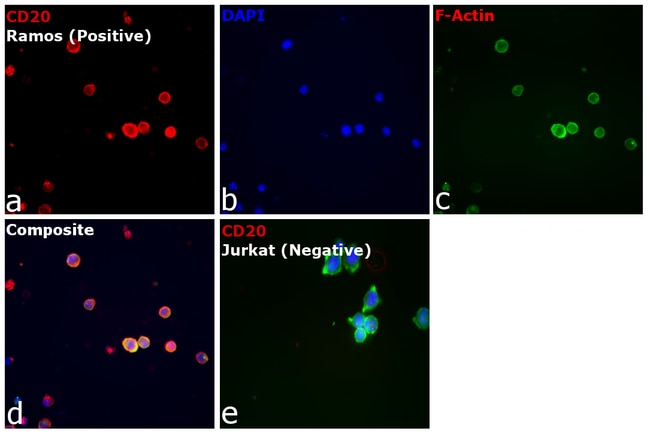
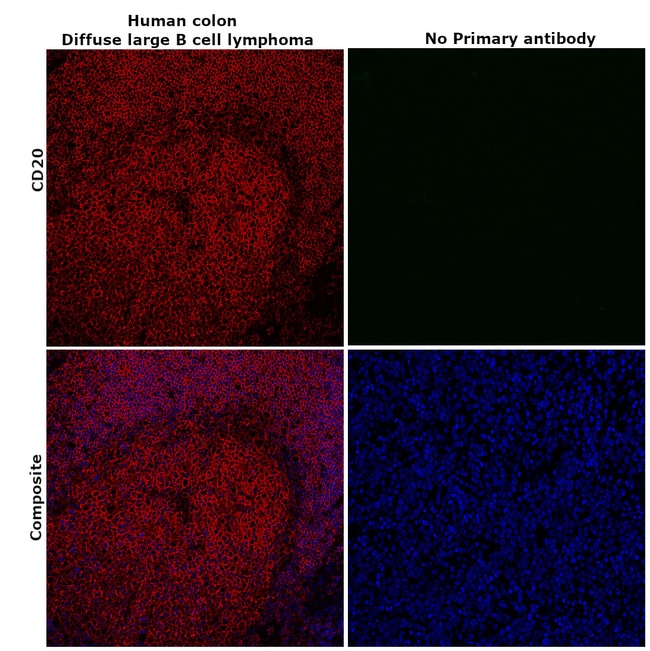
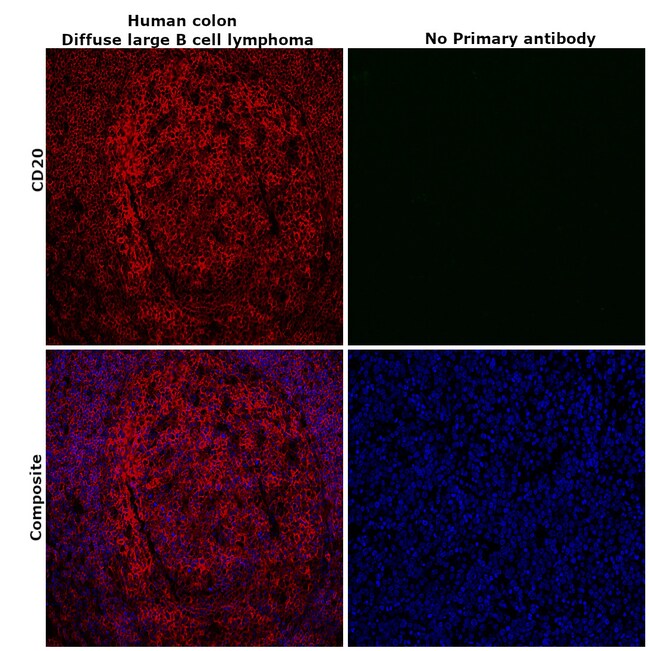
Invitrogen™ CD20 Monoclonal Antibody (L26), eFluor™ 660, eBioscience™, Invitrogen™


Description
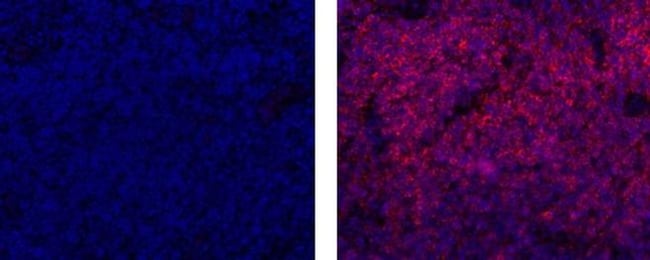
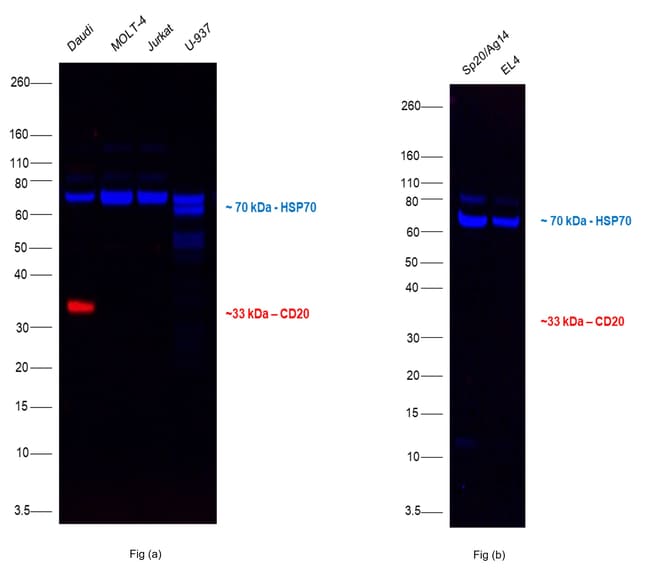
Description: The monoclonal antibody L26 recognizes human CD20, a two transmembrane spanning protein found on precursor and mature B lymphocytes. Expression is lost upon differentiation to plasma cells. The levels of CD20 are critical in evaluating maligt B lymphocytes including Non-Hodgkin's Lymphoma, and Acute B cell, Chronic Lymphocytic and Hairy-Cell Leukemias. CD20 plays a role in B cell differentiation and activation. The structure of the protein shows a small extracellular loop with the carboxy and amino termini in the cytoplasmic compartment. The L26 antibody recognizes an epitope in the cytoplasmic domain and therefore requires permeabilization of the tissue for staining applications. Unlike many anti-CD20 antibodies that recognize the extracellular domain, the epitope recognized by L26 will not be blocked by therapeutic antibodies to CD20, like Rituximab. Applications Reported: This L26 antibody has been reported for use in immunohistochemical staining of formalin-fixed paraffin embedded tissue sections. Applications Tested: This L26 antibody has been tested by immunohistochemistry on formalin-fixed paraffin embedded human tonsils using IHC Antigen Retrieval Solution - Low pH (cat. 00-4955). eFluor™ 660 is a replacement for Alexa Fluor™ 647. eFluor™ 660 emits at 659 nm and is excited with the red laser (633 nm). Please make sure that your instrument is capable of detecting this fluorochome.

Specifications
Specifications
| Antigen | CD20 |
| Applications | Immunohistochemistry, Immunohistochemistry (Paraffin), Western Blot, Immunocytochemistry |
| Classification | Monoclonal |
| Clone | L26 |
| Concentration | 0.2 mg/mL |
| Conjugate | eFluor 660 |
| Formulation | PBS with 0.09% sodium azide; pH 7.2 |
| Gene | Ms4a1 |
| Gene Accession No. | P11836 |
| Gene Alias | AA960661; APY; ATOPY; B1; B-cell differentiation antigen Ly-44; B-lymphocyte antigen CD20; B-lymphocyte cell-surface antigen B1; B-lymphocyte surface antigen B1; Bp35; Cd20; CD20 antigen; CD20 cell surface protein; CD20 receptor; CVID5; EGK_06167; Fc epsilon receptor I beta chain; Fc Fragment of IgE high affinity I receptor for beta polypeptide; FCER1B; High affinity immunoglobulin epsilon receptor subunit beta; IgE Fc receptor subunit beta; IGEL; IGER; IGHER; LEU16; LEU-16; Leukocyte surface antigen Leu-16; Ly44; Ly-44; Lymphocyte antigen 44; membrane spanning 4-domains A1; membrane-spanning 4-domains subfamily A member 1; membrane-spanning 4-domains, subfamily A, member 1; membrane-spanning 4-domains, subfamily A, member 2; MGC3969; MS4A1; MS4A2; S7 |
| Show More |
Frequently Asked Questions (FAQs)
Our options will depend on the samples you are analyzing.
If cell viability is not critical, you can store your stained samples at 4 degrees C or on ice overnight in the dark and analyze the following day.
For samples stained with eFluor organic fluorochromes, we recommend that cells be suspended in 100 uL of Flow Cytometry Staining Buffer (Cat. No. 00-4222) and 100 uL of eBioscience IC Fixation Buffer (Cat. No. 00-8222); samples can be incubated for up to 3 days at 4 degrees C in the dark. Alternatively, the 1-step Fix/Lyse Solution (Cat. No. 00-5333) can be used. This is a great option when working with whole blood but also works for other cell types.
Yes, the eFluor Organic fluorochromes can be used for intracellular staining. The eFluor organic fluorochromes maintain bright signal and require minimal changes in compensation when fixed with eBioscience IC Fixation Buffer (Cat. No. 00-8222-49) and Permeabilization Buffer (Cat. No. 00-8333-56) or 1-step Fix/Lyse Solution (Cat. No. 00-5333-54, 00-5333-57) (as compared to live cells).
Yes, in-house studies have demonstrated that the eFluor 660 fluorochrome is recognized by Anti-Cy5/Alexa Fluor 647 beads. Side by side studies with Alexa Fluor 647 versus eFluor 660 conjugated antibodies have demonstrated comparable results.
The eFluor Organic fluorochromes and eVolve QDots can be used with flow staining buffers containing PBS and protein.
The eFluor Organic Dyes (eFluor 450, APC-eFluor 780, PerCP-eFluor 710, eFluor 710) are conventional fluorochromes. In contrast, the eVolve line of products are Quantum dots.
For Research Use Only.
By clicking Submit, you acknowledge that you may be contacted by Fisher Scientific in regards to the feedback you have provided in this form. We will not share your information for any other purposes. All contact information provided shall also be maintained in accordance with our Privacy Policy.