Learn More
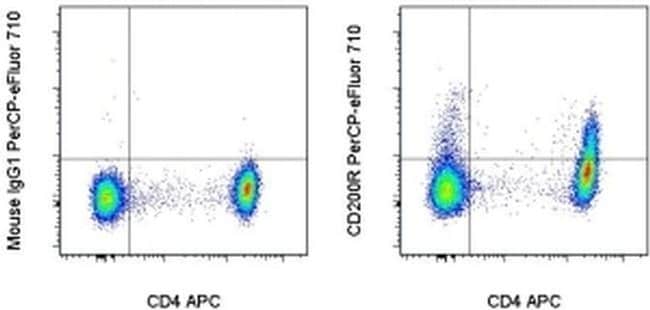
Invitrogen™ CD200 Receptor Monoclonal Antibody (OX108), PerCP-eFluor™ 710, eBioscience™, Invitrogen™


Description
Description: The monoclonal antibody OX108 recognizes human CD200R also known as OX2. CD200R is an inhibitory receptor with a similar structure as its ligand, CD200, yet lacks an ITIM domain typically found in inhibitory receptors. Instead the CD200R cytoplasmic domain contains a novel phosphotyrosine binding domain, NPXY, which after binding SHIP inhibits ERK, JNK and MAPK p38 pathways. In activated macrophages signaling results in inhibition of TNFalpha secretion. Isoforms of CD200R have been identified and are thought to play a major role in differentiation, especially in regards to tolerogenic DCs. Expression is restricted to hematopoietic cells: myeloid cells (monocytes, macrophages, DCs, neutrophils, mast cells and basophils) and a subset of T lymphocytes as well as langerhans (LC) cells and dendritic epidermal T cells. The epitope of OX108 is thought to be near the binding site of CD200. Applications Reported: This OX108 antibody has been reported for use in flow cytometric analysis. Applications Tested: This OX108 antibody has been pre-titrated and tested by flow cytometric analysis of normal human peripheral blood cells. This can be used at 5 μL (0.5 μg) per test. A test is defined as the amount (μg) of antibody that will stain a cell sample in a final volume of 100 μL. Cell number should be determined empirically but can range from 10^5 to 10^8 cells/test.

Specifications
Specifications
| Antigen | CD200 Receptor |
| Applications | Flow Cytometry |
| Classification | Monoclonal |
| Clone | OX108 |
| Concentration | 5 μL/Test |
| Conjugate | PerCP-eFluor 710 |
| Formulation | PBS with BSA and 0.09% sodium azide; pH 7.2 |
| Gene | CD200R1 |
| Gene Accession No. | Q8TD46 |
| Gene Alias | antigen identified by monoclonal antibody MRC OX-2 receptor; CD200 cell surface glycoprotein receptor; CD200 R1; CD200 receptor 1; CD200R; Cd200r1; Cell surface glycoprotein CD200 receptor 1; cell surface glycoprotein OX2 receptor 1; cell surface glycoprotein receptor CD200; CRTR2; HCRTR2; MOX2 receptor; MOX2R; Orexin receptor 2; OX102 antigen; OX2 receptor; OX2R; UNQ2522/PRO6015 |
| Show More |
Frequently Asked Questions (FAQs)
Our options will depend on the samples you are analyzing.
If cell viability is not critical, you can store your stained samples at 4 degrees C or on ice overnight in the dark and analyze the following day.
For samples stained with eFluor organic fluorochromes, we recommend that cells be suspended in 100 uL of Flow Cytometry Staining Buffer (Cat. No. 00-4222) and 100 uL of eBioscience IC Fixation Buffer (Cat. No. 00-8222); samples can be incubated for up to 3 days at 4 degrees C in the dark. Alternatively, the 1-step Fix/Lyse Solution (Cat. No. 00-5333) can be used. This is a great option when working with whole blood but also works for other cell types.
Yes, the eFluor Organic fluorochromes can be used for intracellular staining. The eFluor organic fluorochromes maintain bright signal and require minimal changes in compensation when fixed with eBioscience IC Fixation Buffer (Cat. No. 00-8222-49) and Permeabilization Buffer (Cat. No. 00-8333-56) or 1-step Fix/Lyse Solution (Cat. No. 00-5333-54, 00-5333-57) (as compared to live cells).
The eFluor Organic fluorochromes and eVolve QDots can be used with flow staining buffers containing PBS and protein.
The eFluor Organic Dyes (eFluor 450, APC-eFluor 780, PerCP-eFluor 710, eFluor 710) are conventional fluorochromes. In contrast, the eVolve line of products are Quantum dots.
As with other fluorochromes, we recommend minimal exposure to light to maintain optimal signal.
Safety and Handling
For Research Use Only.
By clicking Submit, you acknowledge that you may be contacted by Fisher Scientific in regards to the feedback you have provided in this form. We will not share your information for any other purposes. All contact information provided shall also be maintained in accordance with our Privacy Policy.