Promotional price valid on web orders only. Your contract pricing may differ. Interested in signing up for a dedicated account number?
Learn More

Invitrogen™ CD273 (B7-DC) Monoclonal Antibody (MIH18), PE, eBioscience™
GREENER_CHOICE

Catalog No. 5010954
Encompass_Preferred
Change view
Click to view available options
Quantity:
100 Tests
1 product options available for selection
Product selection table with 1 available options. Use arrow keys to navigate and Enter or Space to select.
Catalog No. Quantity
50-109-54 100 Tests
Use arrow keys to navigate between rows. Press Enter or Space to select a product option. 1 options available.
1 options
Catalog No. 50-109-54 Supplier Invitrogen™ Supplier No. 12588842
Only null left
Add to Cart
Edge
Add to Cart

Mouse Monoclonal Antibody

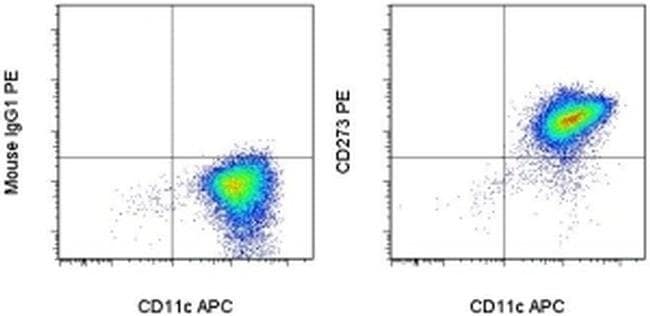
Description: The MIH18 monoclonal antibody reacts with human B7-DC, also known as PD-L2. B7-DC, a recently identified member of the B7 family, has a predicted molecular weight of approximately 25 kDa and belongs to the Ig superfamily. B7-DC is primarily expressed by subpopulations of dendritic cells and monocytes/macrophages. Although B7-DC has structural and sequence similarities to the B7 family, it does not bind CD28/CTLA-4, rather it is a ligand for PD-1. The interactions between PD-1 and B7-DC/PD-L2 have been reported to be involved in costimulation or suppression of T cell proliferation depending on state of cellular activation. MIH18 is a useful tool for studies to elucidate the exact function of B7-DC/PD-L2 in APC/T cell interaction and to characterize the expression pattern of this molecule in humans. MIH18 is a blocking antibody. Applications Reported: The MIH18 antibody has been reported for use in flow cytometric analysis. Applications Tested: This MIH18 antibody has been pre-titrated and tested by flow cytometric analysis of mature dendritic cells and normal human peripheral blood cells. This can be used at 5 μL (0.125 μg) per test. A test is defined as the amount (μg) of antibody that will stain a cell sample in a final volume of 100 μL. Cell number should be determined empirically but can range from 10^5 to 10^8 cells/test. Excitation: 488-561 nm; Emission: 578 nm; Laser: Blue Laser, Green Laser, Yellow-Green Laser. Filtration: 0.2 μm post-...

Programmed death-ligand 2 (PD-L2), or B7-DC, is a member of the B7 ligand family within the immunoglobulin superfamily that, along with programmed death-ligand 1 (PD-L1), acts as a ligand for programmed cell death protein 1 (PD-1). Though expressed primarily in dendritic cells, PD-L2 expression can be induced on a wide variety of immune and non-immune cells depending on the microenvironment. PD-L2 expression is particularly upregulated in the presence of Th2 cytokine, IL-4, as well as Th1 cytokines, TNF-alpha and IFN-gamma to a lesser degree. While generally expressed at lower levels compared to PD-L1, PD-L2 demonstrates a 2 to 6 times higher relative affinity to PD-1 than PD-L1. PD-1 and its ligands are referred to as inhibitory immune checkpoint molecules in that they provide useful negative feedback during physiological homeostasis. Ligation of PD-L2 or PD-L1 inhibits activation, proliferation, and cytokine secretion (e.g. IFN-gamma, IL-10) in T cells, ultimately dampening immune response. Conversely, studies have shown that PD-L2 can also stimulate T cell proliferation and cytokine production, even in PD-1-deficient T cells, suggesting additional receptors. Recent studies have concluded that PD-L2 also binds to a second receptor, repulsive guidance molecule b (RGMb), which was originally identified as a receptor for bone morphogenetic proteins (BMPs). RGMb is expressed in the central nervous system, as well as in macrophages, however, its role in immunity is only beginning to emerge. Interaction between PD-L2 and RGMb regulates the development of respiratory tolerance in the lung through BMP and/or neogenin signaling pathways. The naturally occurring human PD-L2 monomer consists of a 201-amino-acid extracellular domain, a 21-amino-acid transmembrane domain, and a 32-amino-acid cytoplasmic domain.
TRUSTED_SUSTAINABILITY

Specifications

Antigen CD273 (B7-DC)
Applications Flow Cytometry
Classification Monoclonal
Clone MIH18
Concentration 5 μL/Test
Conjugate PE
Formulation PBS with BSA and 0.09% sodium azide; pH 7.2
Gene PDCD1LG2
Gene Accession No. Q9BQ51
Gene Alias B7 dendritic cell molecule; B7DC; B7-DC; bA574F11.2; Btdc; Butyrophilin B7-DC; butyrophilin-like protein; CD273; F730015O22Rik; MGC124039; MGC124040; PD1 ligand 2; PD-1 ligand 2; PD-1-ligand 2; PDCD1 ligand 2; PDCD1L2; Pdcd1lg2; Pdl2; PD-L2; Programmed cell death 1 ligand 2; programmed death ligand 2
Gene Symbols PDCD1LG2
Host Species Mouse
Purification Method Affinity chromatography
Quantity 100 Tests
Regulatory Status RUO
Primary or Secondary Primary
Gene ID (Entrez) 80380
Target Species Human
Content And Storage 4°C, store in dark, DO NOT FREEZE!
Product Type Antibody
Form Liquid
Isotype IgG1 κ
Show More Show Less
WARNING: Cancer and Reproductive Harm - www.P65Warnings.ca.gov
Product Title
Select an issue

By clicking Submit, you acknowledge that you may be contacted by Fisher Scientific in regards to the feedback you have provided in this form. We will not share your information for any other purposes. All contact information provided shall also be maintained in accordance with our Privacy Policy.
