Learn More
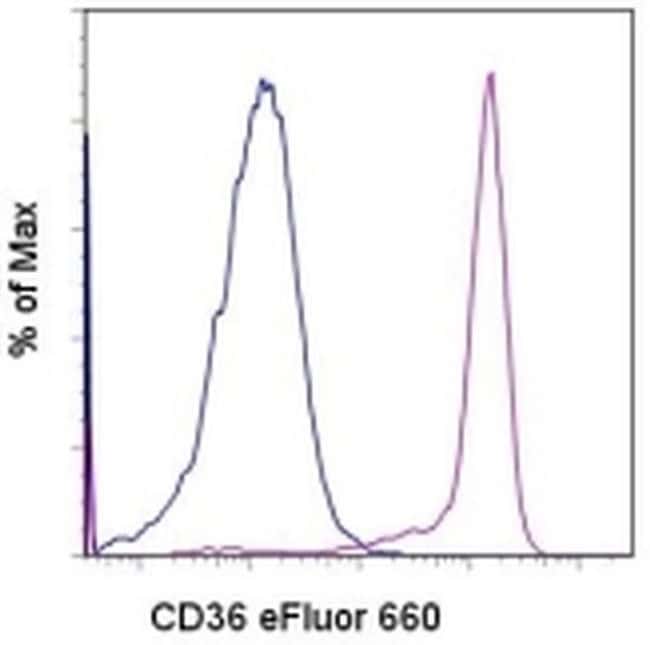
Invitrogen™ CD36 Monoclonal Antibody (eBioNL07 (NL07)), eFluor™ 660, eBioscience™, Invitrogen™


Description
Description: The monoclonal antibody eBioNL07 recognizes human CD36, which is a member of the class B scavenger receptor family. CD36 was originally identified as a platelet-membrane glycoprotein also called glycoprotein IV and a receptor for thrombospondin-1 (TSP-1) and extracellular matrix proteins. Binding to TSP-1 is in the CLESH (CD36 LIMP-II Emp sequence homology) domain of CD36. CD36 expression is broad and includes microvascular (but not large vessel) endothelium, adipocytes, skeletal muscle, dendritic cells, epithelia of the retina, breast, and intestine, smooth muscle cells, and hematopoietic cells, including erythroid precursors, platelets, monocytes/macrophages, DCs and megakaryocytes. Expression on platelets is absent on Nak-a negative donors. Unlike other scavenger receptor, CD36 binds LDL that has been exposed to minimally oxidizing conditions. CD36 is also a fatty acid translocase (FAT) necessary for the transport of long-chain fatty acids (LCFAs) and therefore may play a role in atherosclerosis. Applications Reported: This eBioNL07 (NL07) antibody has been reported for use in flow cytometric analysis. Applications Tested: This eBioNL07 (NL07) antibody has been pre-titrated and tested by flow cytometric analysis of normal human perioheral blood cells. This can be used at 5 μL (0.125 μg) per test. A test is defined as the amount (μg) of antibody that will stain a cell sample in a final volume of 100 μL.

Specifications
Specifications
| Antigen | CD36 |
| Applications | Flow Cytometry |
| Classification | Monoclonal |
| Clone | eBioNL07 (NL07) |
| Concentration | 5 μL/Test |
| Conjugate | eFluor 660 |
| Formulation | PBS with BSA and 0.09% sodium azide; pH 7.2 |
| Gene | CD36 |
| Gene Accession No. | P16671 |
| Gene Alias | adipocyte membrane protein; BDPLT10; Cd36; CD36 antigen; CD36 antigen (collagen type I receptor, thrombospondin receptor); CD36 molecule; CD36 molecule (thrombospondin receptor); CD36 protein; CHDS7; cluster determinant 36; collagen type I receptor thrombospondin receptor; collagen type I receptor, thrombospondin receptor; FAT; FAT/CD36; fatty acid translocase; fatty acid translocase/CD36; fatty acid transport protein; glycoprotein IIIb; GP3B; GP4; GPIIIB; GPIV; I79_011940; Leukocyte differentiation antigen CD36; PAS IV; PAS4; PAS-4; PAS-4 protein; PASIV; Platelet collagen receptor; Platelet glycoprotein 4; platelet glycoprotein IV; Scarb3; scavenger receptor class B, member 3; SR-B3; Thrombospondin receptor |
| Show More |
Frequently Asked Questions (FAQs)
Our options will depend on the samples you are analyzing.
If cell viability is not critical, you can store your stained samples at 4 degrees C or on ice overnight in the dark and analyze the following day.
For samples stained with eFluor organic fluorochromes, we recommend that cells be suspended in 100 uL of Flow Cytometry Staining Buffer (Cat. No. 00-4222) and 100 uL of eBioscience IC Fixation Buffer (Cat. No. 00-8222); samples can be incubated for up to 3 days at 4 degrees C in the dark. Alternatively, the 1-step Fix/Lyse Solution (Cat. No. 00-5333) can be used. This is a great option when working with whole blood but also works for other cell types.
Yes, in-house studies have demonstrated that the eFluor 660 fluorochrome is recognized by Anti-Cy5/Alexa Fluor 647 beads. Side by side studies with Alexa Fluor 647 versus eFluor 660 conjugated antibodies have demonstrated comparable results.
The eFluor Organic Dyes (eFluor 450, APC-eFluor 780, PerCP-eFluor 710, eFluor 710) are conventional fluorochromes. In contrast, the eVolve line of products are Quantum dots.
As with other fluorochromes, we recommend minimal exposure to light to maintain optimal signal.
For Research Use Only.
By clicking Submit, you acknowledge that you may be contacted by Fisher Scientific in regards to the feedback you have provided in this form. We will not share your information for any other purposes. All contact information provided shall also be maintained in accordance with our Privacy Policy.