Learn More
Invitrogen™ CD5 Monoclonal Antibody (UCHT2), FITC, eBioscience™


Description
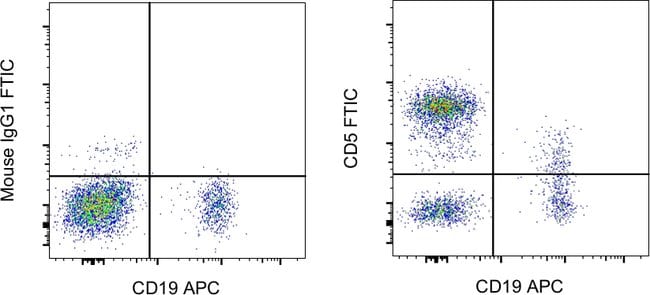
Description: The UCHT2 monoclonal antibody reacts with human CD5, a 67 kDa protein expressed by a majority of thymocytes and mature T cells and a subset of B cells. Signaling through the CD5 molecule activates T cells and binding of CD5 to its ligand on B cells, CD72, and plays an important role in T-B interaction and proliferation. The monoclonal antibody UCHT2 recognizes primate CD5. Applications Reported: The UCHT2 antibody has been reported for use in flow cytometric analysis. Applications Tested: This UCHT2 antibody has been pre-titrated and tested by flow cytometric analysis of normal human peripheral blood cells. This can be used at 5 μL (1 μg) per test. A test is defined as the amount (μg) of antibody that will stain a cell sample in a final volume of 100 μL. Cell number should be determined empirically but can range from 10^5 to 10^8 cells/test. Excitation: 488 nm; Emission: 520 nm; Laser: Blue Laser. Filtration: 0.2 μm post-manufacturing filtered.

Specifications
Specifications
| Antigen | CD5 |
| Applications | Flow Cytometry |
| Classification | Monoclonal |
| Clone | UCHT2 |
| Concentration | 5 μL/Test |
| Conjugate | FITC |
| Formulation | PBS with BSA and 0.09% sodium azide; pH 7.2 |
| Gene | Cd5 |
| Gene Accession No. | P06127 |
| Gene Alias | alanyl (membrane) aminopeptidase; alanyl aminopeptidase; alanyl aminopeptidase, membrane; aminopeptidase M; Aminopeptidase N; ANPEP; AP-M; APN; AP-N; CD antigen CD5; CD13; CD28; CD28 antigen (Tp44); CD28 molecule; Cd5; CD5 antigen; CD5 antigen (p56 62); CD5 antigen (p56-62); CD5 antigen p56-62; CD5 molecule; CD5 protein; CD74 antigen, invariant polypeptide of major; cell surface protein; costimulatory molecule B7 receptor CD28; fCD5; GP150; hAPN; LAP1; LEU1; Ly-1; Ly12; Ly-12; LyA; Ly-A; Lymphocyte antigen 1; Lymphocyte antigen CD5; lymphocyte antigen T1/Leu-1; Lyt-1; membrane alanyl aminopeptidase; microsomal aminopeptidase; Myeloid plasma membrane glycoprotein CD13; P150; Pan T cell; PEPN; T1; T-cell costimulatory molecule CD28; T-cell surface glycoprotein CD5; T-cell-specific surface glycoprotein CD28; unnamed protein product |
| Show More |
By clicking Submit, you acknowledge that you may be contacted by Fisher Scientific in regards to the feedback you have provided in this form. We will not share your information for any other purposes. All contact information provided shall also be maintained in accordance with our Privacy Policy.