Promotional price valid on web orders only. Your contract pricing may differ. Interested in signing up for a dedicated account number?
Learn More

Invitrogen™ CD83 Monoclonal Antibody (HB15e), APC, eBioscience™, Invitrogen™

Catalog No. p-7090061
Encompass_Preferred
Change view
Click to view available options
Quantity:
100 Tests
25 Tests
2 product options available for selection
Product selection table with 2 available options. Use arrow keys to navigate and Enter or Space to select.
Catalog No. Quantity
50-150-26 25 Tests
50-150-27 100 Tests
Use arrow keys to navigate between rows. Press Enter or Space to select a product option. 2 options available.
2 options
Catalog No. 50-150-26 Supplier Invitrogen™ Supplier No. 17083941
Only null left
Add to Cart
Add to Cart

Mouse Monoclonal Antibody

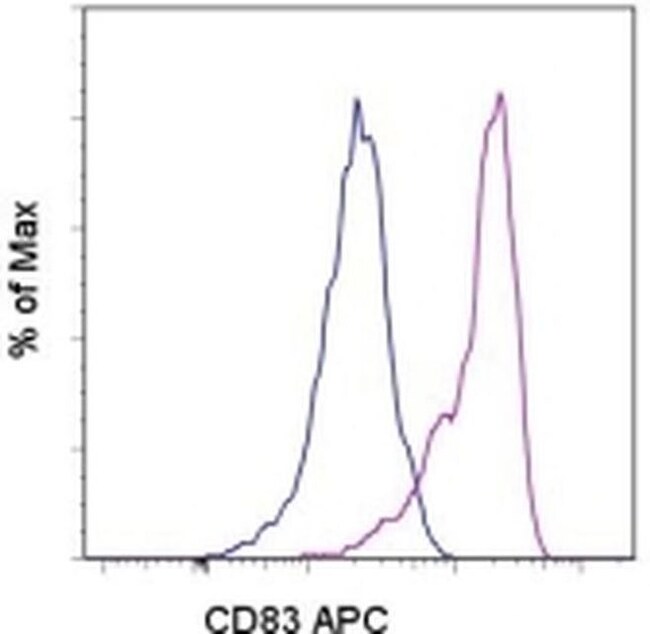
Description: The HB15e monoclonal antibody reacts with human CD83, a 45 kDa transmembrane glycoprotein. CD83, a member of the Ig superfamily, is expressed on cultured dendritic cells, interdigitating, follicular, and circulating dendritic cells as well as some proliferating lymphocytes, and human cell lines express this antigen. While the function of CD83 is unclear, it can serve as a useful marker for mature human blood dendritic cells. Applications Reported: This HB15e antibody has been reported for use in flow cytometric analysis. Applications Tested: This HB15e antibody has been pre-titrated and tested by flow cytometric analysis of human dendritic cells. This can be used at 5 μL (0.5 μg) per test. A test is defined as the amount (μg) of antibody that will stain a cell sample in a final volume of 100 μL. Cell number should be determined empirically but can range from 10^5 to 10^8 cells/test. Excitation: 633-647 nm; Emission: 660 nm; Laser: Red Laser. Filtration: 0.2 μm post-manufacturing filtered.

CD83 cell surface antigen is a 40-45kD glycoprotein expressed by peripheral blood dendritic cells. Peripheral lymphocytes can be induced to express very low levels of CD83 after culture in agents such as Con A or PHA. In immunohistology, CD83 is shown to be expressed strongly by interfollicular interdigitating reticulum cells and more weakly by cells within germinal centres. CD83 is also expressed by Langerhan's cells in the skin. The CD83 antigen is a 186-amino-acid single-chain glycoprotein and this molecule is a member of the immunoglobulin superfamily that is composed of an extracellular V-type Ig-like single domain, a transmembrane region, and a short, 40-amino-acid cytoplasmic tail. CD83 antigen undergoes extensive post-translational glycosylation, since the determined Mr is twice the predicted size of the core protein. However, CD83+ cells have a unique cell surface immuno-phenotype that does not correlate with that of T cells, B cells, NK cells, or cells of the myelomonocytic lineage. CD83+ cells coexpress the highest levels of MHC class II molecules, when compared with other leucocyte lineages. They also co-express T cell markers (CD2, CD5), B cell markers (CD40, CD78), myeloid cell markers (CD13, CD33, CD36), cytokine receptors as well as other cell surface molecules. Diseases associated with CD83 dysfunction include plague and Rift Valley Fever.
TRUSTED_SUSTAINABILITY

Specifications

Antigen CD83
Applications Flow Cytometry
Classification Monoclonal
Clone HB15e
Concentration 5 μL/Test
Conjugate APC
Formulation PBS with BSA and 0.09% sodium azide; pH 7.2
Gene CD83
Gene Accession No. Q01151
Gene Alias B-cell activation protein; BL11; CD antigen CD83; CD83; CD83 antigen; CD83 antigen (activated B lymphocytes, immunoglobulin superfamily); CD83 molecule; cell surface protein HB15; cell-surface glycoprotein; HB15; hCD83; mCD83
Gene Symbols CD83
Host Species Mouse
Purification Method Affinity chromatography
Quantity 25 Tests
Regulatory Status RUO
Primary or Secondary Primary
Gene ID (Entrez) 9308
Target Species Human
Content And Storage 4°C, store in dark, DO NOT FREEZE!
Product Type Antibody
Form Liquid
Isotype IgG1 κ
Show More Show Less
WARNING: Cancer and Reproductive Harm - www.P65Warnings.ca.gov

For Research Use Only.

Product Title
Select an issue

By clicking Submit, you acknowledge that you may be contacted by Fisher Scientific in regards to the feedback you have provided in this form. We will not share your information for any other purposes. All contact information provided shall also be maintained in accordance with our Privacy Policy.