Promotional price valid on web orders only. Your contract pricing may differ. Interested in signing up for a dedicated account number?
Learn More
Learn More
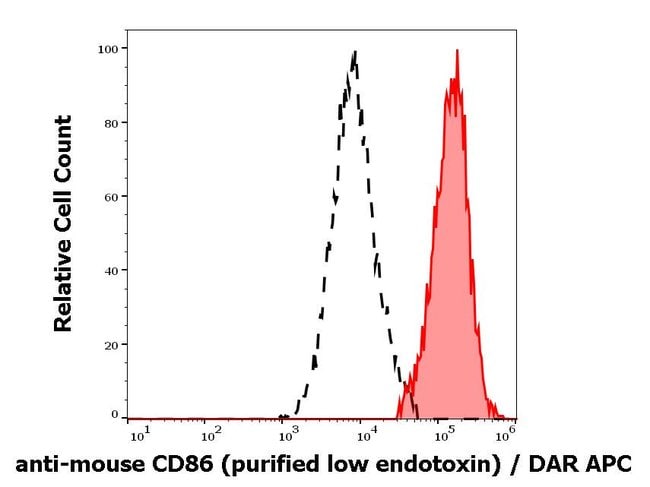
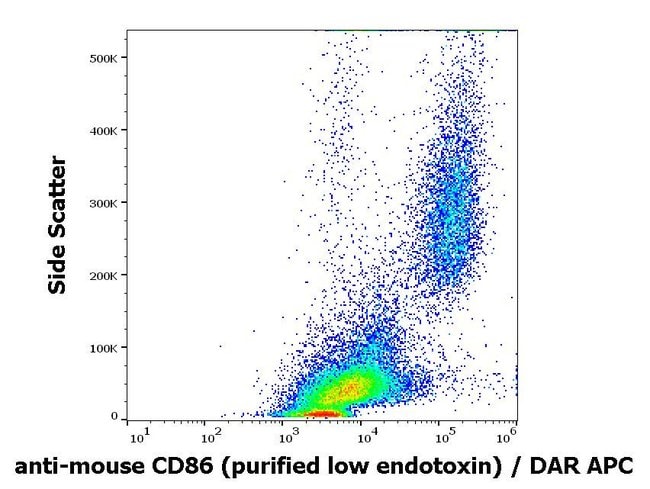


Description
This antibody reacts with an extracellular epitope of CD86 (B7-2), a 70-80 kDa type I transmembrane glycoprotein of immunoglobulin supergene family, expressed on professional antigen-presenting cells, such as dendritic cells, macrophages or activated B lymphocytes. Functional Application: Blocking.
CD86, along with CD80, is a member of the B7 family of costimulatory molecules and plays a crucial role in T cell activation and immune response regulation. CD86 is expressed at low levels on B cells, macrophages, and dendritic cells, and its expression is upregulated on B cells through various stimuli, including the BCR complex, CD40, and certain cytokine receptors. As a type I membrane protein and member of the immunoglobulin superfamily, CD86 serves as a ligand for the T cell surface proteins CD28 and CTLA-4 (CD152). The interaction between CD86 and CD28 provides a costimulatory signal essential for T cell activation during antigen presentation, while binding with CTLA-4 negatively regulates T cell activation, diminishing the immune response. This interaction is critical for T-B cell crosstalk, T cell costimulation, autoantibody production, and Th2-mediated Ig production. The kinetics of CD86 upregulation upon stimulation suggest its significant contribution during the primary phase of an immune response. CD86 and CD80 have distinct roles in T helper cell differentiation, and insufficient co-stimulation involving these molecules can induce tolerance. Alternative splicing of CD86 results in two transcript variants encoding different isoforms, with additional variants described but not fully sequenced. Dysfunction in CD86 is associated with diseases such as gallbladder squamous cell carcinoma and myocarditis.

Specifications
Specifications
| Antigen | CD86 |
| Applications | Flow Cytometry, Functional Assay, Immunohistochemistry (Frozen), Immunoprecipitation, Immunocytochemistry |
| Classification | Monoclonal |
| Clone | GL-1 |
| Concentration | 1 mg/mL |
| Conjugate | Unconjugated |
| Formulation | PBS with no preservative; pH 7.4 |
| Gene | CD86 |
| Gene Accession No. | P42082 |
| Gene Alias | activation B7-2 antigen; B lymphocyte activation antigen B72; B7; B7.2; B70; B7-2; B-lymphocyte activation antigen B7-2; BU63; CD28 antigen ligand 2; Cd28l2; CD28LG2; CD86; CD86 antigen; CD86 antigen (CD28 antigen ligand 2, B7-2 antigen); CD86 antigen precursor; CD86 molecule; CLS1; CTLA-4 counter-receptor B7.2; early T cell costimulatory molecule-1; early T-cell costimulatory molecule 1; Early T-cell co-stimulatory molecule 1; ETC-1; FUN-1; LAB72; Ly58; Ly-58; MB7; MB7-2; membrane glycoprotein; MGC34413; T-lymphocyte activation antigen CD86; TS/A-2 |
| Show More |
Product Title
By clicking Submit, you acknowledge that you may be contacted by Fisher Scientific in regards to the feedback you have provided in this form. We will not share your information for any other purposes. All contact information provided shall also be maintained in accordance with our Privacy Policy.
Spot an opportunity for improvement?