Learn More

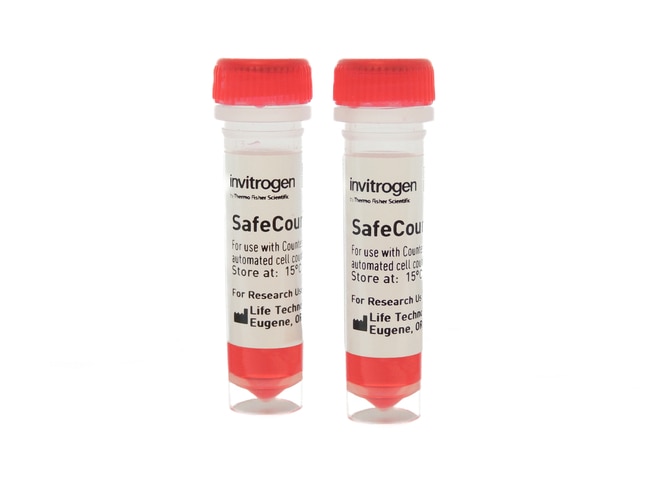
Invitrogen™ Colorimetric Cell Viability Stains


Description
SafeCount Cell Viability Stain represents a significant advancement in cell viability assessment, offering a non-toxic alternative to traditional Trypan Blue staining for cell counting applications. As a membrane integrity dye, SafeCount stain functions identically to Trypan Blue as a membrane integrity exclusion dye while minimizing the associated safety and handling concerns that have long plagued laboratory workflows.
SafeCount stain has been specifically validated for use with Countess 3 and Countess 3FL automated cell counters in conjunction with Countess chamber slides, ensuring a smooth integration into existing automated counting workflows.
Features of SafeCount Cell Viability Stain include:
- Non-carcinogenic formulation—provides a safer alternative for laboratory personnel while maintaining equivalent functionality for cell viability assessment
- Enhanced solution stability—does not precipitate during storage or use, unlike Trypan Blue which is prone to precipitation formation
- Equivalent staining mechanism—maintains the same exclusion dye principle for distinguishing viable from non-viable cells based on membrane integrity
Non-toxic safety profile minimizes hazardous material handling concerns
SafeCount Cell Viability Stain represents a significant advancement in cell viability assessment by addressing the inherent safety limitations of traditional Trypan Blue staining. Unlike Trypan Blue, which is known to be toxic to both people and cells and requires hazard label warnings, SafeCount stain is formulated to be non-toxic and carries no hazard label warnings. This fundamental difference in toxicity profile allows for simpler disposal procedures and, more importantly, provides non-toxic conditions for laboratory personnel. Minimizing hazardous material handling requirements reduces regulatory compliance burdens and enhances overall laboratory safety protocols.
Enhanced stability prevents precipitation-related counting errors
The formulation of SafeCount stain addresses a critical limitation observed with Trypan Blue, which is prone to precipitation over time or under certain storage conditions. These precipitates can form aggregates that may be erroneously counted as cells during analysis, leading to inaccurate measurements of both cell count and viability assessments. SafeCount stain's superior stability characteristics reduce this source of measurement error, ensuring more reliable and reproducible results throughout the product's shelf life.
Membrane integrity-based detection mechanism enables protocol integration
SafeCount stain functions as a membrane integrity dye that operates on the exclusion principle, making it compatible with existing cell counting workflows. The dye is specifically designed to be excluded from entering healthy cells with intact membranes, allowing these viable cells to appear opaque. In contrast, cells with compromised membranes permit SafeCount dye entry, causing these non-viable cells to appear dark. This membrane integrity exclusion method is identical to Trypan Blue, enabling SafeCount stain to serve as a direct replacement without requiring protocol modifications.
Streamlined application protocol optimizes workflow efficiency
The use of SafeCount stain follows a simplified two-step protocol designed for compatibility with automated counting systems. The procedure requires mixing 10 μL of SafeCount dye with 10 μL of cell sample, followed by analysis using the Countess 3 or 3FL automated cell counter. This straightforward approach maintains the ease of use expected from cell viability assays while enabling enhanced safety and stability benefits inherent to the SafeCount formulation.

Specifications
Specifications
| Type | Trypan Blue Stain |
| For Use With (Equipment) | Countess Automated Cell Counter |
| Color | Blue |
| Detection Method | Colorimetric |
| Label or Dye | Trypan Blue |
| Content And Storage | Trypan blue stain, 0.4% solution, 2 x 1 mL vials Store at room temperature. |
| Quantity | 2 x 1 mL |
| Shipping Condition | Room Temperature |
Frequently Asked Questions (FAQs)
When counting cells that have been mixed with Trypan Blue, the Countess accounts for this 1:1 dilution and multiplies the count by 2.
When using the Countess 3 Standard Slide, the Trypan Blue correction box needs to be unchecked, since a 1:1 dilution was not made with Trypan Blue.
The Trypan Blue Stain (0.4%) can be warmed up to 37 degrees C numerous times. The entire 1 mL volume of the stain should be warmed up to ensure that you are getting the entire amount at the proper concentration of 0.4%; if you took out an aliquot to warm up, and left behind some precipitate, the aliquot that is warmed up may not contain the complete amount of dye and the final concentration may be less than 0.4%.
The shelf life of the product is 36 months from the date of production.
Unfortunately, there is no definitive answer to this question. The rate at which the cell-impermeant dye is absorbed depends on the cell type, their state of health, nourishment, engulfment activity, etc.
Exposure to light may degrade the dye and these contaminants may promote precipitation. Trypan blue can also form orange/red fibrous aggregates if exposed to refrigeration or freezing temperatures.
For Research Use Only.
By clicking Submit, you acknowledge that you may be contacted by Fisher Scientific in regards to the feedback you have provided in this form. We will not share your information for any other purposes. All contact information provided shall also be maintained in accordance with our Privacy Policy.