Promotional price valid on web orders only. Your contract pricing may differ. Interested in signing up for a dedicated account number?
Learn More
Learn More
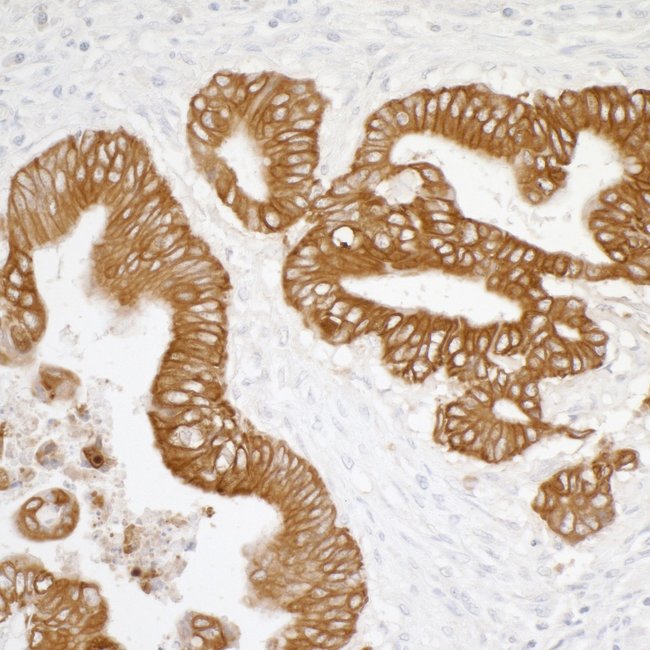
Cytokeratin Mouse anti-Human, Clone: AE1/AE3, Bethyl Laboratories

Description
The recommended shelf life for this product is 1 year from date of receipt. Application Note: For IHC, epitope retrieval with citrate buffer pH 6.0 is recommended for FFPE tissue sections.
Cytokeratin pan is part of a subfamily of intermediate filament proteins that are characterized by remarkable biochemical diversity, and represented in human epithelial tissues by at least 20 different polypeptides. Cytokeratins range in molecular weight between 40 kDa- 68 kDa, and an isoelectric pH between 4.9-7.8. The individual human cytokeratins are numbered 1 to 20. The various epithelia in the human body usually express cytokeratins which are not only characteristic of the type of epithelium, but also related to the degree of maturation or differentiation within an epithelium. Cytokeratin subtype expression patterns are used to an increasing extent in the distinction of different types of epithelial maligcies. The cytokeratin antibodies are not only of assistance in the differential diagnosis of tumors using immunohistochemistry on tissue sections, but are also a useful tool in cytopathology and flow cytometric assays. The composition of cytokeratin pairs vary with the epithelial cell type, stage of differentiation, cellular growth environment, and disease state. Many studies have shown the usefulness of keratins as markers in cancer research and tumor diagnosis.
Specifications
Specifications
| Antigen | Cytokeratin |
| Applications | Immunohistochemistry |
| Classification | Monoclonal |
| Clone | AE1/AE3 |
| Conjugate | Unconjugated |
| Formulation | PBS with 0.09% sodium azide |
| Gene | KRT10 |
| Gene Accession No. | P02538, P13647, P12035, P05783, P19013, P35908, P05787, P08727, P08729, P19012, P02533, P04264, P08779, P13645, P13646 |
| Gene Alias | pankeratin |
| Gene Symbols | KRT1, KRT10, KRT13, KRT14, KRT15, KRT16, KRT18, KRT19, KRT2, KRT3, KRT4, KRT5, KRT6A, KRT7, KRT8 |
| Show More |
Product Title
By clicking Submit, you acknowledge that you may be contacted by Fisher Scientific in regards to the feedback you have provided in this form. We will not share your information for any other purposes. All contact information provided shall also be maintained in accordance with our Privacy Policy.
Spot an opportunity for improvement?