Promotional price valid on web orders only. Your contract pricing may differ. Interested in signing up for a dedicated account number?
Learn More

Invitrogen™ Endostatin Polyclonal Antibody
GREENER_CHOICE

Catalog No. PA1601
Change view
Click to view available options
Quantity:
100 μg
1 product options available for selection
Product selection table with 1 available options. Use arrow keys to navigate and Enter or Space to select.
Catalog No. Quantity
PA1601 100 μg
Use arrow keys to navigate between rows. Press Enter or Space to select a product option. 1 options available.
1 options
Catalog No. PA1601 Supplier Invitrogen™ Supplier No. PA1601
Only null left
Add to Cart
Add to Cart

Rabbit Polyclonal Antibody

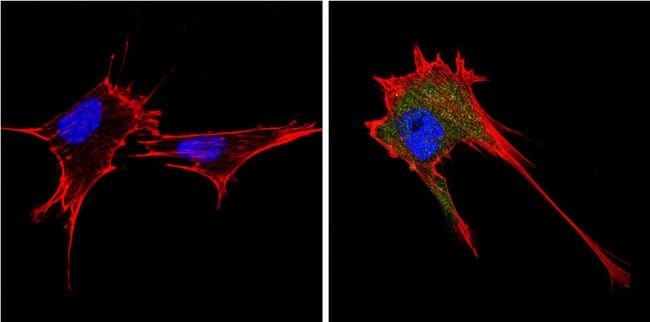
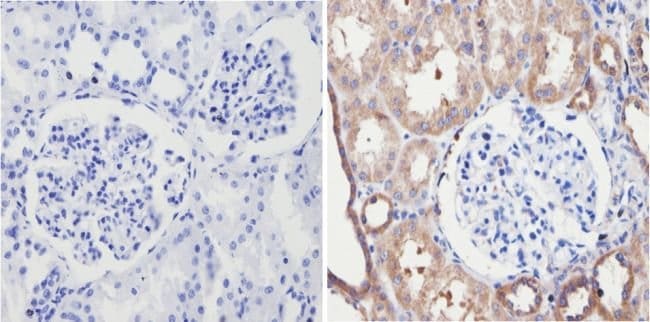
PA1-601 detects recombinant human and mouse endostatin. PA1-601 has been successfully used in Western blot, IF/ICC and IHC (P) procedures. By Western blot, this antibody detects a 20 kDa protein representing recombinant human endostatin. PA1-601 immunizing peptides are two peptides derived from mouse and human endostatin protein corresponding to amino acid residues 129-142 of endostatin. PA1-601 can be used with blocking peptide PEP-112.

Endostatin is able to avoke non-uniform response for proliferation, cell mount and migration of entothelial cells, which different endostatin binding characteristic, leads to the assumption that endostatin effect is strongly dependent from endothelial cell type. Furthermore endostatin inhibits angiogenesis and tumor growth in vivo by inducing apoptosis in endothelial cells. The local delivery of endostatin seems to specifically affect tumor-associated microvessels by reduction of the vessel density, diameter and functionality. Tumor cell migration and invasion was greatly reduced in the endostatin treated animals. Endostatin is non-toxic and does not induce aquired drug resistance and has therefor become a potent new therapy strategy in solid neoplasias. This therapy appears to have a high potential not only for the treatment of gliomas, the most common brain tumors, but also in other tumors. The ability of endostatin to inhibit neoangiogenesis is mediated, at least in part, by Zn^+2 binding and elastase processing. Widespread endostatin expression was found in elactic fibers in vessel walls and in some other basement membrane zones. Endostatin is released by neurons to accumulate in amyloid plaques in Alzheimer's disease.
TRUSTED_SUSTAINABILITY

Specifications

Antigen Endostatin
Applications Immunohistochemistry (Paraffin), Western Blot, Immunocytochemistry
Classification Polyclonal
Concentration 1 mg/mL
Conjugate Unconjugated
Formulation PBS with 1mg/mL BSA and 0.05% sodium azide
Gene COL18A1
Gene Accession No. P39060, P39061
Gene Alias antiangiogenic agent; Col18a1; Collagen alpha-1(XVIII) chain; collagen type XVIII alpha 1 chain; collagen, type XVIII, alpha 1; endostatin; FLJ27325; FLJ34914; KNO; KNO1; KS; MGC74745; multi-functional protein MFP; NC1; Non-collagenous domain 1; procollagen, type XVIII, alpha 1
Gene Symbols COL18A1
Host Species Rabbit
Immunogen Synthetic peptides corresponding to residues R(1718) R L M E S Y C E T W R T E(1731) of Mouse Endostatin and R(1699) R L T E S Y C E T W R T E(1712) of Human Endostatin.
Purification Method Antigen affinity chromatography
Quantity 100 μg
Regulatory Status RUO
Primary or Secondary Primary
Gene ID (Entrez) 12822, 80781
Target Species Human, Mouse
Content And Storage -20°C, Avoid Freeze/Thaw Cycles
Product Type Antibody
Form Liquid
Isotype IgG
Show More Show Less
Product Title
Select an issue

By clicking Submit, you acknowledge that you may be contacted by Fisher Scientific in regards to the feedback you have provided in this form. We will not share your information for any other purposes. All contact information provided shall also be maintained in accordance with our Privacy Policy.