Learn More
Invitrogen™ FceR1 alpha Monoclonal Antibody (CRA1 (AER37))

Description
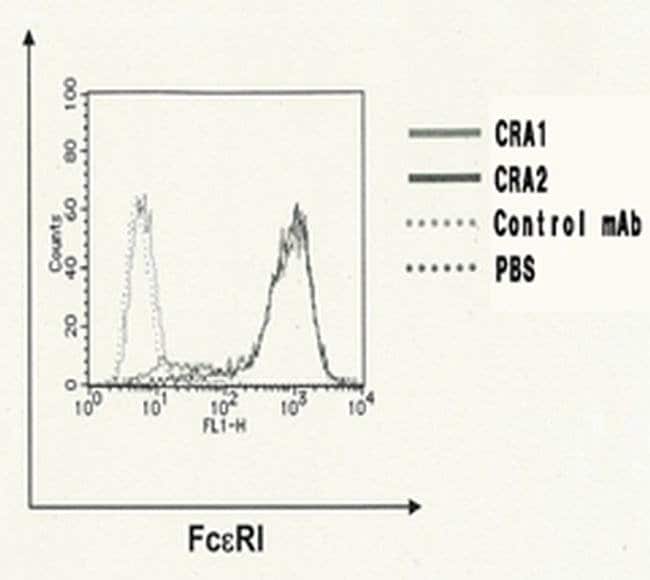
MA1-4997 detects Fc epsilonR1 alpha from human samples. The CRA1 (AER37) monoclonal antibody reacts with the Fc epsilonR1 alpha subunit on a region that does not overlap the region of the IgE binding site, thus it does not compete with IgE for the receptor bindings. MA1-4997 has been successfully used in Western blot, immunocytochemistry, flow cytometry, and immunohistochemistry (paraffin, frozen) applications. The MA1-4997 immunogen is region of Fc epsilonR1 alpha which does not overlap with the IgE binding site. The epitope has been mapped to amino acids 26-110.

Specifications
Specifications
| Antigen | FceR1 alpha |
| Applications | Flow Cytometry, Immunohistochemistry (Frozen), Immunohistochemistry (Paraffin), Immunoprecipitation, Western Blot |
| Classification | Monoclonal |
| Clone | CRA1 (AER37) |
| Concentration | 1 mg/mL |
| Conjugate | Unconjugated |
| Formulation | PBS with 50% glycerol and no preservative; pH 7.4 |
| Gene | FCER1A |
| Gene Accession No. | P12319 |
| Gene Alias | alpha polypeptide; fc epsilon r1; Fc epsilon receptor Ia; Fc epsilon RI alpha-chain; Fc fragment of IgE receptor Ia; Fc fragment of IgE, high affinity I, receptor for; alpha polypeptide; Fc IgE receptor, alpha polypeptide; Fc receptor, IgE, high affinity I, alpha polypeptide; Fce1a; Fc-epsilon RI-alpha; fcepsilonri; FCER1A; FcERI; Fcr-5; high affinity immunoglobulin epsilon receptor alpha-subunit; high affinity immunoglobulin epsilon receptor subunit alpha; IgE Fc receptor subunit alpha; Iger01; immunoglobulin E receptor, high-affinity, of mast cells, alpha polypeptide; RATIGER01; RP11-550P17.3 |
| Show More |
Safety and Handling
By clicking Submit, you acknowledge that you may be contacted by Fisher Scientific in regards to the feedback you have provided in this form. We will not share your information for any other purposes. All contact information provided shall also be maintained in accordance with our Privacy Policy.