Promotional price valid on web orders only. Your contract pricing may differ. Interested in signing up for a dedicated account number?
Learn More

Invitrogen™ Glucagon Recombinant Superclonal™ Antibody (3HCLC)

Catalog No. PI710316
Change view
Click to view available options
Quantity:
100 μg
1 product options available for selection
Product selection table with 1 available options. Use arrow keys to navigate and Enter or Space to select.
Catalog No. Quantity
PI710316 100 μg
Use arrow keys to navigate between rows. Press Enter or Space to select a product option. 1 options available.
1 options
Catalog No. PI710316 Supplier Invitrogen™ Supplier No. 710316
Only null left
Add to Cart
Edge
Add to Cart

Rabbit Recombinant Superclonal Antibody

This antibody is predicted to react with mouse, rat, rabbit and porcine based on sequence homology. Recombinant rabbit Superclonal™ antibodies are unique offerings from Thermo Fisher Scientific. They are comprised of a selection of multiple different recombinant monoclonal antibodies, providing the best of both worlds - the sensitivity of polyclonal antibodies with the specificity of monoclonal antibodies - all delivered with the consistency only found in a recombinant antibody. While functionally the same as a polyclonal antibody - recognizing multiple epitope sites on the target and producing higher detection sensitivity for low abundance targets - a recombinant rabbit Superclonal™ antibody has a known mixture of light and heavy chains. The exact population can be produced in every lot, circumventing the biological variability typically associated with polyclonal antibody production. Note: Formerly called Recombinant polyclonal antibody, this product is now rebranded as Recombinant Superclonal™ antibody. The physical product and the performance remain unchanged.

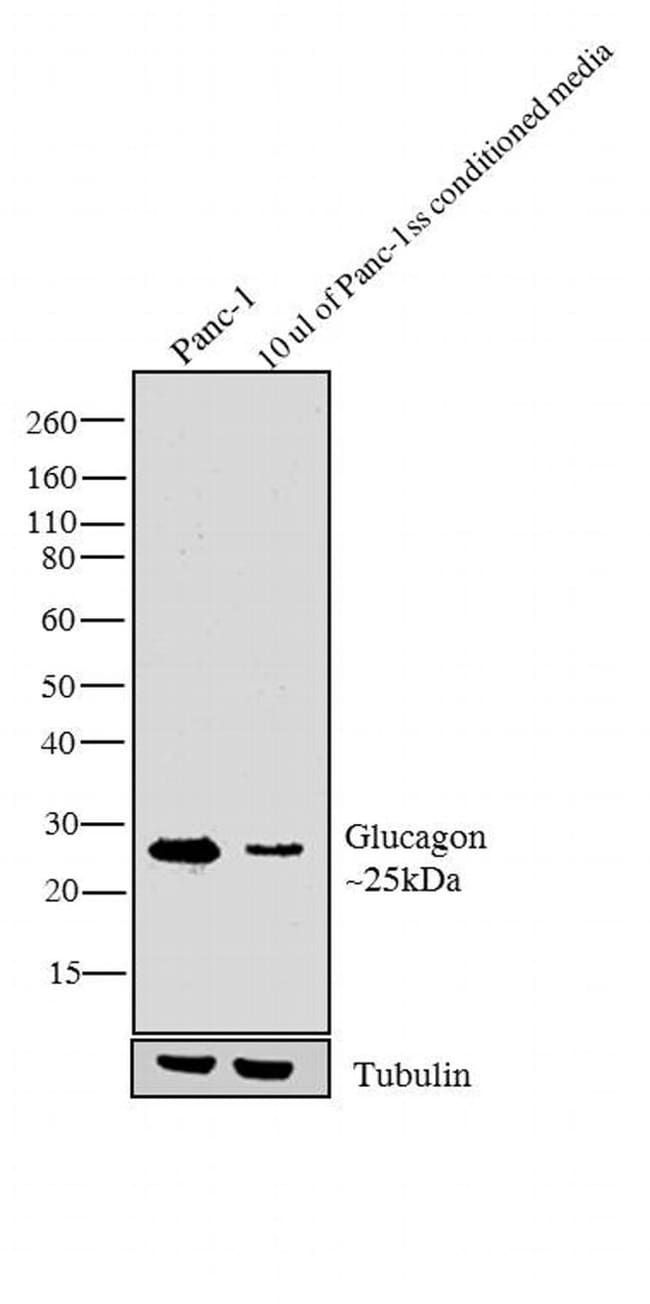
Glucagon is a 29-residue polypeptide hormone (MW 3482), produced in the pancreas. A related hormone, enteroglucagon (or oxyntomodulin), which is produced in the mucosa of the small and large intestine, consists of the 29 amino acid sequence of pancreatic glucagon extended by 8 additional residues at the C-terminus. The biological activities of pancreatic glucagon include glycogenolysis, lipolysis, gluconeogenesis, and ketogensis, which are antagonistic effects to those of insulin action, thus leading to increased blood glucose levels. Immunocytochemical studies have revealed the presence of pancreatic glucagon inside the A or alpha cells, which constitute 15-20% of the islet cell population. These cells are located preferentially at the periphery of the human pancreatic islets. Pathological manifestations of the glucagon-type peptide residue almost exclusively with the exsistence of tumors or glucagonomas, as no states of glucagon-cell deficiency or hyperplasia have been identified. Glucagon-specific antibodies would prove useful as a cell and tumor markers applying immunohistochemical techniques, and as an analytical tool in qualification of the hormone.
TRUSTED_SUSTAINABILITY

Specifications

Antigen Glucagon
Applications Western Blot
Classification Recombinant Superclonal
Clone 3HCLC
Concentration 0.5 mg/mL
Conjugate Unconjugated
Formulation PBS with 0.09% sodium azide
Gene Gcg
Gene Accession No. P01275
Gene Alias GCG; Glicentin; Glicentin-related polypeptide; GLP1; GLP-1; GLP-1(7-36); GLP-1(7-37); GLP1/2; GLP2; GLP-2; Glu; glucagon; Glucagon-like peptide 1; Glucagon-like peptide 1(7-36); Glucagon-like peptide 1(7-37); Glucagon-like peptide 2; glucagon-like peptide-1; GRPP; IL12p35; IL12P40; Incretin hormone; OXM; OXY; Oxyntomodulin; porcine proglucagon; PPG; preproglucagon; proglucagon
Gene Symbols Gcg
Host Species Rabbit
Immunogen Peptide corresponding to amino acids 53-81 of human Glucagon.
Purification Method Protein A
Quantity 100 μg
Regulatory Status RUO
Primary or Secondary Primary
Gene ID (Entrez) 2641
Target Species Human, Monkey
Content And Storage Store at 4°C short term. For long term storage, store at -20°C, avoiding freeze/thaw cycles.
Product Type Antibody
Form Liquid
Isotype IgG
Show More Show Less
Product Title
Select an issue

By clicking Submit, you acknowledge that you may be contacted by Fisher Scientific in regards to the feedback you have provided in this form. We will not share your information for any other purposes. All contact information provided shall also be maintained in accordance with our Privacy Policy.