Learn More
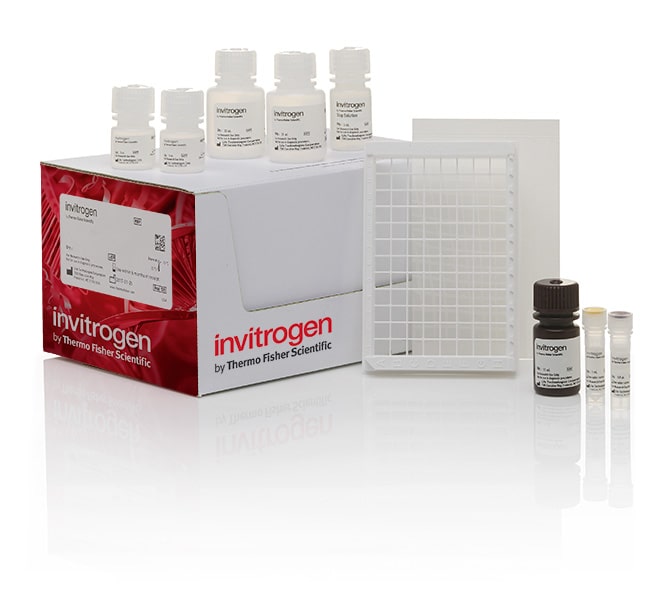
Invitrogen™ Glucose Colorimetric Detection Kit


Description
Includes
96-well plates, standard, other assay specific reagents, buffers and lot-specific technical data sheet.
The Glucose Detection research-use-only kit is a colorimetric assay designed for the quantification and detection of glucose in serum, plasma, urine, buffers and tissue culture media.
This complete, ready-to-use kit includes clear 96-well plate(s), glucose standard, assay buffer, and other components to perform the assay. A 96-well microplate reader capable of reading optical density at 560 nm is required for use of this kit.
Performance characteristics
• Assay type: colorimetric detection kit
• Sample types: serum, plasma, urine, buffers, and tissue culture media
• Sensitivity: 0.413 mg/dL
• Standard curve range: 0.5–32 mg/dL
• Reactivity: species independent
Background
Glucose is by far the most common carbohydrate. It is a monosaccharide, an aldose, a hexose, and a reducing sugar and is also known as dextrose, because it is dextrorotatory (rotates polarized light clockwise). The structure of glucose is shown below as both the straight chain and cyclic forms. For all biological and molecular events and for multiple cellular functions, energy is essential.
Energy is available in the form of ATP (adenosine triphosphate), most of which is generated through aerobic cellular respiration of carbohydrate and glucose, the major source of biological free energy in higher organisms. Reduced energy levels threaten cellular homeostasis and integrity. Impaired energy metabolism may trigger pro-apoptotic signaling (programmed cell death), oxidative damage, excitotoxicity, and impede mitochondrial DNA repair.
Assay principle
The Glucose Colorimetric Detection Kit is designed to quantitatively measure glucose in a variety of samples. A beta-D-glucose standard is provided to generate a standard curve for the assay and all samples should be read off the standard curve. Samples are mixed with the colorimetric substrate and horseradish peroxidase and the reaction initiated by addition of glucose oxidase. The reaction is incubated at room temperature for 30 minutes. The glucose oxidase reacts with glucose to produce hydrogen peroxide which, in the presence of HRP, reacts with the colorimetric substrate to convert the colorless substrate into a pink-colored product. The pink product is read at 560 nm. Increasing levels of glucose cause a linear increase in color.

Specifications
Specifications
| Content And Storage | 96-well plate(s), standard, other assay specific reagents, buffers, and lot-specific technical data sheet. Store at –20°C. |
| Detection Method | Colorimetric |
| Immunoassay Kit Format | Colorimetric Detection Kit |
| Product Type | Glucose Colorimetric Detection Kit |
| Sample Type | Other Biological Fluids, Plasma, Serum |
| For Use With (Equipment) | Microplate Reader |
| Gene ID (Entrez) | Non-Gene |
| Gene Symbol | Non-Gene |
| Quantity | 2 x 96 Tests |
| Shipping Condition | Approved for shipment on Wet or Dry Ice |
| Show More |
Frequently Asked Questions (FAQs)
The Glucose Colorimetric Detection Kit (Cat. No. EIAGLUC) is designed to measure glucose in various sample types, including serum, plasma, urine, buffered solutions, and tissue culture medium. While the assay was characterized with human samples, the kit is described as species-independent, meaning it should be suitable for use with samples from other species including mouse samples.
However, it is always recommended to validate the assay with your specific sample type to help ensure accurate and reliable results.
For Research Use Only. Not for use in diagnostic procedures.
By clicking Submit, you acknowledge that you may be contacted by Fisher Scientific in regards to the feedback you have provided in this form. We will not share your information for any other purposes. All contact information provided shall also be maintained in accordance with our Privacy Policy.