Promotional price valid on web orders only. Your contract pricing may differ. Interested in signing up for a dedicated account number?
Learn More
Learn More
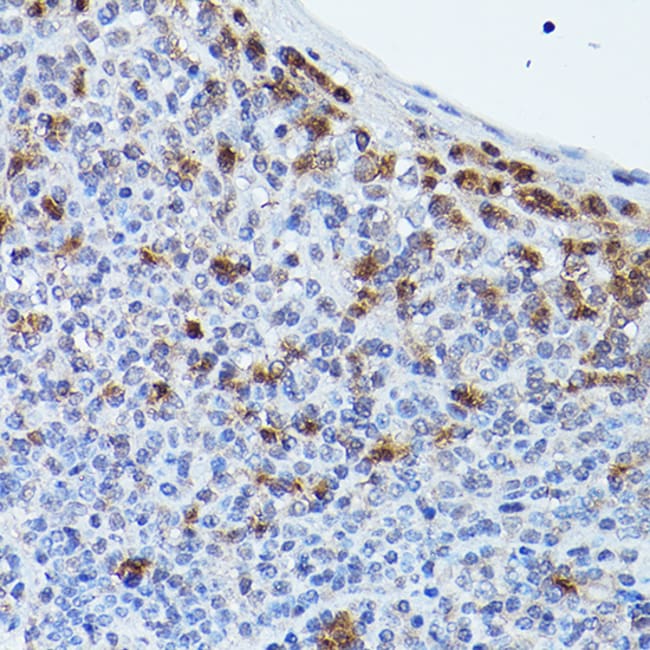
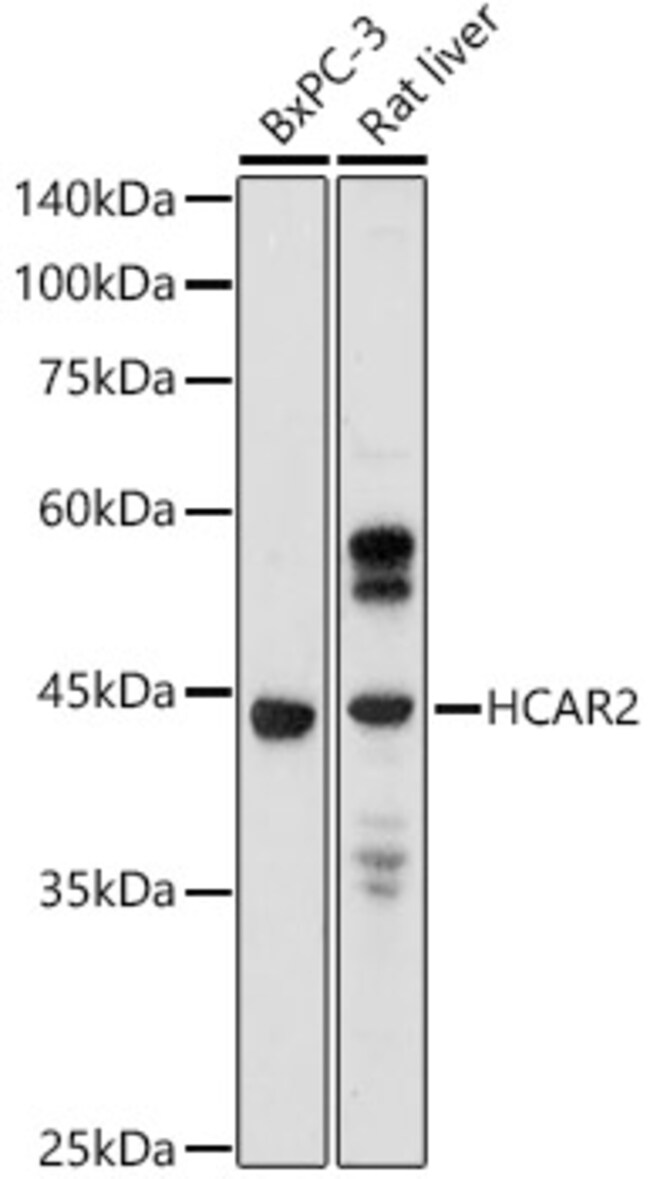
Invitrogen™ GPR109 Polyclonal Antibody

Description
Positive Samples: HepG2, Rat heart.
GPR109A (also known as HCA2, HM74a, and NIACR1) is a 42kDa G-protein coupled receptor that belongs to a family of three hydroxyl-carboxylic acid receptors, which also include GPR109B and GPR81. GPR109A has two known ligands: niacin and butyrate (or its derivative 3-hydroxybutyrate). The endogenous ligands for GPR109B and GPR81 are 3-hydroxyl-octanoic acid and 2-hydroxy-propanoate (lactate), respectively. GPR109A is expressed on adipocytes, neutrophils, Langerhans cells, keratinocytes, intestinal epithelial cells, and intestinal colonic macrophages. Niacin, also known as nicotinic acid or vitamin B3, is known to improve cholesterol metabolism (LDL/HDL ratio) and reduce inflammation. It has been demonstrated that this effect is mediated through GPR109A. Notably, GPR109A also has an essential role in suppressing inflammation and cancer in the colon. Both GPR109A ligands are produced by colonic commensal bacteria. In mice, GPR109A expression on intestinal epithelial cells and DCs/macrophages contributes to the suppression of colitis and colon cancer. In humans, GPR109A is silenced in colon carcinoma cells by DNA methylation, which increases inflammation in the intestinal tract.

Specifications
Specifications
| Antigen | GPR109 |
| Applications | ELISA, Immunohistochemistry (Paraffin), Western Blot, Immunocytochemistry |
| Classification | Polyclonal |
| Concentration | 1.05 mg/mL |
| Conjugate | Unconjugated |
| Formulation | PBS with 50% glycerol and 0.09% sodium azide; pH 7.3 |
| Gene | HCAR2 |
| Gene Accession No. | Q80Z39, Q8TDS4, Q9EP66 |
| Gene Alias | G protein-coupled receptor 109A; G protein-coupled receptor 109B; G protein-coupled receptor HM74a; Gpr109; Gpr109a; Gpr109b; G-protein coupled receptor 109; G-protein coupled receptor 109A; G-protein coupled receptor HM74; G-protein coupled receptor HM74A; HCA2; Hcar2; HM74; HM74a; HM74b; hydroxycarboxylic acid receptor 2; hydroxy-carboxylic acid receptor 2; interferon-gamma inducible gene, Puma-g; mHM74b; Niacin receptor 1; Niacr1; Nicotinic acid receptor; Protein PUMA-G; PUMAG; PUMA-G; PUMA-G. GPR109; putative seven transmembrane spanning receptor |
| Gene Symbols | HCAR2 |
| Show More |
Safety and Handling
WARNING: Cancer - www.P65Warnings.ca.gov
Product Title
By clicking Submit, you acknowledge that you may be contacted by Fisher Scientific in regards to the feedback you have provided in this form. We will not share your information for any other purposes. All contact information provided shall also be maintained in accordance with our Privacy Policy.
Spot an opportunity for improvement?