Promotional price valid on web orders only. Your contract pricing may differ. Interested in signing up for a dedicated account number?
Learn More

Invitrogen™ HAS1 Polyclonal Antibody
GREENER_CHOICE

Catalog No. PIPA587911
Change view
Click to view available options
Quantity:
100 μL
1 product options available for selection
Product selection table with 1 available options. Use arrow keys to navigate and Enter or Space to select.
Catalog No. Quantity
PIPA587911 100 μL
Use arrow keys to navigate between rows. Press Enter or Space to select a product option. 1 options available.
1 options
Catalog No. PIPA587911 Supplier Invitrogen™ Supplier No. PA587911
Only null left
Add to Cart
Add to Cart

Rabbit Polyclonal Antibody

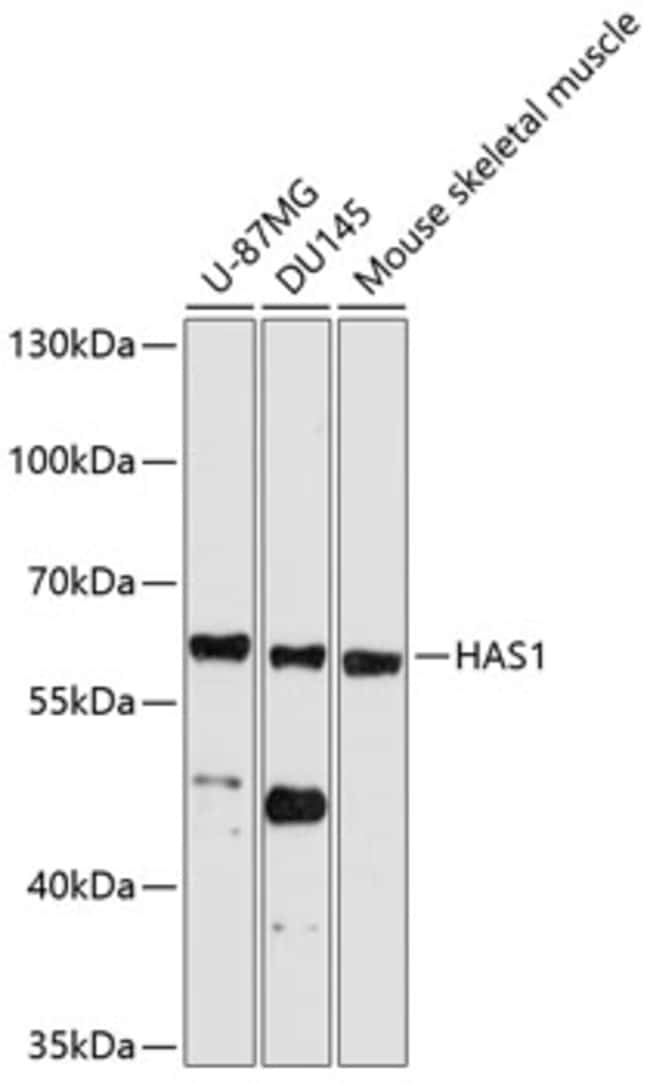
Immunogen sequence: RVAAAARGPL DAATARSVAL TISAYQEDPA YLRQCLASAR ALLYPRARLR VLMVVDGNRA EDLYMVDMFR EVFADEDPAT YVWDGNYHQP WEPAAAGAVG AGAYREVEAE DPGRLAVEAL VRTRRCVCVA QRWGGKREVM YTAFKALGDS VDYVQVCDSD TRLDPMALLE LVRVLDEDPR VGAVGGDVRI LNPLDSWVSF LSSLRYWVAF NVERACQSYF HCVSCISGPL GLYRNNLLQQ FLEAWYNQKF LGTHCTFGDD RHLTNRMLSM GYATKYTSRS RCYSETPSSF LRWLSQQTRW SKSYFREWLY N; Positive Samples: U-87MG, DU145, Mouse skeletal muscle; Cellular Location: Membrane, Multi-pass membrane protein.

Hyaluronic acid is a high molecular weight unbranched polysaccharide synthesized by a wide variety of organisms from bacteria to mammals, and is a constituent of the extracellular matrix. It consists of alternating glucuronic acid and N-acetylglucosamine residues that are linked by beta-1-3 and beta-1-4 glycosidic bonds. HA is synthesized by membrane-bound synthase at the inner surface of the plasma membrane, and the chains are extruded through pore-like structures into the extracellular space. It serves a variety of functions, including space filling, lubrication of joints, and provision of a matrix through which cells can migrate. HA is actively produced during wound healing and tissue repair to provide a framework for ingrowth of blood vessels and fibroblasts. Changes in the serum concentration of HA are associated with inflammatory and degenerative arthropathies such as rheumatoid arthritis. In addition, the interaction of HA with the leukocyte receptor CD44 is important in tissue-specific homing by leukocytes, and overexpression of HA receptors has been correlated with tumor metastasis. HAS1 is a member of the newly identified vertebrate gene family encoding putative hyaluronan synthases, and its amino acid sequence shows significant homology to the hasA gene product of Streptococcus pyogenes.
TRUSTED_SUSTAINABILITY

Specifications

Antigen HAS1
Applications ELISA, Western Blot
Classification Polyclonal
Concentration 0.33 mg/mL
Conjugate Unconjugated
Formulation PBS with 50% glycerol and 0.02% sodium azide; pH 7.3
Gene Has1
Gene Accession No. Q61647, Q92839
Gene Alias HA synthase 1; HAS; Has1; huHAS1; Hyaluronan synthase 1; hyaluronan synthase1; hyaluronate synthase 1; Hyaluronic acid synthase 1
Gene Symbols Has1
Host Species Rabbit
Immunogen Recombinant fusion protein containing a sequence corresponding to amino acids 80-390 of human HAS1 (NP_0015142).
Purification Method Affinity Chromatography
Quantity 100 μL
Regulatory Status RUO
Primary or Secondary Primary
Gene ID (Entrez) 15116, 3036
Target Species Human, Mouse
Content And Storage -20°C, Avoid Freeze/Thaw Cycles
Product Type Antibody
Form Liquid
Isotype IgG
Show More Show Less
Product Title
Select an issue

By clicking Submit, you acknowledge that you may be contacted by Fisher Scientific in regards to the feedback you have provided in this form. We will not share your information for any other purposes. All contact information provided shall also be maintained in accordance with our Privacy Policy.