Promotional price valid on web orders only. Your contract pricing may differ. Interested in signing up for a dedicated account number?
Learn More

Invitrogen™ HIF-1 beta Monoclonal Antibody (2B10)
GREENER_CHOICE

Catalog No. MA1515
Change view
Click to view available options
Quantity:
100 μL
1 product options available for selection
Product selection table with 1 available options. Use arrow keys to navigate and Enter or Space to select.
Catalog No. Quantity
MA1515 100 μL
Use arrow keys to navigate between rows. Press Enter or Space to select a product option. 1 options available.
1 options
Catalog No. MA1515 Supplier Invitrogen™ Supplier No. MA1515
Only null left
Add to Cart
Add to Cart

Mouse Monoclonal Antibody

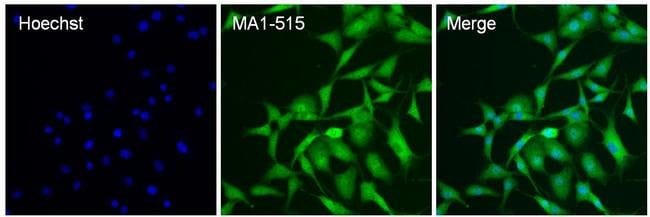
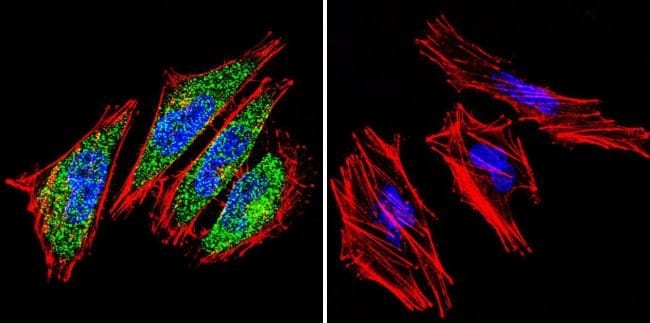
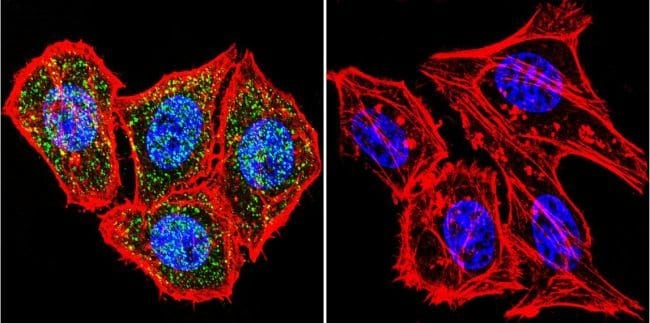
MA1-515 detects aryl hydrocarbon (Ah) receptor nuclear translocator (ARNT) from human, mouse, rat, and primate tissues. MA1-515 has been successfully used in Western blot, immunofluorescence, gel shift, immunocytochemistry, and immunoprecipitation procedures. By Western blot, this antibody detects an 87 kDa protein representing ARNT in COS cell extract. Immunofluorescence staining of ARNT in VT{2} cells (Hepa 1-C4T mutant deficient in ARNT function but stably transfected with the full length human ARNT cDNA) using MA1-515 yields non-nucleolar, nuclear staining only. MA1-515 immunogen is a synthetic peptide corresponding to residues C N(771) S Y N N E E F P D L T M F P P F S E(789) of human ARNT.

HIF-1 beta is a series of aryl hydrocarbon receptor nuclear translocator (ARNT) gene products. Hypoxia contributes significantly to the pathophysiology of major categories of human disease, including myocardial and cerebral ischemia, cancer, pulmonary hypertension, congenital heart disease and chronic obstructive pulmonary disease. Hypoxia contributes significantly to the pathophysiology of major categories of human disease, including myocardial and cerebral ischemia, cancer, pulmonary hypertension, congenital heart disease and chronic obstructive pulmonary disease. HIF-1 is a nuclear protein involved in mammalian oxygen homeostasis. This occurs as a posttranslational modification by prolyl hydroxylation. HIF-1 is a heterodimer composed of HIF-1 alpha and HIF-1 beta subunits. Both subunits are constantly translated. However, under normoxic conditions, human HIF-1 alpha is hydroxylated at Pro402 or Pro564 by a set of HIF prolyl hydroxylases, is polyubiquinated, and eventually degraded in proteosomes. Under hypoxic conditions, the lack of hydroxylation prevents HIF degradation and increases transcriptional activity. Therefore, the concentration of HIF-1 alpha increases in the cell. In contrast, HIF-1 beta remains stable under either condition. HIF-1 beta is a series of aryl hydrocarbon receptor nuclear translocator (ARNT) gene products. Diseases associated with HIF-1 beta dysfunction include hypoxia and renal cell carcinoma.HIF-1 beta is a series of aryl hydrocarbon receptor nuclear translocator (ARNT) gene products. Hypoxia contributes significantly to the pathophysiology of major categories of human disease, including myocardial and cerebral ischemia, cancer, pulmonary hypertension, congenital heart disease and chronic obstructive pulmonary disease. Hypoxia contributes significantly to the pathophysiology of major categories of human disease, including myocardial and cerebral ischemia, cancer, pulmonary hypertension, congenital heart disease and chronic obstructive pulmonary disease. HIF-1 is a nuclear protein involved in mammalian oxygen homeostasis. This occurs as a posttranslational modification by prolyl hydroxylation. HIF-1 is a heterodimer composed of HIF-1 alpha and HIF-1 beta subunits. Both subunits are constantly translated. However, under normoxic conditions, human HIF-1 alpha is hydroxylated at Pro402 or Pro564 by a set of HIF prolyl hydroxylases, is polyubiquinated, and eventually degraded in proteosomes. Under hypoxic conditions, the lack of hydroxylation prevents HIF degradation and increases transcriptional activity. Therefore, the concentration of HIF-1 alpha increases in the cell. In contrast, HIF-1 beta remains stable under either condition. HIF-1 beta is a series of aryl hydrocarbon receptor nuclear translocator (ARNT) gene products. Diseases associated with HIF-1 beta dysfunction include hypoxia and renal cell carcinoma.
TRUSTED_SUSTAINABILITY

Specifications

Antigen HIF-1 beta
Applications Gel Shift, Immunohistochemistry (Paraffin), Immunoprecipitation, Western Blot, Immunocytochemistry
Classification Monoclonal
Clone 2B10
Concentration 1 mg/mL
Conjugate Unconjugated
Formulation PBS with 1mg/mL BSA and 0.05% sodium azide
Gene ARNT
Gene Accession No. P27540, P41739, P53762
Gene Alias AHA-1; ARNT; ARNT protein; Arnt1; ARNT1a; ARNT1b; aryl hydrocarbon receptor nuclear translocater; Aryl hydrocarbon receptor nuclear translocator; Aryl hydrocarbon receptor nuclear translocator 1; aryl hydrocarbon receptor nuclear translocator type 1a; aryl hydrocarbon receptor nuclear translocator type 1b; bHLHe2; Class E basic helix-loop-helix protein 2; D3Ertd557e; dioxin receptor, nuclear translocator; Drnt; ESTM42; hif 1; HIF1 beta; HIF-1 beta; Hif1b; HIF1BETA; HIF-1beta; HIF-1-beta; HIF1-beta; hypoxia-inducible factor 1 beta; hypoxia-inducible factor 1, beta subunit; hypoxia-inducible factor 1-beta; mKIAA4051; TANGO; W08714; zgc:136664
Gene Symbols ARNT
Host Species Mouse
Immunogen Synthetic peptide corresponding to residues C N(771) S Y N N E E F P D L T M F P P F S E(789) of human ARNT.
Purification Method Purified
Quantity 100 μL
Regulatory Status RUO
Primary or Secondary Primary
Gene ID (Entrez) 11863, 25242, 405
Target Species Human, Mouse, Rat, Monkey
Content And Storage -20°C, Avoid Freeze/Thaw Cycles
Product Type Antibody
Form Liquid
Isotype IgG1
Show More Show Less
Product Title
Select an issue

By clicking Submit, you acknowledge that you may be contacted by Fisher Scientific in regards to the feedback you have provided in this form. We will not share your information for any other purposes. All contact information provided shall also be maintained in accordance with our Privacy Policy.