Promotional price valid on web orders only. Your contract pricing may differ. Interested in signing up for a dedicated account number?
Learn More

Gibco™ Human B7-2 Fc Recombinant Protein, PeproTech®

Catalog No. 31033100UG
Encompass_Preferred
Change view
Click to view available options
Quantity:
1 mg
100 μg
20 μg
250 μg
500 μg
5 product options available for selection
Product selection table with 5 available options. Use arrow keys to navigate and Enter or Space to select.
Catalog No. Quantity
31033100UG 100 μg
310-33-1MG 1 mg
310-33-20UG 20 μg
31033250UG 250 μg
31033500UG 500 μg
Use arrow keys to navigate between rows. Press Enter or Space to select a product option. 5 options available.
5 options
This item is not returnable. View return policy
Catalog No. 31033100UG Supplier Gibco™ Supplier No. 31033100UG
Add to Cart
Add to Cart
This item is not returnable. View return policy

Recombinant Protein

Recombinant Human B7-2Fc is a homodimeric B7-2 fusion protein, whose monomer contains a total of 453 amino acid residues, consisting of 222 amino acid residues corresponding to the extracellular domain of human B7-2, fused to the Fc portion of human IgG1. The calculated molecular weight of the B7-2 Fc monomer is 51.2 kDa. This product is shipped at ambient temperature. For storage, handling and reconstitution information, please see the lot-specific Certificate of Analysis

CD86 is one of two ligands (the other CD80) for CTLA4 and CD28. CD86 acts as costimulatory molecule in eliciting T-cell help during antigen presentation. Antigen presentation in the absence of sufficient co-stimulation involving CD86/CD80 can induce tolerance. CD80 appears to play a role distinct from CD80 in T helper cell differentiation. CD86 is a type I membrane protein that is a member of the immunoglobulin superfamily. The CD86 protein is expressed by antigen-presenting cells, and it is the ligand for two proteins at the cell surface of T cells, CD28 antigen and cytotoxic T-lymphocyte-associated protein 4. Binding of CD86 with CD28 antigen is a costimulatory signal for activation of the T-cell. Binding of CD86 with cytotoxic T-lymphocyte-associated protein 4 negatively regulates T-cell activation and diminishes the immune response. Alternative splicing results in two transcript variants encoding different isoforms of CD86. Additional transcript variants have been described for CD86, but their full-length sequences have not been determined. Diseases associated with CD86 dysfunction include gallbladder squamous cell carcinoma and myocarditis.
TRUSTED_SUSTAINABILITY

Specifications

Accession Number P42081
For Use With (Application) Functional Assay
Formulation protein with no preservative
Gene ID (Entrez) 942
Molecular Weight (g/mol) 51.2 kDa
Name Human B7-2 Fc
Quantity 100 μg
Source CHO cells
Regulatory Status RUO
Endotoxin Concentration <1 EU/ μg
Gene Alias activation B7-2 antigen; B lymphocyte activation antigen B72; B7; B7.2; B70; B7-2; B-lymphocyte activation antigen B7-2; BU63; CD28 antigen ligand 2; Cd28l2; CD28LG2; CD86; CD86 antigen; CD86 antigen (CD28 antigen ligand 2, B7-2 antigen); CD86 antigen precursor; CD86 molecule; CLS1; CTLA-4 counter-receptor B7.2; early T cell costimulatory molecule-1; early T-cell costimulatory molecule 1; Early T-cell co-stimulatory molecule 1; ETC-1; FUN-1; LAB72; Ly58; Ly-58; MB7; MB7-2; membrane glycoprotein; MGC34413; T-lymphocyte activation antigen CD86; TS/A-2
Common Name CD86
Gene Symbol CD86
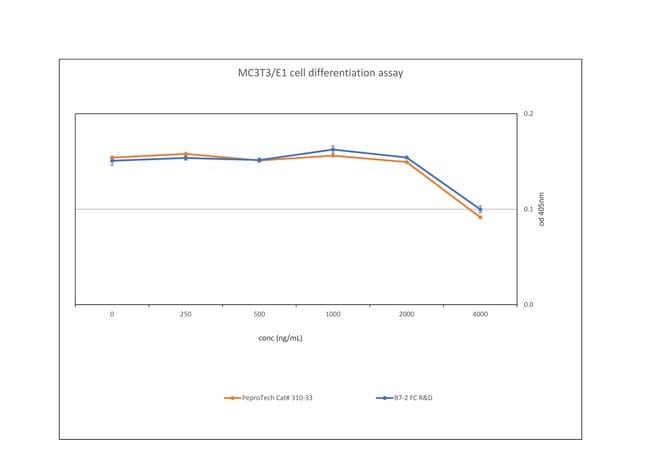
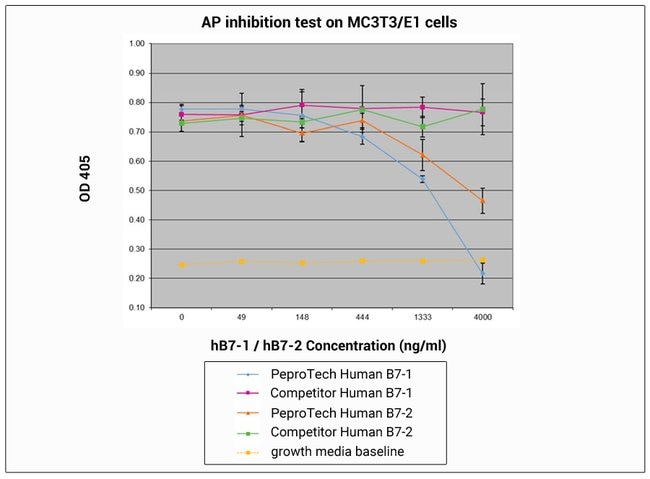
Biological Activity Determined by its ability to inhibit alkaline phosphatase activity in differentiating MC3T3/E1 cells. The expected ED50 for this effect is 0.5-1.5 ug/ml
Conjugate Unconjugated
Recombinant Recombinant
Protein Tag Fc-tag
Sequence LKIQAYFNET ADLPCQFANS QNQSLSELVV FWQDQENLVL NEVYLGKEKF DSVHSKYMGR TSFDSDSWTL RLHNLQIKDK GLYQCIIHHK KPTGMIRIHQ MNSELSVLAN FSQPEIVPIS NITENVYINL TCSSIHGYPE PKKMSVLLRT KNSTIEYDGV MQKSQDNVTE LYDVSISLSV SFPDVTSNMT IFCILETDKT RLLSSPFSIE LEDPQPPPDH GGPKSCDKTH TCPPCPAPEL LGGPSVFLFP PKPKDTLMIS RTPEVTCVVV DVSHEDPEVK FNWYVDGVEV HNAKTKPREE QYNSTYRVVS VLTVLHQDWL NGKEYKCKVS NKALPAPIEK TISKAKGQPR EPQVYTLPPS RDELTKNQVS LTCLVKGFYP SDIAVEWESN GQPENNYKTT PPVLDSDGSF FLYSKLTVDK SRWQQGNVFS CSVMHEALHN HYTQKSLSLS PGK
Content And Storage -20°C
Expression System CHO cells
Form Lyophilized
Purity or Quality Grade ≥ 95% by SDS-PAGE gel and HPLC analyses.
Show More Show Less
Product Title
Select an issue

By clicking Submit, you acknowledge that you may be contacted by Fisher Scientific in regards to the feedback you have provided in this form. We will not share your information for any other purposes. All contact information provided shall also be maintained in accordance with our Privacy Policy.