Promotional price valid on web orders only. Your contract pricing may differ. Interested in signing up for a dedicated account number?
Learn More

Gibco™ Human FGFR3 (IIIc) Fc Recombinant Protein, PeproTech®

Catalog No. 16005500UG
Encompass_Preferred
Change view
Click to view available options
Quantity:
1 mg
10 μg
100 μg
250 μg
50 μg
500 μg
6 product options available for selection
Product selection table with 6 available options. Use arrow keys to navigate and Enter or Space to select.
Catalog No. Quantity
16005500UG 500 μg
16005100UG 100 μg
160-05-10UG 10 μg
160-05-1MG 1 mg
16005250UG 250 μg
160-05-50UG 50 μg
Use arrow keys to navigate between rows. Press Enter or Space to select a product option. 6 options available.
6 options
This item is not returnable. View return policy
Catalog No. 16005500UG Supplier Gibco™ Supplier No. 16005500UG
Add to Cart
Add to Cart
This item is not returnable. View return policy

Recombinant Protein

PeproTech's CHO cell-derived Recombinant Human FGFR3 (IIIc) Fc is a glycosylated, disulfide-linked homodimer of 1,170 amino acid residues whose monomer consists of the 353-amino-acid length extracellular portion of FGFR3a (IIc) fused to the 231-amino-acid length Fc portion of human IgG1 by a single glycine. The calculated molecular weight of CHO cell-derived Recombinant Human FGFR3 (IIIc) Fc is 128.3 kDa, however, it migrates at an apparent molecular weight of approximately 100-110 kDa by SDS-PAGE analysis under reducing conditions due to glycosylation. This product is shipped at ambient temperature. For storage, handling and reconstitution information, please see the lot-specific Certificate of Analysis

FGFR3 is a member of the FGFR family of receptor tyrosine kinases. This family is known to regulate a host of cellular functions including angiogenesis, mitogenesis, osteogenesis, myogenesis, carcinogenesis, cellular differentiation, and tissue repair after injury. The FGFR family has also been implicated in a number of diseases including cancer, rheumatoid arthritis, and diabetic retinopathy. FGFR family members differ from one another in their ligand affinities and tissue distribution. A full-length representative protein would consist of an extracellular region, composed of three immunoglobulin-like domains, a single hydrophobic membrane-spanning segment and a cytoplasmic tyrosine kinase domain. The extracellular portion of the protein interacts with fibroblast growth factors, setting in motion a cascade of downstream signals, ultimately influencing mitogenesis and differentiation. This particular family member binds acidic and basic fibroblast growth hormone and plays a role in bone development and maintenance. Mutations in this gene lead to craniosynostosis and multiple types of skeletal dysplasia. Three alternatively spliced transcript variants that encode different protein isoforms have been described.
TRUSTED_SUSTAINABILITY

Specifications

Accession Number P22607
For Use With (Application) Functional Assay
Formulation protein with no preservative
Gene ID (Entrez) 2261
Molecular Weight (g/mol) 128.3 kDa
Name Human FGFR3 (IIIc) Fc
Quantity 500 μg
Source CHO cells
Regulatory Status RUO
Endotoxin Concentration <1 EU/ μg
Gene Alias ACH; CD333; CEK2; FGF Receptor; FGFR; FGFR3; FGFR-3; FGFR3deltaTM; Fibroblast growth factor receptor 3; fibroblast growth factor receptor 3 variant 4; Flg-2; FR3; HBGFR; heparin-binding growth factor receptor; HSFGFR3EX; hydroxyaryl-protein kinase; JTK4; Mfr3; sam3; tyrosine kinase JTK4
Common Name FGFR3
Gene Symbol FGFR3
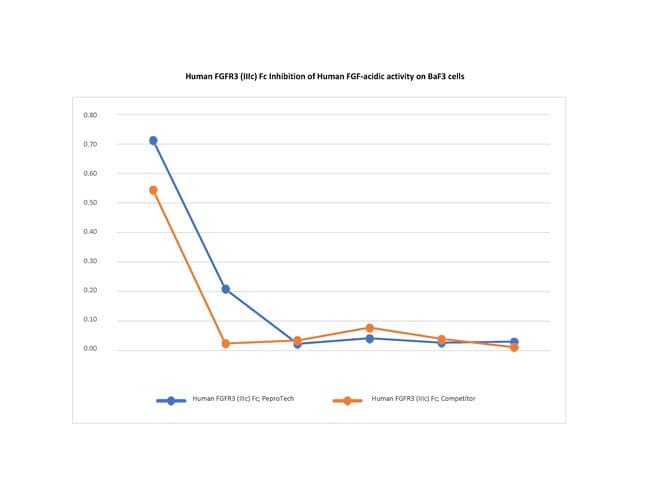
Biological Activity Determined by a cell proliferation assay using Balb/c 3T3 cells.
Conjugate Unconjugated
Recombinant Recombinant
Protein Tag Fc-tag
Sequence ESLGTEQRVV GRAAEVPGPE PGQQEQLVFG SGDAVELSCP PPGGGPMGPT VWVKDGTGLV PSERVLVGPQ RLQVLNASHE DSGAYSCRQR LTQRVLCHFS VRVTDAPSSG DDEDGEDEAE DTGVDTGAPY WTRPERMDKK LLAVPAANTV RFRCPAAGNP TPSISWLKNG REFRGEHRIG GIKLRHQQWS LVMESVVPSD RGNYTCVVEN KFGSIRQTYT LDVLERSPHR PILQAGLPAN QTAVLGSDVE FHCKVYSDAQ PHIQWLKHVE VNGSKVGPDG TPYVTVLKTA GANTTDKELE VLSLHNVTFE DAGEYTCLAG NSIGFSHHSA WLVVLPAEEE LVEADEAGSV YAGGPKSCDK THTCPPCPAP ELLGGPSVFL FPPKPKDTLM ISRTPEVTCV VVDVSHEDPE VKFNWYVDGV EVHNAKTKPR EEQYNSTYRV VSVLTVLHQD WLNGKEYKCK VSNKALPAPI EKTISKAKGQ PREPQVYTLP PSRDELTKNQ VSLTCLVKGF YPSDIAVEWE SNGQPENNYK TTPPVLDSDG SFFLYSKLTV DKSRWQQGNV FSCSVMHEAL HNHYTQKSLS LSPGK
Content And Storage -20°C
Expression System CHO cells
Form Lyophilized
Purity or Quality Grade ≥ 95% by SDS-PAGE gel and HPLC analyses.
Show More Show Less
Product Title
Select an issue

By clicking Submit, you acknowledge that you may be contacted by Fisher Scientific in regards to the feedback you have provided in this form. We will not share your information for any other purposes. All contact information provided shall also be maintained in accordance with our Privacy Policy.