Learn More
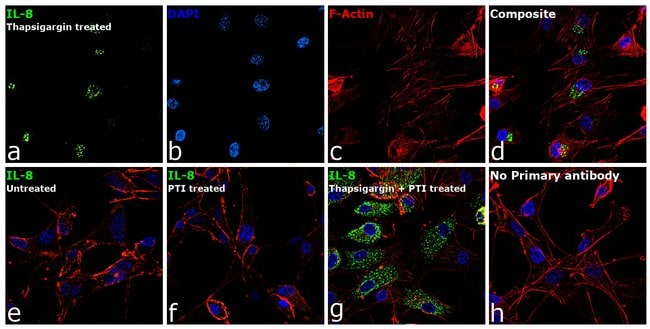
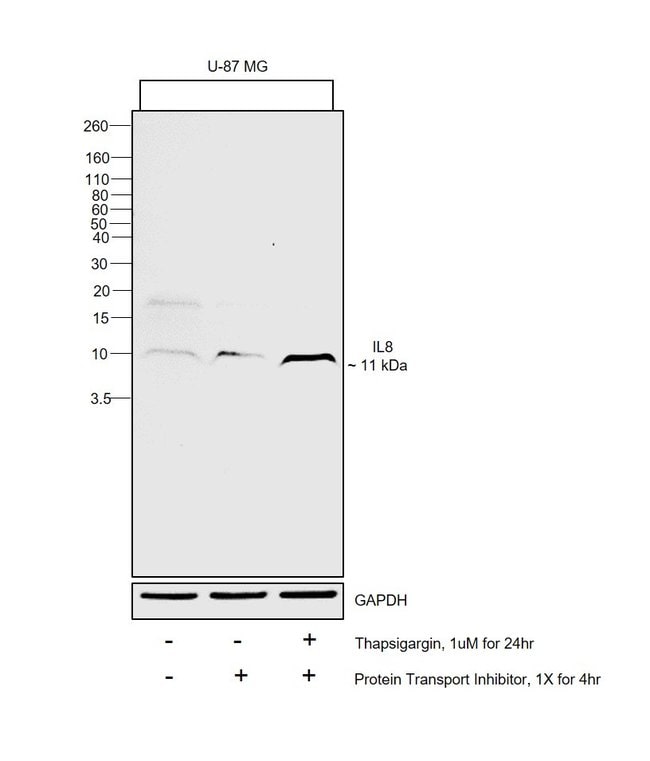
-(CXCL8)-WB-20170216130641.jpg-650.jpg "Invitrogen IL-8 (1-77) (CXCL8) Monoclonal Antibody (N11), eBioscience 2 mg | Buy Online | Invitrogen™ | Fisher Scientific")
Invitrogen™ IL-8 (1-77) (CXCL8) Monoclonal Antibody (N11), eBioscience™

Description
Description: The monoclonal antibody N11 reacts specifically with the 77 amino acid form of IL-8 (IL-877, IL-8(1-77), CXCL877) and does not react with the more common 72 amino acid form. Frequently referred to as 'endothelial' IL-8, the 77 amino acid form is secreted in cultured leukocytes. The 72 amino acid form is the result of efficient cleavage of an N-terminal pentamer from IL-877 after secretion. IL-8 is a C-X-C chemokine with potency in neutrophil chemotaxis and activation. IL-877 has decreased chemotactic activity when compared to IL-872, but has other specific pro-apoptotic and tumor cell chemotactic activities. IL-877 has recently been shown to be the major isoform present in premature neonates due to deficiency in serum protease activity that is not seen in term neonates. Applications Reported: This N11 antibody has been reported for use in immunoblotting (WB). Applications Tested: This N11 antibody has been tested by immunoblot of peripheral blood mononuclear cells stimulated with LPS for 4 hours. This can be used at 1-5 μg per mL. It is recommended that the antibody be carefully titrated for optimal performance in the assay of interest. Purity: Greater than 90%, as determined by SDS-PAGE. Aggregation: Less than 10%, as determined by HPLC. Filtration: 0.2 μm post-manufacturing filtered.

Specifications
Specifications
| Antigen | IL-8 (1-77) (CXCL8) |
| Applications | Western Blot, Immunocytochemistry |
| Classification | Monoclonal |
| Clone | N11 |
| Concentration | 0.5 mg/mL |
| Conjugate | Unconjugated |
| Formulation | PBS with 0.09% sodium azide; pH 7.2 |
| Gene | CXCL8 |
| Gene Accession No. | P10145 |
| Gene Alias | (Ala-IL-8)77; (Ser-IL-8)72; Alveolar macrophage chemotactic factor I; alveolar macrophage-derived chemotactic factor-I; AMCF-I; ANX7; beta endothelial cell-derived neutrophil activating peptide; beta-thromboglobulin-like protein; chemokine (C-X-C motif) ligand 8; C-X-C motif chemokine 8; C-X-C motif chemokine ligand 8; CXCL8; cytokine 8; emoctakin; GCP/IL-8 protein I; GCP/IL-8 protein II; GCP/IL-8 protein III; GCP/IL-8 protein IV; GCP/IL-8 protein V; GCP/IL-8 protein VI; GCP1; GCP-1; Granulocyte chemotactic protein 1; IL8; IL-8; IL-8(1-77); IL-8(5-77); IL-8(6-77); IL-8(7-77); IL-8(8-77); IL-8(9-77); IL8/NAP1 form I; IL8/NAP1 form II; IL8/NAP1 form III; IL8/NAP1 form IV; IL8/NAP1 form V; IL8/NAP1 form VI; ILN; Interleukin; interleukin 8; Interleukin8; interleukin-8; interleuklin-8 precursor; LECT; LUCT; lung giant cell carcinoma-derived chemotactic protein; lymphocyte derived neutrophil activating peptide; Lymphocyte-derived neutrophil-activating factor; LYNAP; MDNCF; MDNCF-a; MDNCF-b; MDNCF-c; MONAP; Monocyte-derived neutrophil chemotactic factor; monocyte-derived neutrophil-activating peptide; NAF; NAP1; NAP-1; neutrophil activating peptide 1; neutrophil and T-lymphocyte chemotactic and activating factor; Neutrophil attractant/activation protein 1; neutrophil attractant/activation protein-1; Neutrophil-activating factor; neutrophil-activating peptide 1; Neutrophil-activating protein 1; Permeability factor 1; PF1; Protein 3-10C; RP11-537A6.8; RPF1; small inducible cytokine subfamily B, member 8; SNX; SYNEXIN; T-cell chemotactic factor; tumor necrosis factor-induced gene 1 |
| Show More |
By clicking Submit, you acknowledge that you may be contacted by Fisher Scientific in regards to the feedback you have provided in this form. We will not share your information for any other purposes. All contact information provided shall also be maintained in accordance with our Privacy Policy.