Learn More
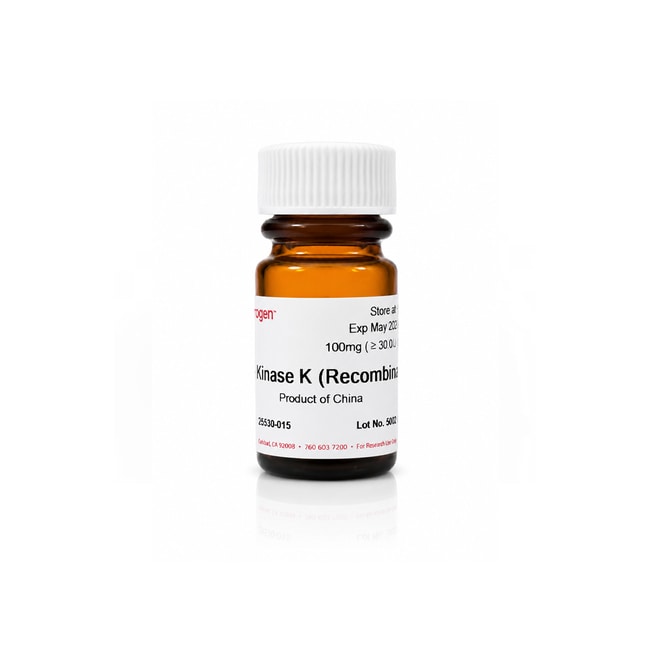
Invitrogen™ Proteinase K, recombinant


Description
Proteinase K from the fungus Engyodontium album is a nonspecific serine protease that is useful for general digestion of proteins.
- Over a wide pH range–optimal activity between 6.5 and 9.5
- Under denaturing conditions–e.g., in the presence of SDS or urea
- In the presence of metal chelating agents–e.g., EDTA
- At comparatively high temperatures–optimum digestion temperature is 65°C
- Protein Filter: P
Applications
Removal of endogenous nucleases during the preparation of DNA and RNA; preparation of tissue sections for in situ hybridization.
Performance and quality testing
Endodeoxyribonuclease and exodeoxyribonuclease assays; liquid form tested for absence of RNase activity.
Unit definition
One mAnson unit is described as that amount of enzyme that liberates 1μmole of Folin-positive amino acid within one minute at 37°C using hemoglobin as a substrate.
Order Info
Approved for shipment at Room Temperature or on Wet Ice

Specifications
Specifications
| Concentration | ≥40 U/mg |
| Content And Storage | One tube Proteinase K Store in refrigerator (2–8°C). |
| Shipping Condition | Approved for shipment at Room Temperature or on Wet Ice |
| Quantity | 1 g |
| Product Type | Proteinase K |
| Form | Powder |
Frequently Asked Questions (FAQs)
We recommend storing it at 4°C.
Scrape a single colony from the surface of an agar plate and transfer to 12 µL of SCL solution [10 mM Tris-HCl (pH 7.5), 1 mM EDTA, 50 µg/mL proteinase K] and incubate for 15 min at 55 degrees C. Inactivate proteinase K for 15 min at 80 degrees C and add 20 µL of deionized water. Centrifuge at 12,000 x g for 3 min. Transfer the supernatant to a new tube.
Concentration: Generally proteinase K is used in the concentration range of 50 to 500 µg/mL at 65 degrees C in the presence of SDS (0.5-1%).
Temperature optimum: 65 degrees C; 12X more active at 65 degrees C than at 25 degrees C.
pH: Proteinase K is stable over a wide pH range (4.0 to 12.5), with optimal activity at pH 6.5 to 9.5. It is most stable at pH 8.
Inactivation: Heat inactivate Proteinase K at 80 degrees C for 15 min. Phenol extraction is the recommended method to ensure complete inactivation.
Inhibited by: PMSF (0.1 to 1.0 mM of PMSF is usually sufficient for inhibition of Proteinase K)
Not inhibited by: Proteinase K is not inactivated by metal ions, chelating agents (e.g., EDTA), sulfhydryl reagents or by trypsin or chymotrypsin inhibitors. Activity can be stimulated by addition of denaturing agents (SDS and urea).
For Research Use Only. Not for use in diagnostic procedures.
By clicking Submit, you acknowledge that you may be contacted by Fisher Scientific in regards to the feedback you have provided in this form. We will not share your information for any other purposes. All contact information provided shall also be maintained in accordance with our Privacy Policy.