Promotional price valid on web orders only. Your contract pricing may differ. Interested in signing up for a dedicated account number?
Learn More
Learn More
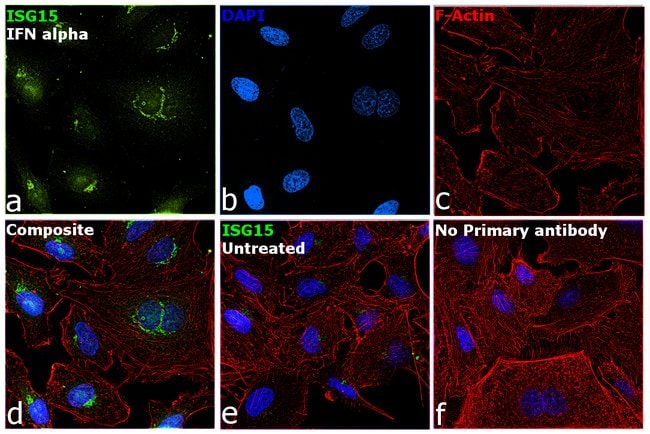

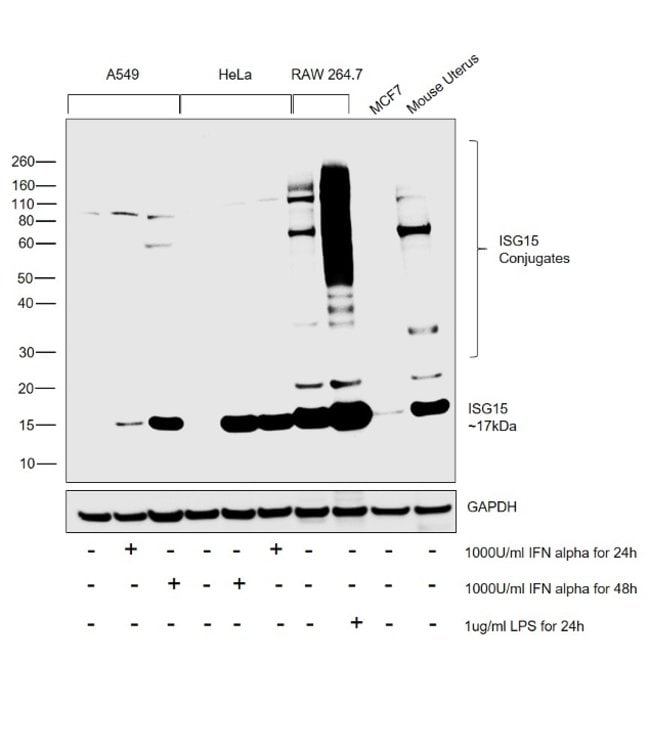
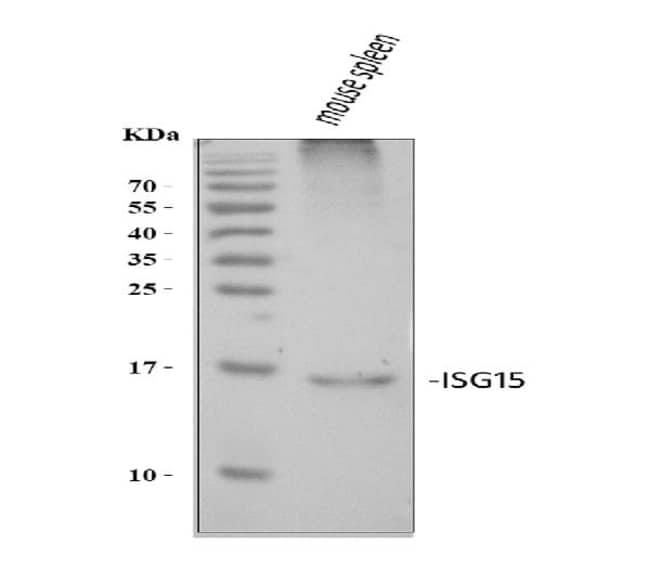


Description
Reconstitute with 0.2 mL of distilled water to yield a concentration of 500 μg/mL. Positive Control - WB: mouse spleen tissue. IHC: mouse kidney tissue.
Ubiquitin-like protein ISG15 plays a key role in the innate immune response to viral infection either via its conjugation to a target protein (ISGylation) or via its action as a free or unconjugated protein. It is secreted from monocytes in response to type I interferons and causes natural killer (NK)-cell proliferation and an augmentation of non-MCH (major histocompatibility complex)-restricted cytotoxicity. Synthesis is stimulated by IFN-alpha or IFN-beta or IFN-omega, but not IFN-gamma. ISG15 expression is also induced by overexpression of interferon regulatory factors that participate in transcriptional regulation of IFN genes, and by influenza B virus. ISG15 is secreted by cell lines of monocyte, T-lymphocyte, B-lymphocyte, human fibroblasts, and epithelial origins. Enhancement of NK cell proliferation, augmentation of non-major histocompatibility complex-restricted cytotoxicity, and induction of IFN-gamma from T cells identify ISG15 as a member of the cytokine cascade and suggest that it may be responsible for amplifying and directing some of the immunomodulatory effects of IFN-alpha or IFN-beta. ISG15 has has also been shown to function intracellularly as a ubiquitin homolog. Mutations affecting the gene can result in Immunodeficiency 38, with basal ganglia calcification (IMD38).

Specifications
Specifications
| Antigen | ISG15 |
| Applications | Immunocytochemistry, Immunohistochemistry (Paraffin), Western Blot |
| Classification | Polyclonal |
| Concentration | 500 μg/mL |
| Conjugate | Unconjugated |
| Formulation | PBS with 5mg BSA and 0.05mg sodium azide |
| Gene | ISG15 |
| Gene Accession No. | Q64339 |
| Gene Alias | G1P2; hUCRP; IFI15; IGI15; IMD38; interferon, alpha-inducible protein; interferon, alpha-inducible protein (clone IFI-15K); interferon-induced 15 kDa protein; interferon-induced 15-KDa protein; interferon-induced 17 kDa protein; interferon-induced 17-kDa/15-kDa protein; interferon-stimulated protein (15 kDa); interferon-stimulated protein 15; interferon-stimulated protein, 15 kDa; IP17; Irfp; Isg15; ISG15 ubiquitin like modifier; ISG15 ubiquitin-like modifier; ubiquitin cross-reactive protein; Ubiquitin-like protein ISG15; UCRP |
| Gene Symbols | ISG15 |
| Show More |
Safety and Handling
WARNING: Cancer - www.P65Warnings.ca.gov
Product Title
By clicking Submit, you acknowledge that you may be contacted by Fisher Scientific in regards to the feedback you have provided in this form. We will not share your information for any other purposes. All contact information provided shall also be maintained in accordance with our Privacy Policy.
Spot an opportunity for improvement?