Learn More
Invitrogen™ KLRG1 Monoclonal Antibody (2F1), PE-Cyanine7, eBioscience™, Invitrogen™


Description
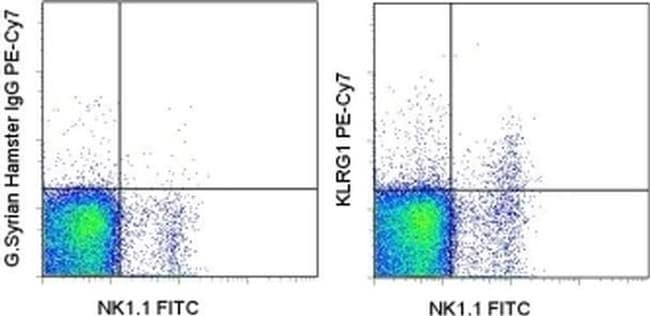
Description: This 2F1 monoclonal antibody reacts with the mouse Killer cell Lectin-like Receptor G1 (KLRG1), also known as Mast cell Function-associated Antigen (MAFA). KLRG1 is a homodimer of glycosylated 30-38 kDa subunits and contains a cytoplasmic motif similar to the immunoreceptor tyrosine-based inhibitory motif (ITIM). Rat MAFA was identified as an antigen specific to rat mast cells; however, the expression of mouse KLRG1/MAFA using 2F1 has not been detected on the surface of mouse mast cell lines, bone marrow-derived mast cells, or peritoneal mast cells. This antigen is expressed on approximately one-third of mouse NK cells and a subset of T cells. MHC class I molecules regulate KLRG1 via interactions with class I-specific inhibitory Ly49 molecules and SHP-1 signaling. Although KLRG1 and Ly49 are both lectin-like inhibitory receptors that are regulated by class I MHC expression, the effects of this on cell surface expression of these molecules are opposing, and the underlying regulatory mechanisms distinct. Applications Reported: This 2F1 antibody has been reported for use in flow cytometric analysis. Applications Tested: This 2F1 antibody has been tested by flow cytometric analysis of mouse splenocytes. This can be used at less than or equal to 0.25 μg per test. A test is defined as the amount (μg) of antibody that will stain a cell sample in a final volume of 100 μL.

Specifications
Specifications
| Antigen | KLRG1 |
| Applications | Flow Cytometry |
| Classification | Monoclonal |
| Clone | 2F1 |
| Concentration | 0.2 mg/mL |
| Conjugate | PE-Cyanine7 |
| Formulation | PBS with 0.09% sodium azide; pH 7.2 |
| Gene | Klrg1 |
| Gene Accession No. | O88713 |
| Gene Alias | 2F1; 2F1-Ag; CLEC15A; C-type lectin domain family 15 member A; C-type lectin domain family 15, member A; ITIM-containing receptor MAFA-L; killer cell lectin like receptor G1; killer cell lectin-like receptor subfamily G member 1; killer cell lectin-like receptor subfamily G, member 1; Klrg1; Mafa; MAFA-2F1; MAFAL; MAFA-L; MAFA-LIKE; MAFA-like receptor; Mast cell function-associated antigen; mast cell function-associated antigen (ITIM-containing); mast cell function-associated antigen 2F1; natural killer cell receptor |
| Show More |
Safety and Handling
For Research Use Only.
By clicking Submit, you acknowledge that you may be contacted by Fisher Scientific in regards to the feedback you have provided in this form. We will not share your information for any other purposes. All contact information provided shall also be maintained in accordance with our Privacy Policy.