Learn More
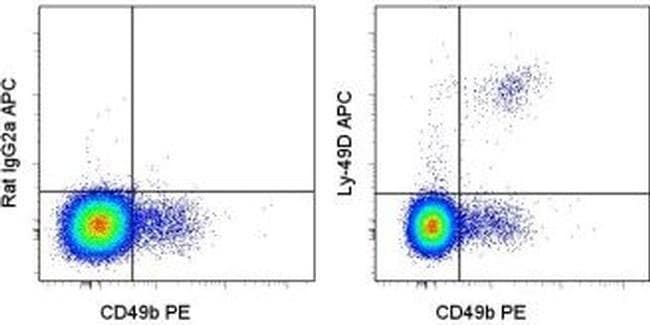
Invitrogen™ Ly-49D Monoclonal Antibody (eBio4E5 (4E5)), APC, eBioscience™


Description
Description: The monoclonal antibody eBio4E5 (4E5) reacts with Ly-49D, an activating member of the Ly-49 family of NK cell receptors. This family of receptors form homodimers that recognize MHC Class I molecules. The activating Ly-49 receptors (Ly-49D and Ly-49H) do not contain immune receptor tyrosine-based inhibitory motifs (ITIM) in their cytoplasmic domains, distinguishing them from the inhibitory Ly-49 family members. Instead, activating Ly-49 molecules have been shown to associate with DAP12 which contains an immunoreceptor tyrosine-based activation motif (ITAM) that is required for positive signaling. Expression of different Ly-49 family members is not linked, therefore, several Ly-49 proteins can be expressed on the same cells. Expression of Ly-49D on subsets of NK cells is strain-dependent and is found in C57BL/6, CB6F1 and SJL mice, while BALB/c, DBA/2, AKR and CBA/J mice are negative for Ly-49D. In 129/J mice, eBio4E5 also recognizes Ly-49O, Ly-49V and Ly-49R. eBio4E5 is reported to have functional (activating) activity. Applications Reported: This eBio4E5 (4E5) antibody has been reported for use in flow cytometric analysis. Applications Tested: This eBio4E5 (4E5) antibody has been tested by flow cytometric analysis of mouse splenocytes. This can be used at less than or equal to 0.5 μg per test. A test is defined as the amount (μg) of antibody that will stain a cell sample in a final volume of 100 μL. Cell number should be determined empirically but can...

Specifications
Specifications
| Antigen | Ly-49D |
| Applications | Flow Cytometry |
| Classification | Monoclonal |
| Clone | eBio4E5 (4E5) |
| Concentration | 0.2 mg/mL |
| Conjugate | APC |
| Formulation | PBS with 0.09% sodium azide; pH 7.2 |
| Gene | Klra4 |
| Gene Accession No. | Q60651 |
| Gene Alias | Chok; killer cell lectin-like receptor 4; killer cell lectin-like receptor subfamily A member 32; killer cell lectin-like receptor subfamily A member 33; killer cell lectin-like receptor, subfamily A, member 4; Klra32; Klra33; Klra4; Ly49d; Ly-49d; Ly49-d; ly49r>129>; Lymphocyte antigen 49d; T-cell surface glycoprotein Ly-49D |
| Show More |
By clicking Submit, you acknowledge that you may be contacted by Fisher Scientific in regards to the feedback you have provided in this form. We will not share your information for any other purposes. All contact information provided shall also be maintained in accordance with our Privacy Policy.