Learn More
Description
The IgE receptor plays a central role in allergic disease, coupling allergen and mast cell to initiate the inflammatory and immediate hypersensitivity responses that are characteristic of disorders such as hay fever and asthma. The allergic response occurs when 2 or more high-affinity IgE receptors are crosslinked via IgE molecules that in turn are bound to an allergen (antigen) molecule. A perturbation occurs that brings about the release of histamine and proteases from the granules in the cytoplasm of the mast cell and leads to the synthesis of prostaglandins and leukotrienes--potent effectors of the hypersensitivity response. The IgE receptor consists of 3 subunits: alpha, beta (MIM 147138), and gamma (MIM 147139); only the alpha subunit is glycosylated.[supplied by OMIM
Specifications
Specifications
| Antigen | FCER1A |
| Applications | Flow Cytometry, Immunohistochemistry, Western Blot |
| Classification | Monoclonal |
| Clone | CRA2 |
| Conjugate | Unconjugated |
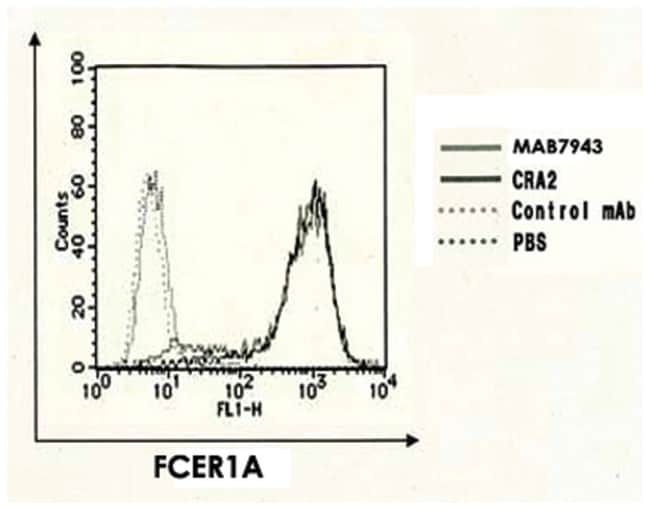
| Description | Mouse monoclonal antibody raised against recombinant FCER1A. |
| Dilution | Western Blot (1 ug/mL) The optimal working dilution should be determined by the end user. |
| Formulation | In PBS, pH 7.4 (50% glycerol) |
| Gene | FCER1A |
| Gene Alias | FCE1A/FcERI |
| Show More |
By clicking Submit, you acknowledge that you may be contacted by Fisher Scientific in regards to the feedback you have provided in this form. We will not share your information for any other purposes. All contact information provided shall also be maintained in accordance with our Privacy Policy.