Promotional price valid on web orders only. Your contract pricing may differ. Interested in signing up for a dedicated account number?
Learn More

Gibco™ Mouse IL-33 Recombinant Protein, PeproTech®

Catalog No. 210332UG
Encompass_Preferred
Change view
Click to view available options
Quantity:
10 μg
10 x 100 μg
100 μg
2 μg
2.5 x 100 μg
5 x 100 μg
50 μg
7 product options available for selection
Product selection table with 7 available options. Use arrow keys to navigate and Enter or Space to select.
Catalog No. Quantity
210-33-2UG 2 μg
21033100UG 100 μg
210-33-10UG 10 μg
21-033-01M 10 x 100 μg
21-033-250 2.5 x 100 μg
21-033-500 5 x 100 μg
210-33-50UG 50 μg
Use arrow keys to navigate between rows. Press Enter or Space to select a product option. 7 options available.
7 options
This item is not returnable. View return policy
Catalog No. 210-33-2UG Supplier Gibco™ Supplier No. 210332UG
Add to Cart
Edge
Add to Cart
This item is not returnable. View return policy

Recombinant Protein

210-33-1MG will be provided as 10 x 100 μg (210-33-100UG). 210-33-250UG will be provided as multiple 50 μg (210-33-50UG) and 100 μg (210-33-100UG) vials. 210-33-500UG will be provided as 5 x 100 μg (210-33-100UG). Recombinant Murine IL-33 is a 17.5 kDa protein containing 158 amino acid residues. This product is shipped at ambient temperature. For storage, handling and reconstitution information, please see the lot-specific Certificate of Analysis

IL-33 (Interleukin-33) is a 270 amino acid, highly divergent protein belonging to the IL-1 family with an IL-1-like C-terminal domain. IL-33 is a dual function protein that may function both as a proinflammatory cytokine and an intracellular nuclear factor with transcriptional regulatory properties. IL-33 binds to and signals through IL1RL1/ST2 and its stimulation recruits MYD88, IRAK1, IRAK4, and TRAF6. IL-33 activates NF-kappaB and MAP kinases, and drives production of TH2-associated cytokines from in vitro polarized TH2 cells. In vivo, IL-33 induces the expression of IL-4, IL-5, and IL-13 and leads to severe pathological changes in mucosal organs. IL-33 is proteolytically converted to a mature form by CASP1 and is highly expressed in high endothelial venules found in tonsils, Peyer's patches and mesenteric lymph nodes and is almost undetectable in placenta. Prolonged IL-33 treatment of mice led to the development of eosinophilia, splenomegaly, and severe pathological changes in mucosal organs such as lungs, esophagus and small intestine. Recent experiments have shown that IL-33 can also co-localize with heterochromatin and possesses transcriptional repressor activities, indicating that IL-33 may function as both a proinflammatory cytokine and an intracellular nuclear factor with transcriptional regulatory properties. Despite its predicted molecular weight, IL-33 will often run at higher molecular weight in SDS-PAGE. Studies have shown that IL-33 can also co-localize with heterochromatin and possesses transcriptional repressor activities, indicating that IL-33 may function as both a proinflammatory cytokine, and an intracellular nuclear factor with transcriptional regulatory properties.
TRUSTED_SUSTAINABILITY

Specifications

Accession Number P14719, Q8BVZ5
For Use With (Application) Control, Bioactivity
Formulation Protein with no preservative
Gene ID (Entrez) 17082, 77125
Molecular Weight (g/mol) 17.5 kDa
Name Mouse IL-33
Purification Method Purified
Quantity 2 μg
Source E. coli
Storage Requirements -20°C
Regulatory Status RUO
Endotoxin Concentration <1 EU/μg
Gene Alias 9230117N10Rik; C9orf26; DVS27; DVS27-related protein; H-IL-33; IL1F11; IL-1F11; Il33; IL-33; ILN; Interleukin; interleukin 33; interleukin-1 family member 11; Interleukin33; Interleukin-33; Interleukin-33 (109-270); Interleukin-33 (95-270); Interleukin-33 (99-270); Interleukin-33(102-266); Interleukin-33(109-266); NFEHEV; NFHEV; NF-HEV; nuclear factor for high endothelial venules; nuclear factor from high endothelial venules; RGD1311155; RP11-575C20.2
Common Name IL-33
Gene Symbol IL1rl1, IL33
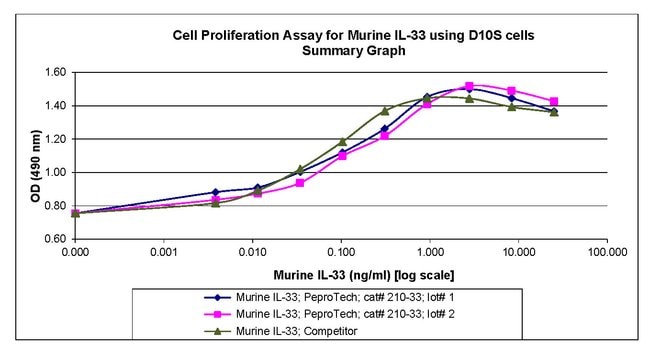
Biological Activity The ED50 was determined by the dose-dependent stimulation of the proliferation of murine D10S cells is ≤ 0.5 ng/ml, corresponding to a specific activity of ≥ 2 x 10^6 units/mg
Product Type Protein
Conjugate Unconjugated
Recombinant Recombinant
Sequence SIQGTSLLTQ SPASLSTYND QSVSFVLENG CYVINVDDSG KDQEQDQVLL RYYESPCPAS QSGDGVDGKK LMVNMSPIKD TDIWLHANDK DYSVELQRGD VSPPEQAFFV LHKKSSDFVS FECKNLPGTY IGVKDNQLAL VEEKDESCNN IMFKLSKI
Content And Storage -20°C
Activity The ED50 was determined by the dose-dependent stimulation of the proliferation of murine D10S cells is ≤ 0.5 ng/ml, corresponding to a specific activity of ≥ 2 x 10^6 units/mg.
Expression System E. coli
Form Lyophilized
Purity or Quality Grade ≥ 98% by SDS-PAGE gel and HPLC analyses.
Show More Show Less
Product Title
Select an issue

By clicking Submit, you acknowledge that you may be contacted by Fisher Scientific in regards to the feedback you have provided in this form. We will not share your information for any other purposes. All contact information provided shall also be maintained in accordance with our Privacy Policy.