Learn More
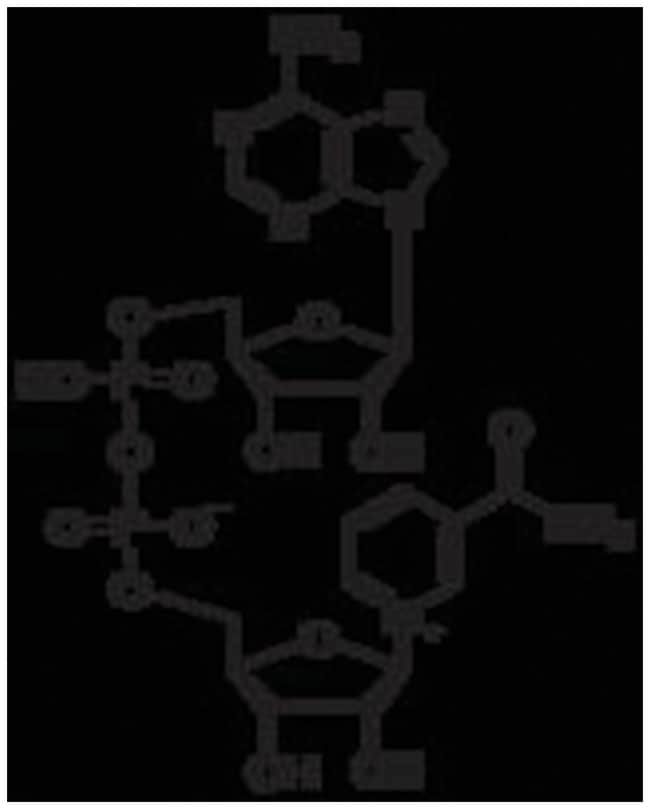
MP Biomedicals™ β-Nicotinamide Adenine Dinucleotide, Oxidized, MP Biomedicals™
Shop All MP Biomedicals, Inc ProductsDescription
Many metabolites and enzymes of biological interest are present in tissues at low concentrations. With the use of β-NAD as a catalyst intermediate and several enzymes in a multistep system, known as enzyme cycling, much greater sensitivity for detection of these components is achieved. The reduced form, β-NADH, is fluorescent whereas β-NAD is not. This difference in fluorescence provides a sensitive fluorescent measurement of the oxidized or reduced pyridine nucleotides at concentrations down to 10-7 M.
- Serves as a coenzyme of the dehydrogenases, especially in the dehydrogenation of primary and secondary alcohols
- NAD usually acts as an electron acceptor, acting as a carrier for hydride ion, forming b-NADH which then serves as a hydrogen donor in the respiratory chain
- Hydride ion is enzymatically removed from a substrate molecule by the action of dehydrogenases such as malic dehydrogenase and lactic dehydrogenase
- Such enzymes catalyze the reversible transfer of a hydride ion from malate or lactate to b-NAD to form the reduced product, b-NADH
- Unlike b-NAD which has no absorbance at 340nm, b-NADH absorbs at 340nm (EmM = 6.22)
- The increase in absorbance at 340nm with the formation of b-NADH is the basis for measurement of activity of many enzymes

Specifications
Specifications
| Color | White |
| Purity | ≥99% |
| pH | 2 to 4 (1% aq soln) |
| Content And Storage | -20°C, Store Desiccated |
| Quantity | 100 mg |
| Molecular Weight (g/mol) | 663.4 (anhyd.) |
| Form | Powder |
By clicking Submit, you acknowledge that you may be contacted by Fisher Scientific in regards to the feedback you have provided in this form. We will not share your information for any other purposes. All contact information provided shall also be maintained in accordance with our Privacy Policy.