Learn More
Invitrogen™ OCT4 Recombinant Rabbit Monoclonal Antibody (3H8L6), Alexa Fluor™ Plus 647

Description
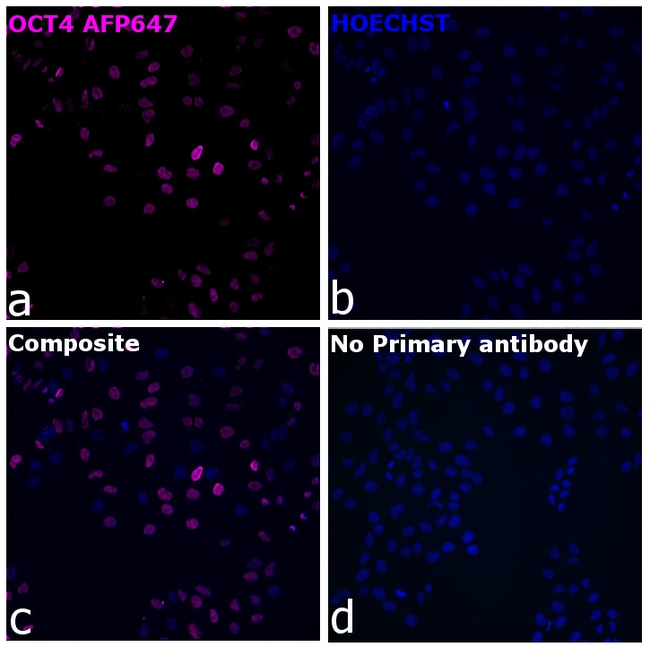
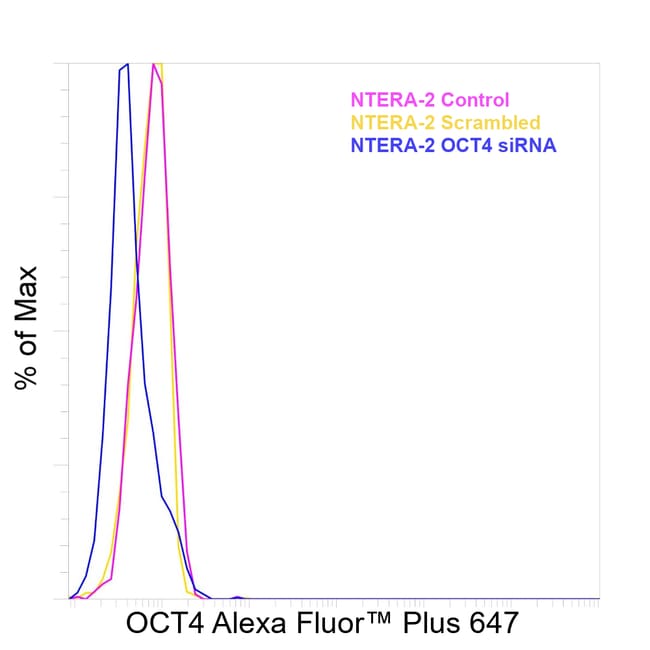
Alexa Fluor™ Plus recombinant antibodies are conjugated using new, proprietary dye chemistry so you can generate stunning data. Alexa Fluor™ Plus antibodies represent an advancement in fluorescent conjugate technology. Alexa Fluor™ Plus antibodies provide brighter signal compared to leading Alexa Fluor™ antibodies, providing you with better signal-to-noise for your critical experiments. These antibodies show better specificity and lot-to-lot consistency as these are recombinant antibodies, generated by cloning specific genes for the desired antibodies into an expression vector and expressed in vitro. Using conjugate solutions: Centrifuge the protein conjugate solution briefly in a microcentrifuge before use; add only the supernatant to the experiment. This step will help eliminate any protein aggregates that may have formed during storage, thereby reducing nonspecific background staining. Applications Tested: This 3H8L6 antibody has been tested by immunocytochemistry and flow cytometric analysis of NTERA-2 cells. This may be used for immunocytochemistry at 10 μg/mL and for flow cytometry at less than or equal to 0.5 μg per test. A test is defined as the amount (μg) of antibody that will stain a cell sample in a final volume of 100 μL. Cell number should be determined empirically but can range from 10^5 to 10^8 cells/test. It is recommended that the antibody be carefully titrated for optimal performance in the assay of interest. Excitatio...

Specifications
Specifications
| Antigen | OCT4 |
| Applications | Flow Cytometry, Immunocytochemistry |
| Classification | Recombinant Monoclonal |
| Clone | 3H8L6 |
| Concentration | 1.0 mg/mL |
| Conjugate | Alexa Fluor Plus 647 |
| Formulation | Proprietary buffer with 0.008% Bromonitrodioxane, 0.008% Methylisothiazolone; pH 6.8 |
| Gene | POU5F1 |
| Gene Accession No. | Q01860 |
| Gene Alias | 2-Oct; 3-Oct; 4-Oct; cb197; chunp6868; DADB-104B20.2; etID49452.21; gp9; gp-9; HGNC:9221; homeobox protein; lymphoid-restricted immunoglobulin octamer-binding protein NF-A2; MGC22487; NF-A3; Oct2; Oct-2; Oct2a; Oct2b; OCT3; Oct-3; Oct3/4; Oct-3/4; OCT4; Oct-4; Octamer-binding protein 2; octamer-binding protein 3; Octamer-binding protein 4; octamer-binding transcription factor 2; Octamer-binding transcription factor 3; OTF2; OTF-2; OTF3; Otf-3; Otf3g; Otf3-rs7; Otf4; Otf-4; OTTHUMP00000221150; OTTHUMP00000221151; POU class 2 homeobox 2; POU class 5 homeobox 1; POU class 5 homeobox 1 transcript variant OCT4B1; POU class 5 homeobox 1 transcript variant OCT4B2; POU class 5 homeobox 1 transcript variant OCT4B3; POU class 5 homeobox 1 transcript variant OCT4B4; POU class 5 homeobox 1 transcript variant OCT4B5; POU class 5 homeobox 1 transcript variant OCT4B6; POU domain class 5 transcription factor 1; POU domain gene 2; POU domain protein 2; POU domain transcription factor OCT4; POU domain, class 2, transcription factor 2; POU domain, class 5, transcription factor 1; POU domain, class 5, transcription factor 3; pou2; pou-2; POU2F2; Pou5f1; pou5f1 protein; pou5f3; POU-type homeodomain-containing DNA-binding protein; spg; spg/pou2; spiel-ohne-grenzen; spiel-ohne-grenzen/pou2; wu:fd18d06 |
| Show More |
By clicking Submit, you acknowledge that you may be contacted by Fisher Scientific in regards to the feedback you have provided in this form. We will not share your information for any other purposes. All contact information provided shall also be maintained in accordance with our Privacy Policy.