Learn More

Invitrogen™ PARP1 Polyclonal Antibody
Description
This antibody is predicted to react with bovine, chicken, amphibian, mouse and rat based on sequence homology. Heat-mediated antigen retrieval is recommended prior to staining, using a 10mM citrate buffer, pH 6.0, for 10 minutes followed by cooling at room temperature for 20 min. Following antigen retrieval, incubate samples with primary antibody for 10 min at room temperature. A suggested positive control is tonsil tissue.

Specifications
Specifications
| Antigen | PARP1 |
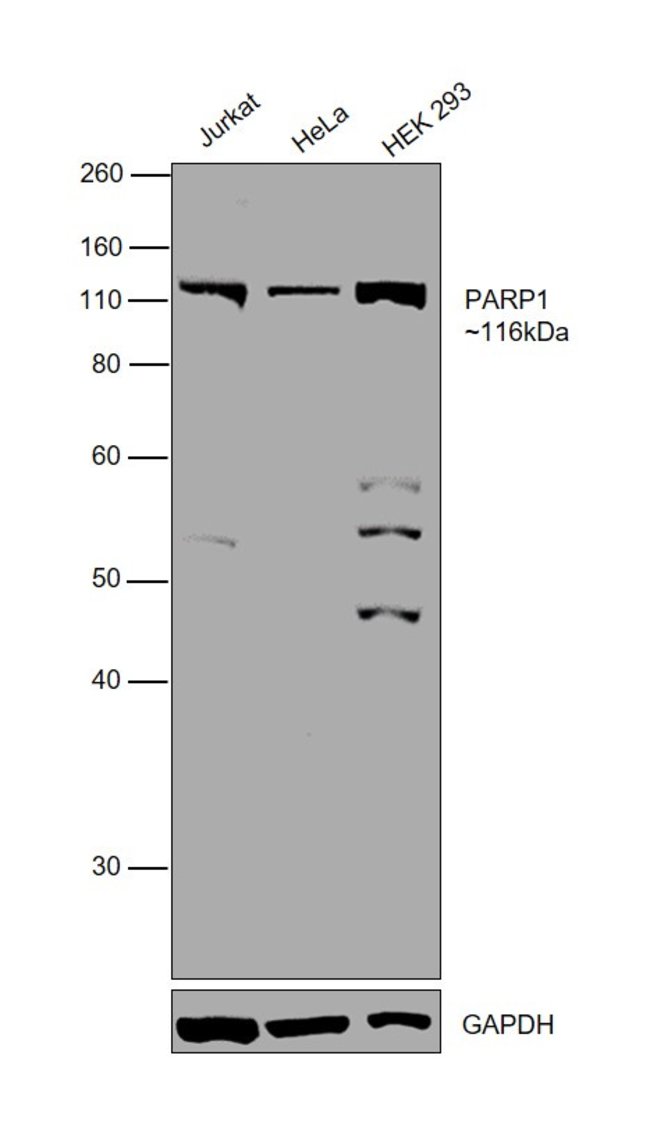
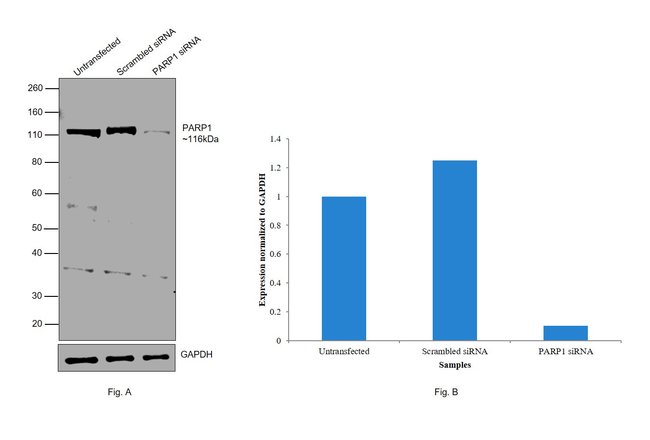
| Applications | Immunohistochemistry (Paraffin), Western Blot |
| Classification | Polyclonal |
| Concentration | 0.2 |
| Conjugate | Unconjugated |
| Formulation | PBS with 1% BSA and <0.1% sodium azide; pH 7.6 |
| Gene | Parp1 |
| Gene Accession No. | P09874 |
| Gene Alias | 5830444G22Rik; ADP-ribosyltransferase (NAD+; ADP-ribosyltransferase (NAD+) poly (ADP-ribose) polymerase); ADP-ribosyltransferase (NAD+, poly (ADP-ribose) polymerase) 1; ADP-ribosyltransferase (NAD+; poly (ADP-ribose) polymerase); ADP-ribosyltransferase (NAD+; poly (ADP-ribose) polymerase) 1; ADP-ribosyltransferase 1; ADP-ribosyltransferase diphtheria toxin-like 1; ADP-ribosyltransferase NAD(+); Adprp; Adprt; ADPRT 1; Adprt1; AI893648; ARTD1; C80510; DNA ADP-ribosyltransferase PARP1; I79_014850; msPARP; NAD(+) ADP-ribosyltransferase 1; NAD(+) pADPRT-1; pADPRT-1; PARP; PARP1; PARP-1; poly (ADP-ribose) polymerase 1; poly (ADP-ribose) polymerase family, member 1; poly (ADP-ribose) polymerase); poly [ADP-ribose] polymerase 1; poly ADP-ribose polymerase; poly(ADP-ribose) polymerase; poly(ADP-ribose) polymerase 1; poly(ADP-ribose) polymerase PARP-1; poly(ADP-ribose) synthetase; poly(ADP-ribosyl)transferase; Poly[ADP-ribose] synthase 1; poly[ADP-ribose] synthetase 1; PPOL; Protein poly-ADP-ribosyltransferase PARP1; sPARP-1; synthetase fragment (AA 67); Unknown (protein for IMAGE:8023736); unnamed protein product |
| Gene Symbols | Parp1 |
| Show More |
By clicking Submit, you acknowledge that you may be contacted by Fisher Scientific in regards to the feedback you have provided in this form. We will not share your information for any other purposes. All contact information provided shall also be maintained in accordance with our Privacy Policy.