Learn More
Invitrogen™ PD-L1 (CD274) Recombinant Rabbit Monoclonal Antibody (RM320), Alexa Fluor™ Plus 647


Description
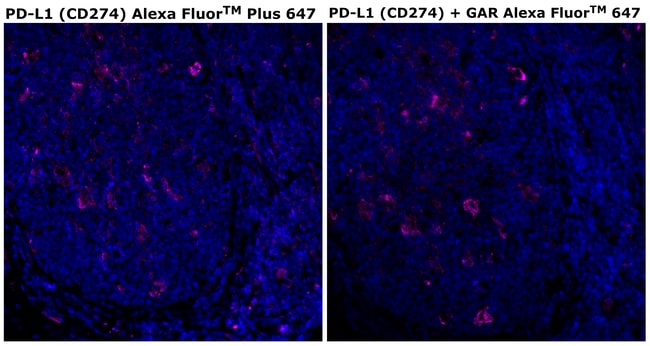
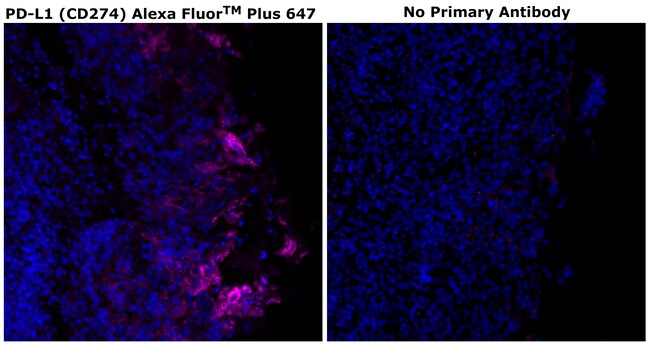
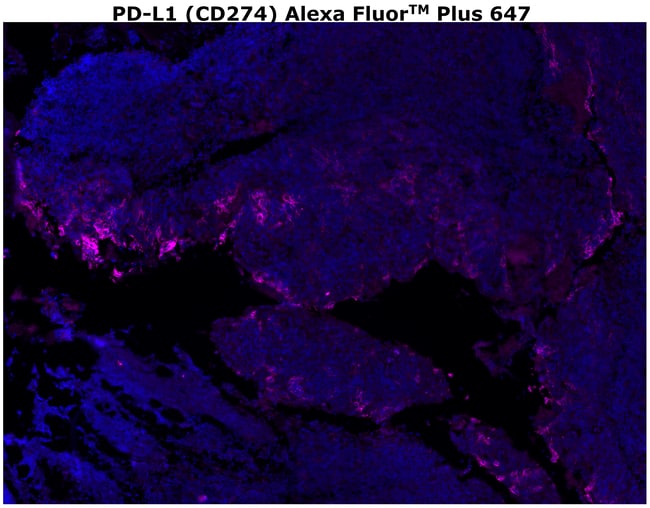
Description: The RM320 monoclonal antibody reacts with human B7-H1, also known as PD-L1. B7-H1, a member of the B7 family, has a predicted molecular weight of approximately 40 kDa and belongs to the Ig superfamily. B7-H1 is expressed on a majority of leukocytes. B7-H1 is a ligand for PD-1. Interaction of PD-1 with either PD-L1 (B7-H1) or PD-L2 (B7-DC) results in inhibition of T and B cell responses. MIH1 is reported to be a blocking antibody. Applications Reported: This RM320 antibody has been tested by immunoblotting, immunohistochemistry, immunocytochemistry and flow cytometry. Applications Tested: This RM320 antibody has been tested by immunohistochemical staining of formalin-fixed paraffin embedded human tissue using low pH antigen retrieval and can be used at 5 μg/mL. It is recommended that the antibody be carefully titrated for optimal performance in the assay of interest. Using conjugate solutions: Centrifuge the protein conjugate solution briefly in a microcentrifuge before use; add only the supernatant to the experiment. This step will help eliminate any protein aggregates that may have formed during storage, thereby reducing nonspecific background staining.

Specifications
Specifications
| Antigen | PD-L1 (CD274) |
| Applications | Immunohistochemistry (Paraffin), Multiplex Immunohistochemistry |
| Classification | Recombinant Monoclonal |
| Clone | RM320 |
| Concentration | 0.2 mg/mL |
| Conjugate | Alexa Fluor Plus 647 |
| Formulation | PBS with 0.5% BSA, 10% proprietary stabilizer and 0.05% sodium azide; pH 7.2 |
| Gene | Cd274 |
| Gene Accession No. | Q9NZQ7 |
| Gene Alias | A530045L16Rik; B7 homolog 1; B7-H; B7h1; B7-H1; Cd274; CD274 antigen; CD274 molecule; PDCD1 ligand 1; Pdcd1l1; Pdcd1lg1; Pdl1; PD-L1; pdl-1; Programmed cell death 1 ligand 1; programmed death ligand 1; RGD1566211; sCD274; soluble CD274; soluble PD L1; sPD L1 |
| Show More |
By clicking Submit, you acknowledge that you may be contacted by Fisher Scientific in regards to the feedback you have provided in this form. We will not share your information for any other purposes. All contact information provided shall also be maintained in accordance with our Privacy Policy.