Promotional price valid on web orders only. Your contract pricing may differ. Interested in signing up for a dedicated account number?
Learn More
Learn More
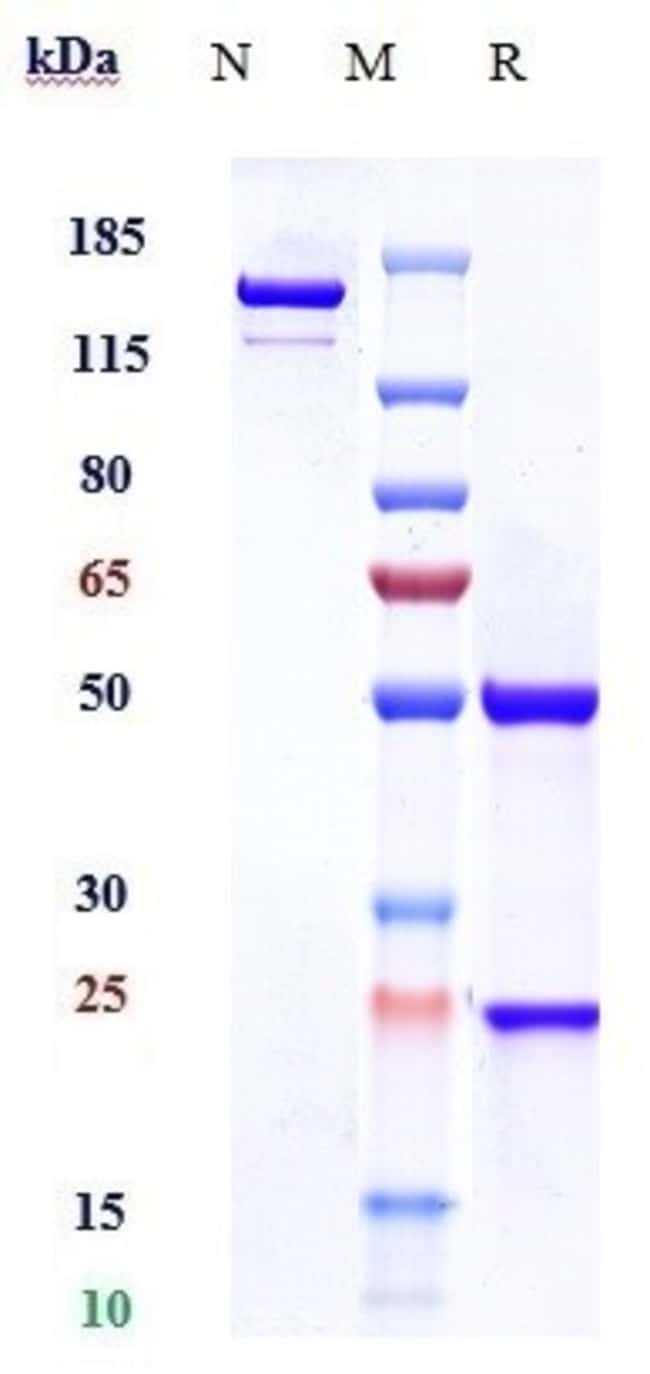
Invitrogen™ PDGF-C Biosimilar Recombinant Monoclonal Antibody


Description
For reconstitution, add sterile, distilled water to achieve a final antibody concentration of 1 mg/mL. Gently shake to solubilize the protein completely. Do not vortex. Reconstituted products should be stored at -80 °. This antibody can also be cross referenced by the term Thrombogenics patent anti-PDGF-C.
Sphingosine Kinase 2 (Sphk2) catalyzes the phosphorylation of sphingosine to sphingosine 1 phosphate (S1P), an important signaling molecule with intra- and extracellular functions. Inside the cell S1P acts as a signaling molecule like other sphingolipid metabolites like ceramide and sphingosine. S1P has been implicated in regulating cell differentiation, calcium mobilization from intracellular stores, and apoptosis. The cell surface receptors for S1P are the EDG family of G protein-coupled receptors (S1P Receptors).These receptors couple to multiple G proteins (e.g. S1P1 couples to Gi whereas S1P2 and S1P3 couple to Gq, G13 in addition to Gi) and regulate a extremely wide range of cellular events including cell motility, survival, apoptosis, migration and cellcell interaction. Important roles for S1P have also been reported in regulation of cardiogenesis, vascular maturation, oocyte survival, immune cell trafficking, cells of the neuronal system and bone cells. S1P levels are regulated by the activity of Sphk (Sphk1 and Sphk2).

Specifications
Specifications
| Antigen | PDGF-C (Biosimilar) |
| Applications | ELISA, Flow Cytometry, Functional Assay, Surface Plasmon Resonance |
| Classification | Recombinant Monoclonal |
| Concentration | 1 mg/mL |
| Conjugate | Unconjugated |
| Formulation | 25mM histidine with 0.01% Tween 80, 8% sucrose and no preservative; pH 6.2 |
| Gene | PDGFC |
| Gene Accession No. | Q9NRA1 |
| Gene Alias | 1110064L01Rik; AI647969; C76851; fallotein; MGC102297; Pdgfc; PDGF-C; PDGFC latent form; PDGFC receptor-binding form; platelet derived growth factor C; platelet-derived growth factor C; Platelet-derived growth factor C, latent form; Platelet-derived growth factor C, receptor-binding form; platelet-derived growth factor, C polypeptide; rScdfg; Scdgf; secretory growth factor-like protein; spinal cord-derived growth factor; UNQ174/PRO200; VEGF-E |
| Gene Symbols | PDGFC |
| Show More |
Product Title
By clicking Submit, you acknowledge that you may be contacted by Fisher Scientific in regards to the feedback you have provided in this form. We will not share your information for any other purposes. All contact information provided shall also be maintained in accordance with our Privacy Policy.
Spot an opportunity for improvement?