

Learn More
Invitrogen™ Phospho-AKT1 (Ser473) Monoclonal Antibody (SDRNR), Brilliant Violet™ 711, eBioscience™


Description
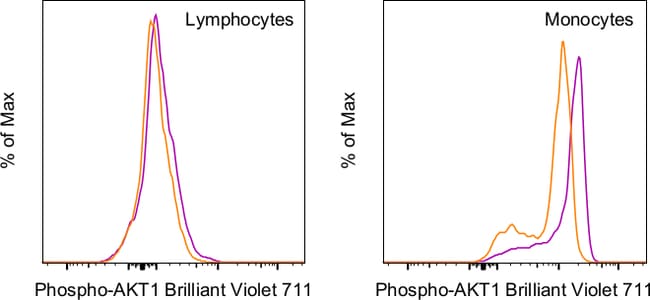
Description This SDRNR monoclonal antibody recognizes human and mouse AKT (also known as Protein Kinase B (PKB)) when phosphorylated on S473. Specificity of this SDRNR clone was determined by ELISA, flow cytometry, and western blotting. Applications Tested This SDRNR antibody has been pre-diluted and tested by intracellular staining followed by flow cytometric analysis of normal human peripheral blood cells using the Intracellular Fixation & Permeabilization Buffer Set (Product # 88-8824-00) and protocol. Please refer to 'Staining Intracellular Antigens for Flow Cytometry, Protocol A: Two step protocol for intracellular (cytoplasmic) proteins' located at Flow Protocols</a>. This may be used at 5 μL (0.25 μg) per test. A test is defined as the amount (μg) of antibody that will stain a cell sample in a final volume of 100 μL. Cell number should be determined empirically but can range from 10^5 to 10^8 cells/test. Blocking Buffers When using two or more Super Bright, Brilliant Violet™, Brilliant Ultra Violet™, or other polymer dye-conjugated antibodies in a staining panel, it is recommended to use Super Bright Complete Staining Buffer (Product # SB-4401</a>) or Brilliant Stain Buffer (Product # 00-4409-75</a>) to minimize any non-specific polymer interactions. Please refer to the datasheet for Super Bright Staining Buffer or Brilliant Stain Buffer for more informatio...

Specifications
Specifications
| Antigen | Phospho-AKT1 (Ser473) |
| Applications | Flow Cytometry |
| Classification | Monoclonal |
| Clone | SDRNR |
| Concentration | 5 μL/Test |
| Conjugate | Brilliant Violet 711 |
| Formulation | PBS with BSA and 0.09% sodium azide; pH 7.2 |
| Gene | AKT1 |
| Gene Accession No. | P31749, P31750 |
| Gene Alias | Akt; Akt kinase; AKT serine/threonine kinase 1; Akt/PKB; akt1; AKT1 kinase; AKT1m; Akt1m protein; Akt1-PA; Akt1-PB; Akt1-PC; Akt1-PD; Akt1-PE; CAKT; C-AKT; CG4006; CG4006-PA; CG4006-PB; CG4006-PC; CG4006-PD; CG4006-PE; CWS6; dAkt; D-Akt; dAkt kinase; dAKT/dPKB; dAkt/PKB; DAKT1; DAKT1/PKB; Dmel\CG4006; Dmel_CG4006; dPKB; DRAC-PK; DRAC-PK66; DRAC-PK85; l(3)04226; l(3)89Bq; murine thymoma viral (v-akt) oncogene homolog 1; pAkt; P-AKT; PKB; PKB alpha; PKB beta; PKB gamma; PKB/AKT; PKB/dAKT; PKBalpha; PKB-ALPHA; PKBG; PRKBA; protein kinase B; Protein kinase B alpha; protein kinase B-alpha; proto-oncogene c-Akt; RAC; rac protein kinase alpha; RAC protein kinase alpha RAC-PK alpha; RAC serine/threonine protein kinase; RAC serine/threonine-protein kinase; RAC-ALPHA; RAC-alpha serine/threonine-protein kinase; RacPK; RAC-PK-alpha; RAC-PK-beta; RAC-PK-gamma; related to A and C kinases; related to PKA to PKC protein kinases; related to the A and C kinases; SD10374p; serine/threonine protein kinase; serine-threonine protein kinase; Thymoma viral proto-oncogene; thymoma viral proto-oncogene 1; v-akt murine thymoma viral oncogene homolog 1; v-akt murine thymoma viral oncogene-like protein 1 |
| Show More |
By clicking Submit, you acknowledge that you may be contacted by Fisher Scientific in regards to the feedback you have provided in this form. We will not share your information for any other purposes. All contact information provided shall also be maintained in accordance with our Privacy Policy.