Promotional price valid on web orders only. Your contract pricing may differ. Interested in signing up for a dedicated account number?
Learn More
Learn More
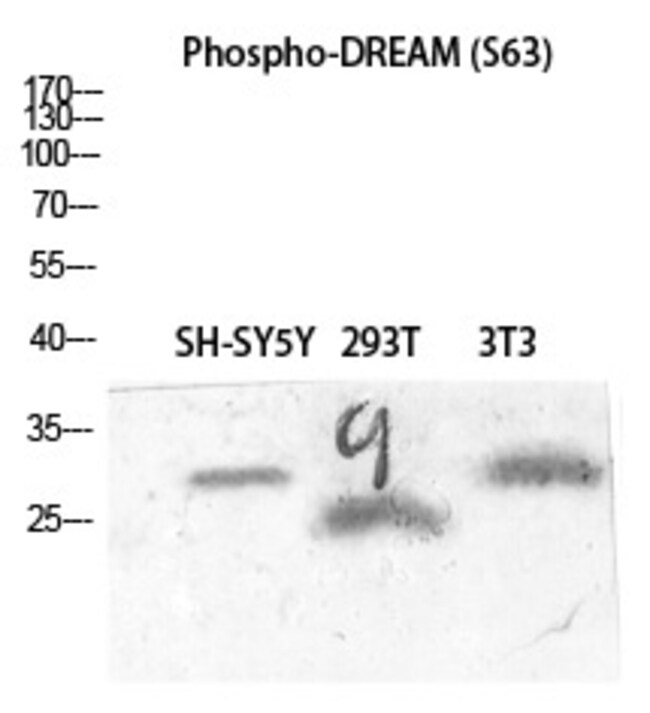

Invitrogen™ Phospho-KChIP3 (Ser63) Polyclonal Antibody

Description
This antibody is predicted to react with mouse based on sequence homology.
Voltage-gated potassium (Kv) channels are key components of the potassium currents in the heart and central nervous system. In the heart, Kv4 channels are involved in the repolarization phase of the action potential. In the brain however, these channels prevent reverse-propagation of action potentials. Found associated with Kv4 channels are a group of calcium-binding proteins termed KChIPs (Kv channel interacting proteins). KChIPs are small molecular weight proteins that bind to the cytoplasmic amino termini of Kv4 alpha-subunits and help to modulate its function. There are currently three known KChIPs; KChIP1 expressed in the brain; KChIP2 expressed in the brain, heart, and lung, and has three isoforms, a, b, and c; and KChIP3, also known as calsenilin and DREAM (downstream regulatory elements (DRE)-antagonist modulator) which is expressed in the brain and testis. KChIP3 has activities beyond the modulation of Kv4 currents. It has been shown that KChIP3 binds to the regulatory DRE and represses transcription from the early-response gene c-fos. Thus, KCHiP3 is the first known calcium-binding protein to function as a DNA-binding transcriptional regulator. KChIP3 is also found associated with the presenilins and is implicated in the mediation of beta-amyloid formation.

Specifications
Specifications
| Antigen | Phospho-KChIP3 (Ser63) |
| Applications | Immunohistochemistry, Western Blot, Immunocytochemistry |
| Classification | Polyclonal |
| Concentration | 1 mg/mL |
| Conjugate | Unconjugated |
| Formulation | PBS with 50% glycerol, 0.5% BSA and 0.02% sodium azide; pH 7.4 |
| Gene | Kcnip3 |
| Gene Accession No. | Q9QXT8, Q9Y2W7 |
| Gene Alias | 4933407H12Rik; AI413860; A-type potassium channel modulating protein 3; A-type potassium channel modulatory protein 3; Calsenilin; calsenilin presenilin-binding protein EF hand transcription factor; calsenilin, presenilin binding protein, EF hand transcription factor; calsenilin, presenilin-binding protein, EF hand transcription fa; calsenilin, presenilin-binding protein, EF hand transcription factor; CSEN; downstream regulatory element-antagonist modulator; DREAM; DRE-antagonist modulator; KChIP3; KCNIP3; Kv channel interacting protein 3; Kv channel interacting protein 3, calsenilin; kv channel-interacting protein 3; potassium channel interacting protein 3; potassium voltage-gated channel interacting protein 3; R74849; rKChIP3 |
| Gene Symbols | Kcnip3 |
| Show More |
Product Title
By clicking Submit, you acknowledge that you may be contacted by Fisher Scientific in regards to the feedback you have provided in this form. We will not share your information for any other purposes. All contact information provided shall also be maintained in accordance with our Privacy Policy.
Spot an opportunity for improvement?