Promotional price valid on web orders only. Your contract pricing may differ. Interested in signing up for a dedicated account number?
Learn More

Phospho-Rad9 (Ser1260)Rabbit anti-Yeast, Polyclonal, Rockland™
SDP

Catalog No. 501991763
Encompass_Preferred
Change view
Click to view available options
Quantity:
100 μg
1 product options available for selection
Product selection table with 1 available options. Use arrow keys to navigate and Enter or Space to select.
Catalog No. Quantity
50-199-1763 100 μg
Use arrow keys to navigate between rows. Press Enter or Space to select a product option. 1 options available.
1 options
Catalog No. 50-199-1763 Supplier Rockland Immunochemicals Supplier No. 600401468
Only null left
Add to Cart
Add to Cart

Rabbit Polyclonal Antibody

Store vial at -20°C prior to opening. Aliquot contents and freeze at -20°C or below for extended storage. Avoid cycles of freezing and thawing. Centrifuge product if not completely clear after standing at room temperature. This product is stable for several weeks at 4°C as an undiluted liquid. Dilute only prior to immediate use. This affinity purified antibody is directed against the phosphorylated form of yeast Rad9 at the pS1260 residue.

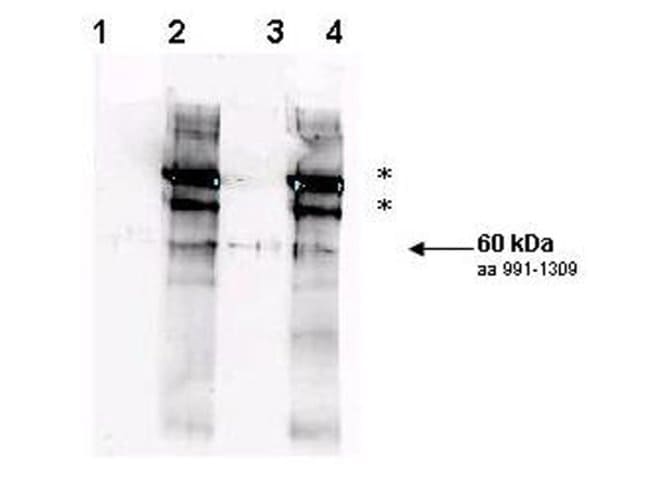
Rad9 is required for the MEC1/TEL1-dependent activation of Saccharomyces cerevisiae DNA damage checkpoint pathways mediated by Rad53 and Chk1. DNA damage induces Rad9 phosphorylation, and Rad53 specifically associates with phosphorylated Rad9. Cells have evolved multiple strategies for tolerating genomic damage. The most important of these are numerous repair systems that remove or bypass potentially mutagenic DNA lesions. Another cellular strategy is to delay cell-cycle transitions at multiple points. The genetic control of these delays, termed 'checkpoints', was first established in budding yeast where it was shown that the RAD9 gene functions in G2/M arrest after irradiation with X-rays. Subsequently, it has become clear that Rad9 also functions at the G1/S, intra-S and mid-anaphase checkpoints. Defects in checkpoint regulation can lead to genome instability and, in higher eukaryotes, neoplastic transformation. Rad9 also controls the transcriptional induction of a DNA damage regulon (DDR). Rad9 may also have a pro-apoptotic function. This is suggested in that Rad9 from Schizosaccharomyces pombe (SpRad9) contains a group of amino acids with similarity to the Bcl-2 homology 3 death domain, which is required for SpRad9 interaction with human Bcl-2 and apoptosis induction in human cells. Overexpression of Bcl-2 in S. pombe inhibits cell growth independently of rad9, but enhances resistance of rad9-null cells to methyl methanesulfonate, ultraviolet and ionizing radiation. Rad9 conveys the checkpoint signal by activating Rad53p and Chk1p; is hyperphosphorylated by Mec1p and Tel1p; and is a potential Cdc28p substrate. Mature yeast Rad9 is reported to have an apparent molecular weight of ∼148kDa. The human homolog is reported at 48.5 kDa.

Specifications

Antigen Phospho-Rad9 (Ser1260)
Applications ELISA, Immunoprecipitation, Western Blot
Classification Polyclonal
Concentration 0.41 mg/mL
Conjugate Unconjugated
Formulation 0.02M potassium phosphate with 0.15M NaCl and 0.01% sodium azide; pH 7.2
Gene RAD9
Gene Accession No. P14737
Gene Symbols RAD9
Host Species Rabbit
Quantity 100 μg
Regulatory Status RUO
Primary or Secondary Primary
Gene ID (Entrez) 851803
Target Species Yeast
Content And Storage -20°C, Avoid Freeze/Thaw Cycles
Product Type Antibody
Form Liquid
Show More Show Less
Product Title
Select an issue

By clicking Submit, you acknowledge that you may be contacted by Fisher Scientific in regards to the feedback you have provided in this form. We will not share your information for any other purposes. All contact information provided shall also be maintained in accordance with our Privacy Policy.