Learn More
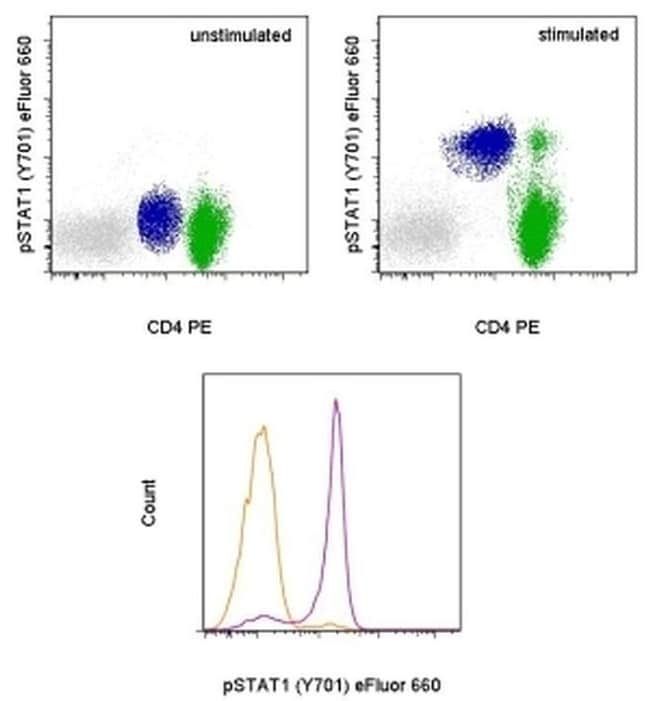
Invitrogen™ Phospho-STAT1 (Tyr701) Monoclonal Antibody (KIKSI0803), eFluor™ 660, eBioscience™, Invitrogen™


Description
Description: This KIKSI0803 monoclonal antibody recognizes signal transducer and activator of transcription 1 (STAT1) when phosphorylated on tyrosine 701. STAT proteins are activated by ligand binding to receptors, such as cytokine receptors, that associate with Janus kinase (JAK) family members. Following their phosphorylation by JAKs, STAT proteins translocate to the nucleus where they bind to DNA and regulate transcription of specific genes in a cell type- and cytokine-specific manner. Phosphorylation of STAT1 on tyrosine 701 by JAK1 and JAK2 is essential for STAT1 dimer formation, nuclear translocation, and DNA binding activity. In response to IFN gamma stimulation, STAT1 homodimerizes or forms heterodimers with STAT3 that can bind to GAS (IFN gamma-activated sequence) promoter elements. In response to either IFN alpha or IFN beta stimulation, STAT1 forms a heterodimer with STAT2 that can bind ISRE (IFN-stimulated response element) promoter elements. Specificity of this KIKSI0803 clone was determined by ELISA, flow cytometry, and western blotting. Applications Reported: This KIKSI0803 antibody has been reported for use in intracellular staining followed by flow cytometric analysis. Applications Tested: This KIKSI0803 antibody has been pre-titrated and tested by intracellular staining and flow cytometric analysis of stimulated normal human peripheral blood cells. This can be used at 5 μL (0.06 μg) per test.

Specifications
Specifications
| Antigen | Phospho-STAT1 (Tyr701) |
| Applications | Flow Cytometry |
| Classification | Monoclonal |
| Clone | KIKSI0803 |
| Concentration | 5 μL/Test |
| Conjugate | eFluor 660 |
| Formulation | PBS with BSA and 0.09% sodium azide; pH 7.2 |
| Gene | STAT1 |
| Gene Accession No. | P42224 |
| Gene Alias | 2010005J02Rik; AA408197; CANDF7; DD6G4-4; DKFZp686B04100; IMD31A; IMD31B; IMD31C; ISGF-3; LOW QUALITY PROTEIN: signal transducer and activator of transcription 1-alpha/beta; OTTHUMP00000165046; OTTHUMP00000205845; signal transducer and activator of transcription 1; signal transducer and activator of transcription 1, 91kD; signal transducer and activator of transcription 1, 91kDa; signal transducer and activator of transcription 1-alpha/beta; signal transducer and activator of transcription-1; STAT; STAT 1; STAT1; STAT-1; stat1 alpha; STAT91; transcription factor ISGF-3; transcription factor ISGF-3 components p91/p84 |
| Show More |
Frequently Asked Questions (FAQs)
Yes, the eFluor Organic fluorochromes can be used for intracellular staining. The eFluor organic fluorochromes maintain bright signal and require minimal changes in compensation when fixed with eBioscience IC Fixation Buffer (Cat. No. 00-8222-49) and Permeabilization Buffer (Cat. No. 00-8333-56) or 1-step Fix/Lyse Solution (Cat. No. 00-5333-54, 00-5333-57) (as compared to live cells).
Antibodies are tested and validated in a variety of ways. First, we verify that in a panel of cells in which different pathways have been induced, we see phosphorylation specific staining only in the cells in which the specific pathway of interest has been activated. Second, we verify that phosphorylation specific staining is observed only in cell types in which the protein is expressed and not in cell types in which the protein is not expressed. Third, whenever possible, western immunoblotting is used to confirm the presence of a band(s) of the appropriate size(s) in stimulated/treated cells (and not in unstimulated/untreated cells, as appropriate).
Yes, in-house studies have demonstrated that the eFluor 660 fluorochrome is recognized by Anti-Cy5/Alexa Fluor 647 beads. Side by side studies with Alexa Fluor 647 versus eFluor 660 conjugated antibodies have demonstrated comparable results.
The eFluor Organic Dyes (eFluor 450, APC-eFluor 780, PerCP-eFluor 710, eFluor 710) are conventional fluorochromes. In contrast, the eVolve line of products are Quantum dots.
We have data demonstrating that fixed cells stored in methanol are stable at -20 degrees C or at -80 degrees C for several weeks. We do not recommend storing fixed cells in eBioscience Foxp3/Transcription Factor Buffer. However, cells fixed with eBioscience Foxp3/Transcription Factor Buffer or eBioscience Intracellular (IC) fixation buffer can be stored in eBioscience IC fixation buffer for up to 3 days at 4 degrees C in the dark.
Note: Please be aware that higher compensation values may be seen with tandem dyes if any other fixative is used apart from eBioscience IC fixation buffer, for 3-day storage.
Safety and Handling
For Research Use Only.
By clicking Submit, you acknowledge that you may be contacted by Fisher Scientific in regards to the feedback you have provided in this form. We will not share your information for any other purposes. All contact information provided shall also be maintained in accordance with our Privacy Policy.