Learn More
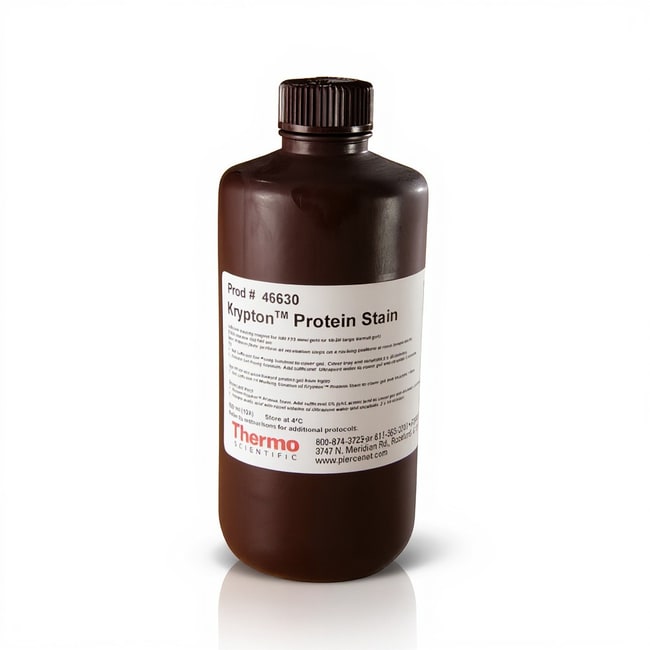
Thermo Scientific™ Krypton™ Fluorescent Protein Stain

Description
Thermo Scientific™ Pierce Krypton Fluorescent Protein Stain enables sensitive fluorescent visualization (520nm excitation; 580nm emission) of proteins separated by polyacrylamide gel electrophoresis or on transfer membranes using popular commercial fluorescence imagers.
Highlights:
Intense fluorescent stain – excitation and emission maxima of 520nm and 580nm, respectively (compatible with 532nm excitation light sources and 580 to 600nm emission filters)
Instrument-compatible – effective with popular laser-based and filter-based fluorescence imagers
Broad dynamic range – linear quantitative range spans three to four orders of magnitude
Sensitive – detect as little as 0.25ng protein with the standard protocol (approx. 2.5 hours); at least as sensitive as fluorescent stains from other suppliers
Fast – standard (2.5 hours) and rapid (30 minutes) protocols are significantly faster than procedures with other popular fluorescent stains
Versatile – compatible with proteomics workflows involving downstream mass spectrometry
Compact – supplied as a 10X solution to save storage space; just dilute with water before use

Specifications
Specifications
| Content And Storage | Upon receipt store at 4°C. |
| Detection Location | In-Gel Detection |
| Detection Method | Fluorescence |
| Label or Dye | Proprietary Mix |
| Quantity | 500 mL |
| Target Molecule | Protein |
| Product Line | Krypton |
| Product Type | Protein Stain |
Frequently Asked Questions (FAQs)
Yes. The solution will be cloudy immediately upon dilution to 1X, especially if it is cold. The cloudiness should dissipate with mixing.
Store Krypton Protein Stain at 4 degrees C; although it is stable enough for ambient shipping. The 10X solution is under warranty for one year from the date of shipment if handled and stored properly. The Working Solution (1X) is stable at 4 degrees C for 1-2 weeks.
Filter sets designed for Cy3 will work with the Krypton Protein Stain. Thermo Scientific scientists have used GE Healthcare Typhoon 9410 Variable Mode Imager (532 nm laser excitation; 580 BP 30 emission filter), Kodak Imager (CCD; 535 nm excitation and 600 nm emission filters), and visible light box. Sensitivity is better with lasers than with transilluminators.
Yes. HeLa cell and rat heart tissue lysates separated by 2D electrophoresis and stained with the Krypton Protein Stain provided excellent sensitivity while not over-saturating highly concentrated spots. MALDI tryptic peptide mass fingerprinting of BSA and myoglobin resulted in characteristic profiles. The proteins were destained and processed with the Thermo Scientific In-Gel Tryptic Digestion Kit (Cat. No. 89871). The lack of peak shifts indicates that the dye was not bound to the proteins after destaining.
No.
For Research Use Only. Not for use in diagnostic procedures.
By clicking Submit, you acknowledge that you may be contacted by Fisher Scientific in regards to the feedback you have provided in this form. We will not share your information for any other purposes. All contact information provided shall also be maintained in accordance with our Privacy Policy.